
 Algeria
 Egypt
 Libya
 Morocco
 Sudan
 Tunisia
 Benin
 Burkina Faso
 Cabo Verde
 Ghana
 Guinea
 Guinea-Bissau
 Liberia
 Mali
 Mauritania
 Niger
 Nigeria
 Senegal
 Sierra Leone
 The Gambia
 Togo
 Cameroon
 Central African Republic
 Chad
 DR Congo
 Equatorial Guinea
 Gabon
 Republic of the Congo
 São Tomé and Príncipe
 Burundi
 Comoros
 Djibouti
 Eritrea
 Ethiopia
 Kenya
 Madagascar
 Malawi
 Mauritius
 Mozambique
 Rwanda
 Seychelles
 Somalia
 South Sudan
 Tanzania
 Uganda
 Angola
 Botswana
 Eswatini
 Lesotho
 Namibia
 South Africa
 Zambia
 Zimbabwe
The stock market as a test of confidence
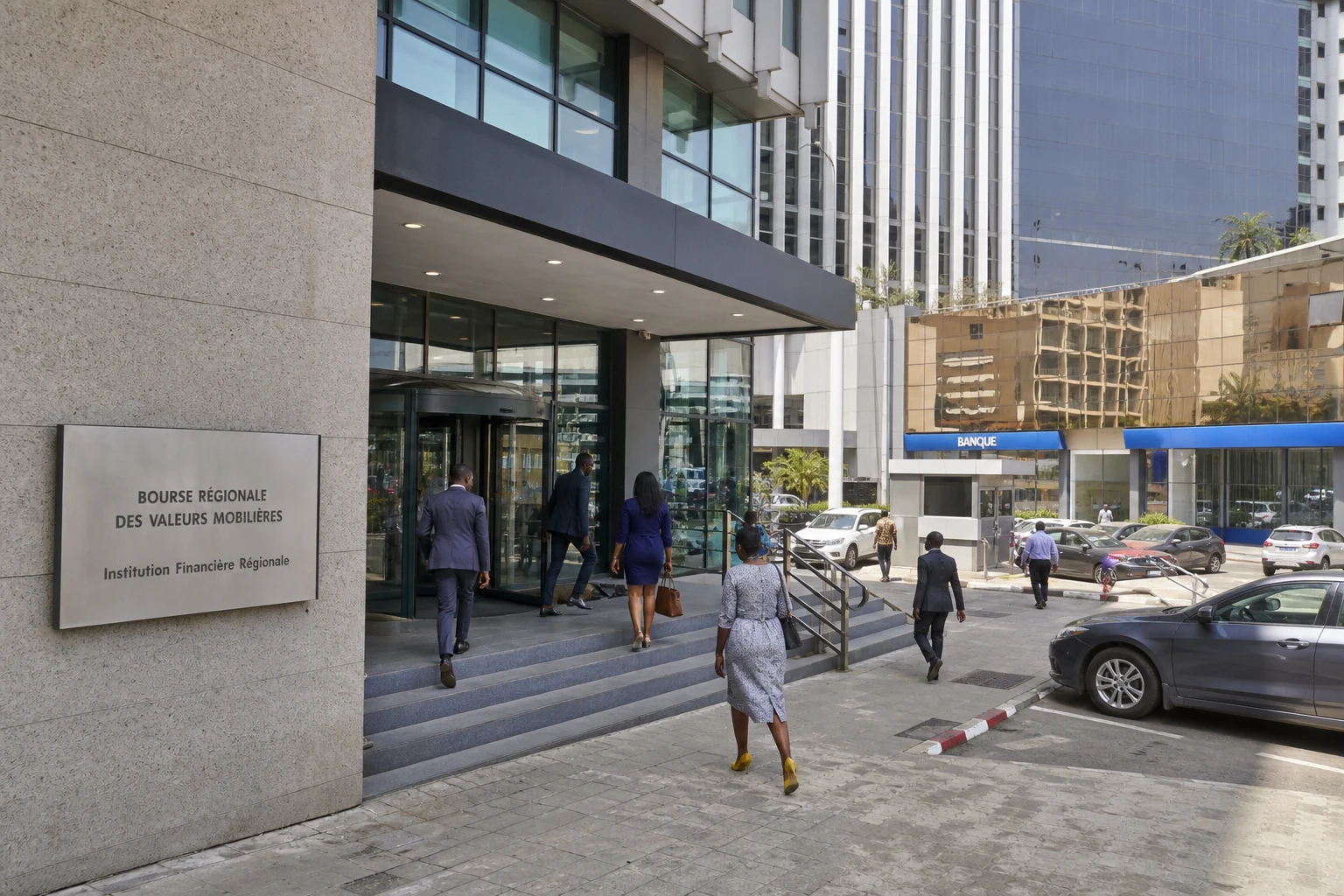
In Abidjan, a stock market listing tells more than the story of a financial transaction. It also measures the confidence investors place in an Ivorian bank and, more broadly, in the WAEMU economy—the West African Economic and Monetary Union—where the BRVM serves as a common regional market. In this context, the arrival of Bridge Bank Group Côte d’Ivoire on the exchange says something important: local banks are now seeking capital beyond the traditional banking system alone.
Côte d’Ivoire, whose political capital is Yamoussoukro, continues to play a central role in this dynamic. The country remains the WAEMU’s largest economy, according to the Ivorian Ministry of Foreign Affairs, while Abidjan accounts for most of the region’s financial activity. It is therefore only natural that market movements there are closely watched by businesses and Ivorian and West African savers alike.
First listing set for 24 September
The BRVM has confirmed that Bridge Bank Group Côte d’Ivoire’s first listing will take place on Thursday 24 September 2026. The official notice states that the bank’s shares will be admitted to trading on the main equity market under the ticker BBGC. The reference price is the price set in the public share offering, at CFAF 6,750 per share.
The step follows a public share offering launched on 20 July 2026 and closed early on 21 July because of strong demand. The offering covered 10 million existing shares, representing 20% of the capital. Applications reached CFAF 95.8 billion against CFAF 67.5 billion on offer, equivalent to a 142% subscription rate.
The signal to the market is clear. When demand exceeds supply by such a margin, the bank is doing more than raising funds. It is also becoming an asset that is tracked, listed and observed, and subject to the daily discipline of the secondary market. The opening price will now be determined by the interaction between buyers and sellers, rather than by a single price set in advance.
What the capital structure reveals
Before the operation, Bridge Group West Africa held 77% of the capital, the National Social Security Fund (CNPS) 20%, and other shareholders 3%. After the sale of 20% to the public, the shareholding structure will be reshaped around an unchanged majority core, with 57% held by Bridge Group West Africa, 20% by the CNPS and 20% by the new shareholders from the public offering.
This configuration matters. It opens up the capital without changing control of the institution. For the bank, the message is twofold. On the one hand, it is broadening its shareholder base. On the other, it is retaining a stable chain of command, which is useful in a banking sector where continuity of management reassures depositors, regulators and partners.
Interest from individual investors was also evident. According to information released during the offering, they accounted for 58% of the amounts subscribed. In total, 17,544 investors across four continents took part. This figure represents an unusual degree of openness for an Ivorian bank of this size and shows that finance in the sub-region is now attracting a wider public than institutional investors alone.
An Ivorian bank already looking beyond Côte d’Ivoire
Founded in 2006, Bridge Bank Group Côte d’Ivoire has built its business around corporate clients, SMEs and individuals. The bank says it intends to use the funds raised to finance its regional expansion, accelerate its digital transformation and strengthen its ability to support businesses. This is a typical growth strategy for institutions seeking to turn their banking scale into greater reach.
The plan is not limited to Côte d’Ivoire. The bank is already present in Senegal through a branch, with the stated aim of turning it into a banking subsidiary. An entry into Guinea is being considered for January 2027, while a branch in Burkina Faso is planned for the first half of 2027. An application for authorisation in Burkina Faso was submitted in April 2025.
This strategy sheds light on a deeper reality: banking competition in West Africa is increasingly regional. Fast-growing groups are no longer content with a single domestic market. They are seeking footholds in several WAEMU countries, with digital services, credit lines and products tailored to businesses that export or operate across borders.
SMEs are where the real stakes lie
Beyond the stock market ceremony, the central issue remains credit. In Côte d’Ivoire, SMEs still struggle to access finance. Bridge Bank says it has already structured CFAF 15 billion in portfolio guarantees for these businesses, with coverage of up to 75% when gender criteria are met. This matters because it points to a focus on the real economy, rather than solely on investment returns.
The public offering also takes place against a broader regional backdrop. In 2026, the BRVM’s equity market capitalisation passed the CFAF 20,000 billion mark, according to its official website. Abidjan’s exchange therefore remains a hub for businesses in the WAEMU that want to raise funds within a common regional financial framework.
From this perspective, Bridge Bank’s listing has implications beyond the bank itself. It adds a new banking stock to a market where financial shares already play a structural role. It also reinforces the idea that an Ivorian company can raise capital, retain its local roots and pursue expansion across West Africa without leaving its home market.
What to watch after 24 September
The first listing on 24 September will show whether the price set in the public offering holds up in the secondary market. It will also show whether the broader shareholder base proves lasting or whether most trading remains concentrated among a few active investors. For the BRVM, the challenge is straightforward: turning a successful subscription into regular liquidity.
For Côte d’Ivoire, the deal is an indicator of financial maturity. In a country where Yamoussoukro is the political capital and Abidjan the economic capital, the rise of a banking player able to operate across several countries shows that Ivorian growth is now also reflected in capital markets. An increasing share of the financing for businesses, jobs and regional expansion is at stake there.



