Algeria
 Egypt
 Libya
 Morocco
 Sudan
 Tunisia
 Benin
 Burkina Faso
 Cabo Verde
 Côte d'Ivoire
 Ghana
 Guinea
 Guinea-Bissau
 Liberia
 Mali
 Mauritania
 Niger
 Nigeria
 Sierra Leone
 The Gambia
 Togo
 Cameroon
 Central African Republic
 Chad
 DR Congo
 Equatorial Guinea
 Gabon
 Republic of the Congo
 São Tomé and Príncipe
 Burundi
 Comoros
 Djibouti
 Eritrea
 Ethiopia
 Kenya
 Madagascar
 Malawi
 Mauritius
 Mozambique
 Rwanda
 Seychelles
 Somalia
 South Sudan
 Tanzania
 Uganda
 Angola
 Botswana
 Eswatini
 Lesotho
 Namibia
 South Africa
 Zambia
 Zimbabwe
Debt reset without derailing the economy
In Dakar, the real issue is not just the volume of debt. It is also how to make it manageable without closing off access to financing or stifling economic activity. For Senegalese people, the question affects wages, public contracts, SMEs and the state’s ability to pay on time.
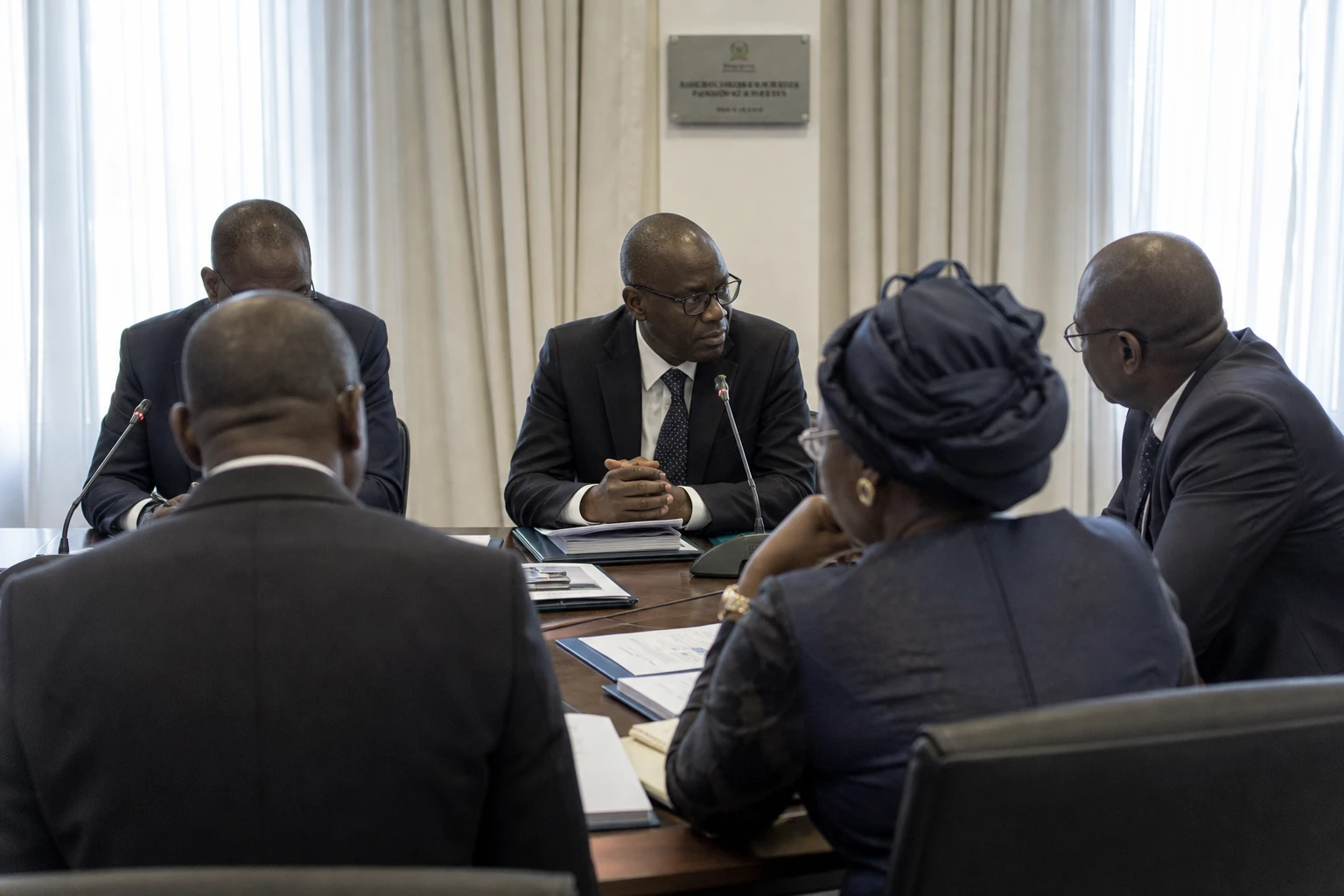
The Senegalese government is therefore treading a narrow path. It wants to ease the pressure of its debt, but without using the word that worries investors: restructuring. Addressing the National Assembly on Tuesday 8 September 2026, Prime Minister Ahmadou Al Aminou Lô defended another approach: reprofiling. The idea is simple in principle: extend some maturities and renegotiate interest rates to ease pressure on public finances.
The debate comes as Senegal seeks to bring to a close a period that began with the disclosure in 2025 of significant under-reporting of debt and deficits between 2019 and 2023. The International Monetary Fund then confirmed that central government debt had been revised from 74.4% to 99.7% of GDP at the end of 2023, and that consolidated public-sector debt had reached about 132% of GDP at the end of 2024, according to Senegalese authorities.
The context: restoring credibility after hidden debts came to light
In an economy belonging to the West African Economic and Monetary Union, confidence matters as much as the figures. Senegal remains a closely watched sovereign borrower in the sub-region, because its debt, fiscal policy and market access also influence perceptions of risk in West Africa. The country is also bound by the WAEMU’s shared rules, which set a medium-term public deficit target, and by the broader economic framework of ECOWAS, where fiscal room for manoeuvre narrows as external shocks multiply.
The signal from the IMF is decisive. On 1 September 2026, the institution announced a staff-level agreement with the Senegalese authorities on a 36-month programme worth about $2.2bn. This support remains subject to approval by the Fund’s executive board and to corrective measures linked to the case of misreporting public data. The Fund also said the programme should help restore macroeconomic stability, debt sustainability and fiscal transparency.
Meanwhile, the government does not deny the scale of the bill. In his policy statement, the prime minister cited a stock of domestic arrears of FCFA 1,956 billion, or about $3.5bn, at the end of March 2025. He also acknowledged that these payment delays are weighing on SMEs and employment. APS reported his remarks on 8 September 2026, placing them within the strategy to restore public finances.
Reprofiling: a technical solution with major political consequences
In substance, reprofiling is not merely a matter of terminology. It can change a loan’s term, repayment schedule or interest costs. For the state, that frees up fiscal space. For creditors, it is often a sign that a country can no longer service its debt on the agreed terms. That is precisely why Dakar is seeking to distinguish this mechanism from a formal restructuring.
But markets do not always make such fine distinctions. When the original terms of a loan change, investors often see it as a de facto restructuring. This can permanently increase the cost of future financing. Senegal needs to retain access to international markets while rebuilding room for social investment, infrastructure and day-to-day spending.
The government also wants to avoid an abrupt break with the local business community. Payment arrears leave companies waiting to be paid by the state. They weaken subcontractors, suppliers and construction projects. They also ultimately affect households through project delays, falling employment and banks becoming more cautious towards sectors dependent on public contracts.
Dakar’s strategy also envisages a greater role for FONSIS, the Sovereign Strategic Investment Fund, as well as the renegotiation of several mining agreements. The authorities see this as a way to mobilise domestic resources rather than rely exclusively on new borrowing. This approach is consistent with the stated aim of strengthening domestic financing, but it will require rapid results to convince businesses and households.
What this period says about Senegal and the region
For the Senegalese authorities, there are two objectives. First, the public finances must be stabilised. Second, public trust must be restored after a period in which financial commitments were not properly reported. The IMF has specifically stressed the need for better governance rules, improved monitoring of public debt and stricter oversight of domestic arrears.
For President Bassirou Diomaye Faye and his team, this period also has political significance. The government came to power promising a break with past practices. The fiscal reality now forces it to balance financial orthodoxy, social protection and a revival of investment. It is a test of both approach and credibility.
Across West Africa, Senegal’s case is a reminder that a state can post a solid growth trajectory while remaining vulnerable if its accounts lack transparency. The IMF noted that the Senegalese economy grew by 6.7% in 2025, driven by the start of oil production, but that growth outside hydrocarbons remained more modest. In other words, the potential is there, but still depends on a credible fiscal recovery.
The next steps will unfold on several fronts. The IMF executive board still has to approve the agreement in principle. Discussions on debt treatment will need to specify which creditors will be affected, on what terms, and with what impact on the CFA franc and locally held securities. Dakar’s goal is clear: buy time without losing confidence. For West Africa, the case will serve as a benchmark for how to address an unsustainable debt burden without damaging the real economy.