Algeria
 Egypt
 Libya
 Morocco
 Sudan
 Tunisia
 Benin
 Burkina Faso
 Cabo Verde
 Côte d'Ivoire
 Ghana
 Guinea
 Guinea-Bissau
 Liberia
 Mali
 Mauritania
 Niger
 Nigeria
 Senegal
 Sierra Leone
 The Gambia
 Togo
 Cameroon
 Central African Republic
 Chad
 DR Congo
 Equatorial Guinea
 Gabon
 Republic of the Congo
 São Tomé and Príncipe
 Burundi
 Comoros
 Djibouti
 Eritrea
 Ethiopia
 Kenya
 Malawi
 Mauritius
 Mozambique
 Rwanda
 Seychelles
 Somalia
 South Sudan
 Tanzania
 Uganda
 Angola
 Botswana
 Eswatini
 Lesotho
 Namibia
 South Africa
 Zambia
 Zimbabwe
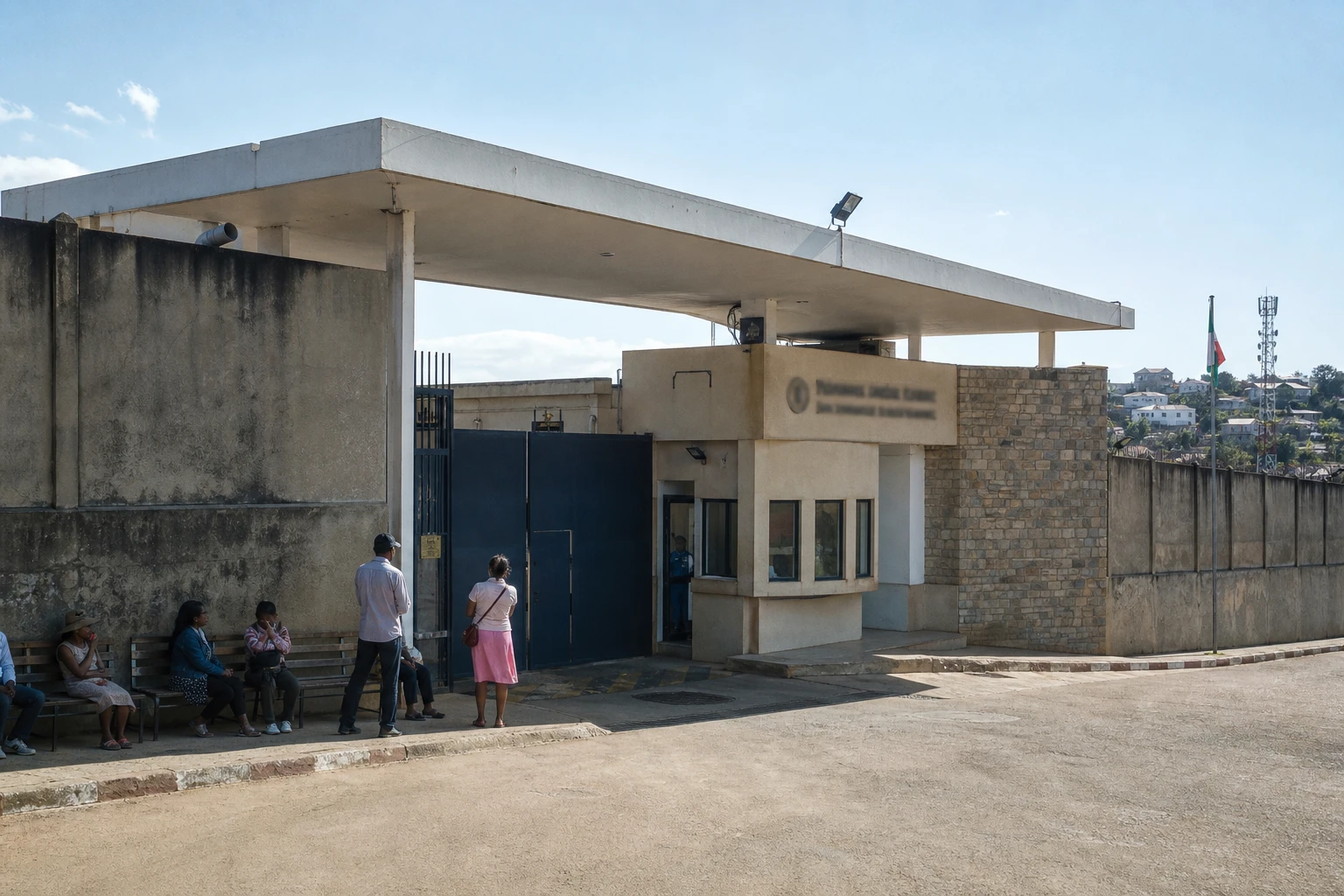
At Tsiafahy, a prison case becomes a political test
In Madagascar, a high-security prison can sometimes carry as much weight as a court. When access to a detainee is cut off, the question is no longer just about a criminal case. It also concerns the credibility of a transition that says it wants to restore the rule of law in Antananarivo, in a country where justice, security and politics remain closely intertwined.
Colonel Patrick Rakotomamonjy has been held at Tsiafahy since April 2026. He was placed in pre-trial detention on 17 April, following his arrest in a case involving an alleged assassination attempt against Refoundation President Michaël Randrianirina and an alleged coup plot. Malagasy media and international news agencies have confirmed that he is among the main suspects named by prosecutors, alongside other military personnel and civilians.
A case born out of the 2025 political upheaval
To understand this case, it is necessary to go back to the rupture of October 2025. The protest movement that swept away the former regime paved the way for a transition led by Colonel Michaël Randrianirina, under the watch of regional institutions. The SADC, the Southern African Development Community, subsequently stepped up its engagement with the Malagasy authorities, calling for inclusive dialogue and a return to constitutional normality. The African Union also sent a joint mission with the UN in July 2026 to support a credible political process.
In this context, Colonel Rakotomamonjy briefly held a sensitive position. Official sources and local media recall that he headed the “Grievances Office” for a few weeks, between November 2025 and January 2026, before coming under scrutiny after a video circulated in which he accused the regime of corruption. In Malagasy institutional terminology, the office served as a channel for gathering complaints and comments addressed to the presidency.
What his family says, and the ministry’s response
In late August, a new development shifted the debate from the judicial arena to detention conditions. In a video shared on social media, his wife says she has been unable to visit him since 23 August and fears for his health. She is calling for his medical evacuation to a military hospital and speaks of “torture”, accusing the authorities of having tried to eliminate him. These are serious allegations, but for now they remain the claims of a detainee’s relative.
The Justice Ministry’s response is quite different. Fanirisoa Ernaivo, the justice minister and keeper of the seals, says visits were restricted following new charges of attempted escape and a plot to set fire to Tsiafahy prison. According to her, a mobile phone smuggled into the prison was used to prepare the plan. The ministry therefore presents the restrictions as a disciplinary and judicial measure, not a political one. That is the central issue: without full public evidence, the public is left to weigh two conflicting accounts.
The clash between these accounts comes as Madagascar’s justice system seeks to project greater firmness. The Refoundation government highlights the modernisation of the judicial system, anti-corruption co-operation and engagement with the SADC. But each high-profile case is also a reminder of a simpler reality: in a country whose institutions are emerging from a period of rupture, the treatment of political prisoners, or those perceived as such, immediately becomes a matter of public trust.
Judicial, institutional and regional stakes
The case remains serious from a legal standpoint. Colonel Patrick Rakotomamonjy is facing charges of attempted assassination and plotting a coup, and new suspicions of an escape attempt have further complicated his situation. Politically, his case raises a broader question: how does the transition intend to deal with military figures from the former system or those who have opposed the new line of the authorities? In Madagascar, where the army has often played a role in political shifts, this question matters as much in the palaces of power as in the barracks.
The regional dimension is not secondary. In statements issued in December 2025 and then August 2026, the SADC reiterated its support for resolving the crisis through dialogue, inclusive governance and a return to constitutional normality. In other words, Madagascar’s case is not being followed solely as an internal matter; it is also a test of regional organisations’ ability to support a transition without allowing a lasting political closure to take hold. For the public, the stakes are tangible: freedom of movement for lawyers and families, health safeguards in detention, and confidence that justice remains predictable.
Across the continent, Madagascar is thus back in a broader debate about African transitions. The African Union and regional organisations are looking not only at changes of power, but also at whether they can produce reliable institutions, including prisons, courts and public administrations. For Antananarivo, what happens next will depend on two very concrete things: the progress of Colonel Rakotomamonjy’s case and how the authorities respond to demands for access, medical care and transparency concerning the detainees involved.