Algeria
 Egypt
 Libya
 Morocco
 Sudan
 Tunisia
 Burkina Faso
 Cabo Verde
 Côte d'Ivoire
 Ghana
 Guinea
 Guinea-Bissau
 Liberia
 Mali
 Mauritania
 Niger
 Nigeria
 Senegal
 Sierra Leone
 The Gambia
 Togo
 Cameroon
 Central African Republic
 Chad
 DR Congo
 Equatorial Guinea
 Gabon
 Republic of the Congo
 São Tomé and Príncipe
 Burundi
 Comoros
 Djibouti
 Eritrea
 Ethiopia
 Kenya
 Madagascar
 Malawi
 Mauritius
 Mozambique
 Rwanda
 Seychelles
 Somalia
 South Sudan
 Tanzania
 Uganda
 Angola
 Botswana
 Eswatini
 Lesotho
 Namibia
 South Africa
 Zambia
 Zimbabwe
More training is not enough
In Benin, the question is no longer only whether people can access school. It is now about moving into employment, and then achieving independence. For Beninese people with disabilities, this second threshold remains the hardest to cross.
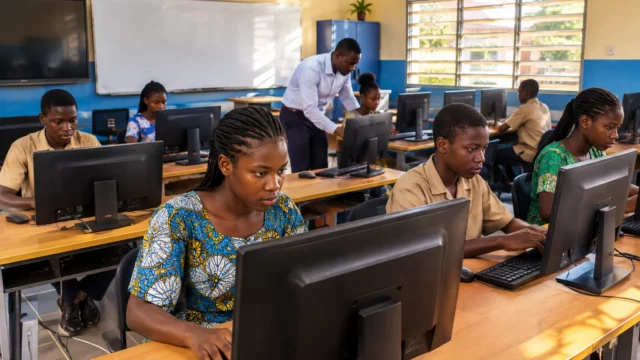
The Council of Ministers on 2 September 2026 sent a clear signal. From the 2026-2027 school year, 5,000 pupils with disabilities will be exempt from tuition fees at public mainstream secondary schools, as well as at specialised public centres. The government also announced support for economic empowerment and technical aids for the beneficiaries concerned. The policy is social in nature. It responds to a long-standing expectation.
But it also reveals a deeper imbalance. Benin is making progress on three fronts: education, support and protection. However, the formal economy still absorbs too few young graduates with disabilities. Without real job prospects, school can become a holding area rather than a springboard.
A legal framework is in place, but inclusion in employment remains too slow
The country is not starting from scratch. Law No. 2017-06 of 29 September 2017 laid the foundations for protecting and promoting the rights of people with disabilities. Implementing decrees adopted in June 2023 set out several mechanisms, including the equal opportunities card. This document provides access to benefits in education, training, employment, transport and social assistance.
Since then, the executive has introduced a series of measures. In December 2024, the distribution of equal opportunities cards was presented as a turning point. The government also announced that it would cover certain employer contributions when a company hires a person with a disability, as well as provide increased support for entrepreneurship among people concerned.
The approach is coherent. It is based on a simple idea: disability should not be treated solely as a matter of assistance, but also as a matter of rights, training and economic participation. This approach is in line with the standards of the International Labour Organization, which points out that people with disabilities face more barriers to entering the labour market everywhere. The ILO also notes that, in several developing countries, unemployment or inactivity can reach very high levels among people with disabilities of working age.
In Benin, this challenge can be measured. The ILO says young people with disabilities there have NEET rates — meaning they are not in employment, education or training — three times higher than those of their peers without disabilities. This gap places the country among the most pronounced cases in WAEMU, the West African Economic and Monetary Union.
Public-sector jobs help, but cannot absorb everyone
The public sector has opened a door. The Beninese government says it has recruited more than 50 people with disabilities through the 5% quota. The figure is worth noting because it shows that the rule exists and is already having an effect. But it remains modest in relation to social demand.
The real problem lies elsewhere: in the economy’s ability to turn educational pathways into careers. In Benin, as across much of West Africa, the labour market is still dominated by the informal sector. There are few structured businesses, adapted jobs remain limited, and physical barriers persist. Accessible premises, transport, technical support, discrimination in hiring: every stage can become an additional filter.
For young graduates with disabilities, the challenge is twofold. First, they must obtain a recognised qualification. Then they must convince recruiters, who often remain wary of the adjustments required. The result is familiar: longer studies, slower transitions and, sometimes, an early exit from the labour market.
The new tuition-fee exemption can therefore be seen as a measure of educational justice. But it will need to be followed by more precise indicators on employment outcomes. How many beneficiaries will continue through to the baccalaureate? How many will then enter higher education or vocational training? How many will find formal employment, or set up their own viable business? The real effectiveness of public policy will be judged by the answers to these questions.
An issue for Benin and West Africa
The Beninese case extends beyond national borders. Across the ECOWAS region, large numbers of young people are entering the labour market, while the creation of formal jobs does not always keep pace. The inclusion of people with disabilities is thus becoming a test of credibility for employment, technical training and social protection policies.
The ILO points out that young people with disabilities in WAEMU are, on average, far more exposed to the risk of being NEET than others. In other words, disability compounds a vulnerability already affecting young people confronted with a shortage of stable jobs. This is where the debate moves to a broader level: it is no longer just about social assistance, but about productivity, skills and the economy’s capacity to absorb workers.
Benin can still turn this into progress. The country already has a legal foundation, administrative tools and a clearer public stance on inclusion. It must now move towards measuring outcomes, sector by sector and region by region. In Porto-Novo, Cotonou, inland municipalities and urban areas, the same question arises: does school really open the door to work?
The answer will determine what comes next. If educational initiatives and economic support measures converge, Benin can move towards more tangible inclusion. Otherwise, the country will continue to address the consequences without tackling the root of the problem quickly enough: the persistent gap between qualifications and employment for people with disabilities.