Algeria
 Egypt
 Libya
 Morocco
 Sudan
 Tunisia
 Benin
 Burkina Faso
 Cabo Verde
 Côte d'Ivoire
 Ghana
 Guinea
 Guinea-Bissau
 Liberia
 Mali
 Mauritania
 Niger
 Nigeria
 Senegal
 Sierra Leone
 The Gambia
 Togo
 Cameroon
 Central African Republic
 Chad
 DR Congo
 Equatorial Guinea
 Gabon
 Republic of the Congo
 São Tomé and Príncipe
 Burundi
 Comoros
 Djibouti
 Eritrea
 Ethiopia
 Kenya
 Malawi
 Mauritius
 Mozambique
 Rwanda
 Seychelles
 Somalia
 South Sudan
 Tanzania
 Uganda
 Angola
 Botswana
 Eswatini
 Lesotho
 Namibia
 South Africa
 Zambia
 Zimbabwe
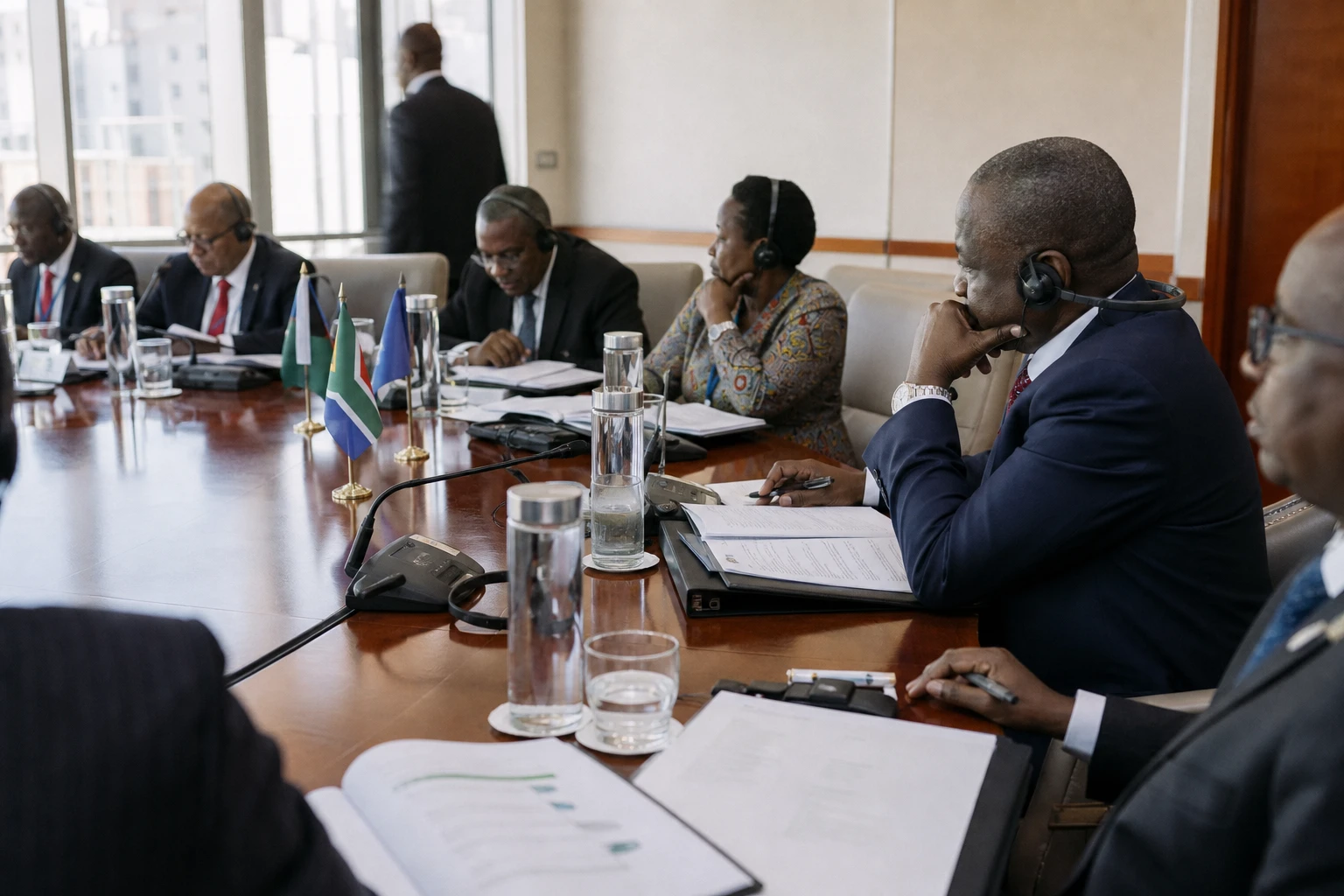
Madagascar wants to retain more value at home
In Madagascar, the battle over minerals is no longer being fought only deep underground. It is also being fought in factories, on electricity networks and in ports. The country has deposits sought after for graphite, nickel, cobalt and rare earths, but much of the value still leaves the island in the form of concentrate or barely processed material. The question is simple: how can this wealth benefit Antananarivo, mining regions and small local businesses more, rather than only foreign industrial supply chains?
The response put forward by the Malagasy authorities rests on three levers: reserving a share of strategic output for the local market, creating a mining industrial park and pushing ahead with the infrastructure projects needed for processing. This approach is part of a broader reindustrialisation strategy, already set out in the industrial programming pact signed in February 2026, which aims to raise industry’s share of GDP from 15% to 30% by 2040.
A more assertive legal framework, but one that remains incomplete
The new mining decree published in Antananarivo on 8 April 2026 gives this ambition concrete form. It establishes a list of strategic mineral substances and sets a maximum quota of 30% of output for local industries, unless the holder agrees to go further. The text cites natural graphite, cobalt, nickel, rare earths, copper, lithium, uranium, titanium and zircon, among others. It also provides for a minimum 10% state stake in certain projects, through specialised public entities.
This development has not come out of nowhere. The 2023 Mining Code has already redefined the scope of the sector, covering the extraction, processing, marketing and export of mineral substances. It also paved the way for specific rules on strategic substances. In other words, the Malagasy state is no longer talking only about extraction. It is now saying it wants greater influence over the value chain.
The 2026 text is also clear about the logic of economic sovereignty. It gives the state access to technical, fiscal, social and environmental information on the projects concerned, and provides for oversight of certain decisions deemed sensitive. This is one way to address a long-standing weakness in the sector: opacity, often criticised in extractive activities when they remain confined to the export of unprocessed materials.
The real bottleneck: energy, roads and financing
Madagascar already knows how to process some of its minerals locally. At Ambatovy, in the east of the country, ore is refined near Toamasina to produce nickel and cobalt with a minimum purity of 99.9%. The site shows that advanced processing is technically possible on Malagasy soil. But it remains an exception, not yet the norm.
The government is therefore banking on a mining industrial park to pool costly facilities: energy, water, logistics access, processing and storage. The problem is that its details have yet to be specified. Neither its location, financing nor electricity connection has been publicly set out. Yet electricity remains a major constraint on competitiveness in the country. The IMF’s study on Madagascar notes that electricity is the second most frequently cited obstacle by businesses, in a context of costly generation and persistent fragility at JIRAMA, the state-owned electricity company.
This point is central. Without reliable energy, local processing of critical minerals quickly becomes a slogan. Refining plants, facilities producing anode materials or rare-earth separation complexes require a stable supply and predictable costs. The IMF also notes that outages and technical losses weigh on households and businesses alike, with a direct effect on prices, employment and investment.
Graphite, rare earths, cobalt: strategic deposits, contested markets
Madagascar’s position is real. The USGS says that in 2024 the country was among the world’s leading graphite producers, with estimated production of 80,000 tonnes in the reference article used for the estimate cited in the specialist press, while its country profile ranks it second in the world for graphite in 2024. The USGS also notes that Madagascar is among the world’s cobalt and titanium producers, confirming the diversity of the Malagasy mining portfolio.
This wealth has not yet generated a dense industrial base. UNCTAD, in its assessment of Madagascar published in June 2026, warns that extractive activities risk remaining enclaves unless they are better connected to the national economy. The organisation recommends strengthening skills, financing, infrastructure, business services and innovation. It also estimates that moving up the value chain could create at least 20,000 direct and indirect jobs across several priority sectors.
Private-sector players are testing different strategies. US group Energy Fuels plans to produce monazite concentrate in Madagascar before shipping it to the United States to make rare-earth oxides. Canadian group NextSource, meanwhile, is already developing a more downstream graphite value chain, with a first anode materials plant in the United Arab Emirates. These choices show that companies are chiefly seeking to secure profitability and international markets. They do not always align with the Malagasy state’s goal of local added value.
A regional and continental balance of power
Madagascar is not speaking in a vacuum. Across the SADC, the Southern African Development Community, several countries are seeking to capture more industrial revenue from critical minerals. The example most often cited is Indonesia, which imposed a strategy of local nickel processing. Tsingshan’s presentation of a multi-billion-dollar industrial park project in Madagascar shows that Asian industrial groups now see the island as a potential base in the Indian Ocean. But the proposal remains under consideration at this stage.
The precedent set in January 2026 is important. Madagascar lifted a 16-year moratorium on new mining permits for most substances, while maintaining the suspension on gold. The decision reopened the market to investors, but it also increased pressure on the authorities to issue clear, stable rules compatible with the announced goal of local processing. For operators, the question is one of timing and legal certainty. For the state, it is about control of resource rents. For mining regions, it is about jobs, infrastructure and tangible benefits.
At continental level, the Malagasy case sums up a familiar African dilemma. The continent supplies a growing share of the minerals needed for batteries, digital technologies and the energy transition, but still captures too little value in refining and manufacturing. Madagascar is tightening its rules to prevent its resources from remaining mere raw exports. What happens next will depend on very practical decisions: where to build industrial plants, how to supply them with electricity, which partnerships to accept, and how far the state can enforce the local quota without deterring investment.