Algeria
 Egypt
 Libya
 Morocco
 Sudan
 Tunisia
 Benin
 Burkina Faso
 Cabo Verde
 Côte d'Ivoire
 Ghana
 Guinea
 Guinea-Bissau
 Liberia
 Mali
 Mauritania
 Niger
 Nigeria
 Senegal
 Sierra Leone
 The Gambia
 Togo
 Cameroon
 Central African Republic
 Chad
 DR Congo
 Equatorial Guinea
 Gabon
 Republic of the Congo
 São Tomé and Príncipe
 Burundi
 Comoros
 Djibouti
 Eritrea
 Ethiopia
 Kenya
 Malawi
 Mauritius
 Mozambique
 Rwanda
 Seychelles
 Somalia
 South Sudan
 Tanzania
 Uganda
 Angola
 Botswana
 Eswatini
 Lesotho
 Namibia
 South Africa
 Zambia
 Zimbabwe
In Antananarivo, rice is more than a staple. It is a social balance.
In Madagascar, rice affects household budgets, farmers’ incomes and market stability. When foreign shipments rise, the issue is not just the price per kilo. It is also about market access for Malagasy rice farmers, rural employment and the state’s ability to balance food security with protecting local production.
The issue is particularly sensitive because the Republic of Madagascar, whose capital is Antananarivo, is a member of both the African Union and SADC, the Southern African Development Community. These regional frameworks promote market integration, as well as agricultural resilience and local processing. In this context, Madagascar’s rice sector carries significance well beyond a single industry: it is a test of economic sovereignty.
What the ANMCC investigation says
On 31 August 2026, the National Agency for the Measurement of Results and Analysis of Public Policies, the ANMCC, opened a safeguard investigation into several categories of imported rice. Madagascar subsequently notified the World Trade Organization on 2 September. The investigation covers husked rice, semi-milled or wholly milled rice, whether polished or glazed, as well as broken rice.
In WTO terminology, a safeguard investigation seeks to establish whether a surge in imports is causing, or threatening to cause, serious injury to a domestic industry. If such injury is established, the state can apply temporary measures, such as additional customs duties or quotas. The WTO also stresses that such measures can only be introduced following a transparent and notified investigation.
The ANMCC says rice imports rose from 262,002 tonnes in 2024 to 800,812 tonnes in 2025. That is a threefold increase in one year. The agency adds that between 2023 and 2025, local production and sales reportedly fell by 25.6% and 25.4% respectively, while the rate of production capacity utilisation dropped from 35% to 24%. Published as part of the investigation, these figures indicate the extent of the pressure on the industry.
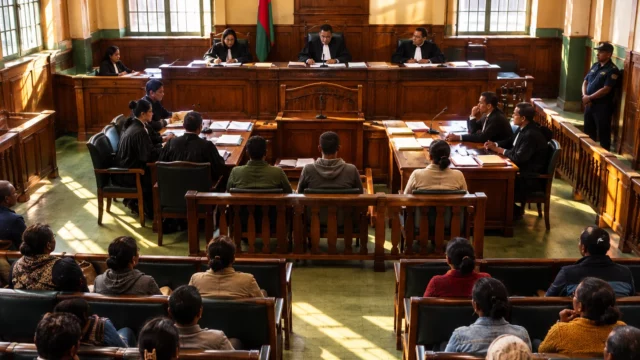
The timeline matters. Importers, exporters and other interested parties have 30 days from the publication of the notice to register and submit their comments. Questionnaires must be returned within 30 working days of receipt. The ANMCC may also hold public hearings, at the request of interested parties or on its own initiative.
Why the local industry says it is being gradually squeezed
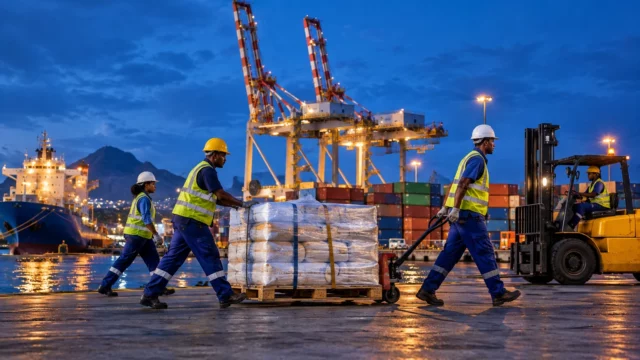
Rice remains Madagascar’s staple food. When imports rise too quickly, they can drive down prices at rice mills and reduce the market for locally grown paddy. The World Bank notes that the port of Toamasina handles most of the country’s imports, amplifying the impact of foreign shipments on urban markets. In practice, the capital and major coastal centres often feel the pressure on prices sooner than production areas.
This imbalance is not theoretical. Malagasy media reported in August 2026 that the government had temporarily suspended the customs duties and VAT announced on imported rice, on the grounds that local production did not yet meet market needs, particularly as the lean season approached — the time of year when stocks dwindle before the next harvest. Here, too, the issue is not merely fiscal. It is also social.
The tax suspension sheds light on the balance the Malagasy authorities are trying to strike. On the one hand, they want to protect producers from overwhelming competition. On the other, they need to prevent supply shortages in a country where imported rice often acts as a buffer. The government is therefore seeking to contain prices without allowing the market to run dry. This is a delicate balancing act: excessive taxes can make rice more expensive in cities, while an unrestricted flow of imports can weaken domestic production.
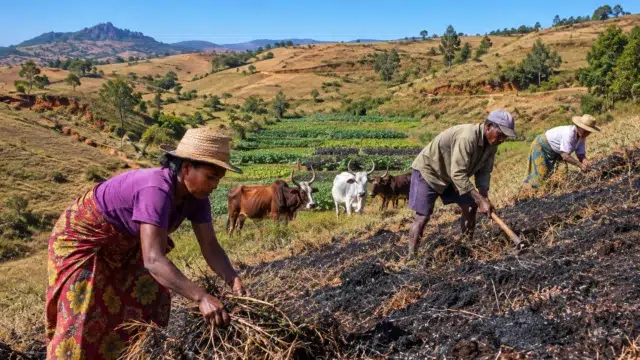
Harvest forecasts further complicate the picture. The USDA said in its recent projections that Malagasy rice production was expected to recover in 2026, reaching around 2.7 million tonnes in milled-rice equivalent, according to an estimate made in late 2025, while remaining dependent on climatic and logistical factors. Other estimates reported by the local press point to an increase in paddy production in 2026. But a better harvest will not be enough if imports remain high and take up market space before local rice can be sold.
An agricultural issue, but also a trade and regional one
The issue extends beyond agriculture. Madagascar has previously used trade defence instruments under the WTO, and the country is now relying on the ANMCC to conduct this type of investigation. This shows that the authorities no longer want to treat rice solely as a food commodity, but also as a strategic product to be defended through legal channels.
The stakes are particularly clear within SADC. Madagascar is part of a region where goods, capital and agricultural policies circulate, but where food security varies from one country to another. At the 46th SADC summit in August 2026, member states again emphasised regional value chains and industrial integration. For Madagascar, this means rice policy cannot be considered in isolation: it must account for regional trade flows, port costs, inland transport and local producers’ competitiveness against foreign shipments.
The continental significance is clear. In several African countries, rice has become as much a political product as an agricultural one. When a state opens a safeguard investigation, it sends a signal: food security cannot rely indefinitely on cheap imports. Madagascar is thus highlighting how an island or semi-island country, even when it imports heavily, seeks to preserve its farming community and its capacity to feed its people from its own fields. It is this fragile balance that the investigation opened in Antananarivo will have to clarify in the coming weeks.