Algeria
 Egypt
 Libya
 Morocco
 Sudan
 Tunisia
 Benin
 Burkina Faso
 Cabo Verde
 Côte d'Ivoire
 Ghana
 Guinea
 Guinea-Bissau
 Liberia
 Mali
 Mauritania
 Niger
 Nigeria
 Senegal
 Sierra Leone
 The Gambia
 Togo
 Cameroon
 Central African Republic
 Chad
 DR Congo
 Equatorial Guinea
 Gabon
 Republic of the Congo
 São Tomé and Príncipe
 Burundi
 Comoros
 Djibouti
 Eritrea
 Ethiopia
 Madagascar
 Malawi
 Mauritius
 Mozambique
 Rwanda
 Seychelles
 Somalia
 South Sudan
 Tanzania
 Uganda
 Angola
 Botswana
 Eswatini
 Lesotho
 Namibia
 South Africa
 Zambia
 Zimbabwe
In Nairobi, a labour dispute puts the health system to the test
In Kenya’s capital, nurses in white coats took to the streets to make a simple point: when nurses stop work, waiting rooms, maternity wards and dispensaries bear the brunt. In Nairobi, the mobilisation is not just about a payslip. It also exposes Kenya’s difficulty in enforcing collective agreements that are signed and then passed from one office to another.
The dispute is unfolding in a complex institutional landscape. In Kenya, public health services are largely the responsibility of counties, while the Salaries and Remuneration Commission, or SRC, advises the national government and local governments on public-sector pay and benefits. Nurses, meanwhile, link their pay dispute to a collective agreement concluded in 2017, which remains central to their demands.
The crux of the dispute: a 2017 agreement still in limbo
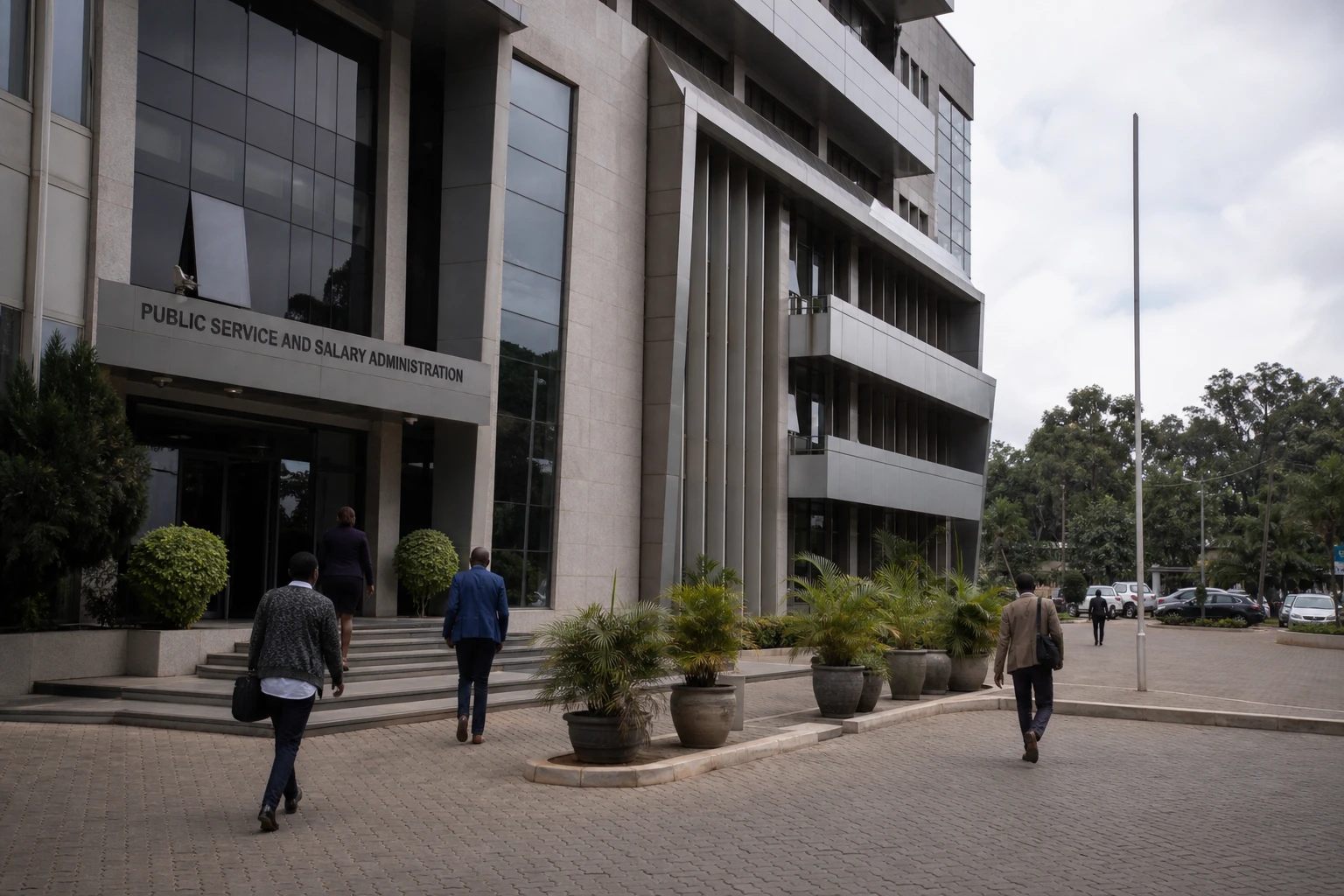
On Thursday 3 September 2026, nurses again marched in Nairobi to the SRC’s offices. Their slogans were direct: “Implement the 2017 RTWA” and “No CBA, No Work”. The movement was led by Seth Panyako, secretary-general of the Kenya National Union of Nurses and Midwives, who is keeping up the pressure on the institution responsible for approving public-sector pay.
The sticking point remains the letter of no objection that the union is seeking from the SRC. Without this document, the KNUNM says, the collective agreement must remain stalled before it can be registered with the Employment and Labour Relations Court, Kenya’s court with jurisdiction over labour matters. The Council of Governors, which represents county executives, is negotiating with the union, but the agreement remains incomplete until the institutional process is concluded.
The strike has been going on for some time. In early September 2026, several Kenyan media outlets reported that it was entering its tenth week, while accounts from the ground described severe disruption to services at many public facilities. The Kenya News Agency also reported that dispensaries and a referral hospital in Tharaka Nithi had been affected, forcing patients to turn to private providers or neighbouring counties.
Hospitals under strain as patients turn to private providers
The dispute extends beyond the union itself. It affects the day-to-day functioning of a health system already under pressure from staffing levels, budgets and the division of responsibilities between Nairobi and the 47 counties. In urban areas, some patients can turn to private clinics. In rural areas, the alternative is often further away, more expensive or simply unavailable.
In 2024, a debate in Parliament had already highlighted the scale of the workforce at stake: the Council of Governors cited about 31,923 nurses serving 16,655 county health facilities. The figure gives an indication of the potential impact of a prolonged stoppage. When nurses stop work, it is not only major referral hospitals that slow down. Basic care, antenatal follow-ups, vaccinations and frontline services are also put at risk.
Sector stakeholders have been saying for years that repeated strikes by healthcare workers have turned pay disputes into an indicator of systemic fragility. A study published on PubMed had already noted that Kenya experienced nearly 250 cumulative days of doctors’ and nurses’ strikes over 11 months in 2016 and 2017. The current dispute is part of that history. It is therefore neither an isolated episode nor a mere administrative squabble.
What the dispute over the SRC and counties reveals
At its core, the case raises a question of governance. The SRC is mandated to advise the state on public-sector pay and ensure that it is sustainable. Unions, for their part, argue that a signed agreement must be implemented. Between the two, county governments often cite budget constraints, while healthcare workers point out that night work, on-call duties, biological risks and excessive workloads cannot go without credible compensation.
The dispute also has political significance. Nurses form the most visible backbone of community health services. Their mobilisation is forcing the authorities to choose between two urgent priorities: holding the line on the public-sector wage bill, or safeguarding continuity of care. In an economy where private healthcare remains beyond the reach of part of the population, the strain is particularly acute for low-income households, pregnant women, older people and patients with chronic conditions.
The Council of Governors is also under scrutiny. Counties manage day-to-day healthcare, but they do not control the pay system on their own. This fragmentation helps explain why the dispute has become entrenched. It also shows why a local agreement can remain a dead letter if the SRC, public-sector employers and judicial mechanisms do not move at the same pace.
A signal to watch beyond Kenya
At regional level, the dispute resonates across East Africa, where East African Community member states are seeking to deepen integration while dealing with highly unequal national health systems. Kenya, often presented as a regional medical and logistics hub, is seeing its domestic credibility tested on very practical grounds: its ability to pay, negotiate and implement agreements.
What happens next will depend less on statements than on a clear institutional step. Until the SRC issues the letter of no objection, the KNUNM says it has no reason to ease the pressure. For the Kenyan authorities, the stakes go beyond a single labour dispute. They must show that social agreements reached in the public service can withstand administrative delays and rivalries between levels of government.