Algeria
 Egypt
 Libya
 Morocco
 Sudan
 Tunisia
 Burkina Faso
 Cabo Verde
 Côte d'Ivoire
 Ghana
 Guinea
 Guinea-Bissau
 Liberia
 Mali
 Mauritania
 Niger
 Nigeria
 Senegal
 Sierra Leone
 The Gambia
 Togo
 Cameroon
 Central African Republic
 Chad
 DR Congo
 Equatorial Guinea
 Gabon
 Republic of the Congo
 São Tomé and Príncipe
 Burundi
 Comoros
 Djibouti
 Eritrea
 Ethiopia
 Kenya
 Madagascar
 Malawi
 Mauritius
 Mozambique
 Rwanda
 Seychelles
 Somalia
 South Sudan
 Tanzania
 Uganda
 Angola
 Botswana
 Eswatini
 Lesotho
 Namibia
 South Africa
 Zambia
 Zimbabwe
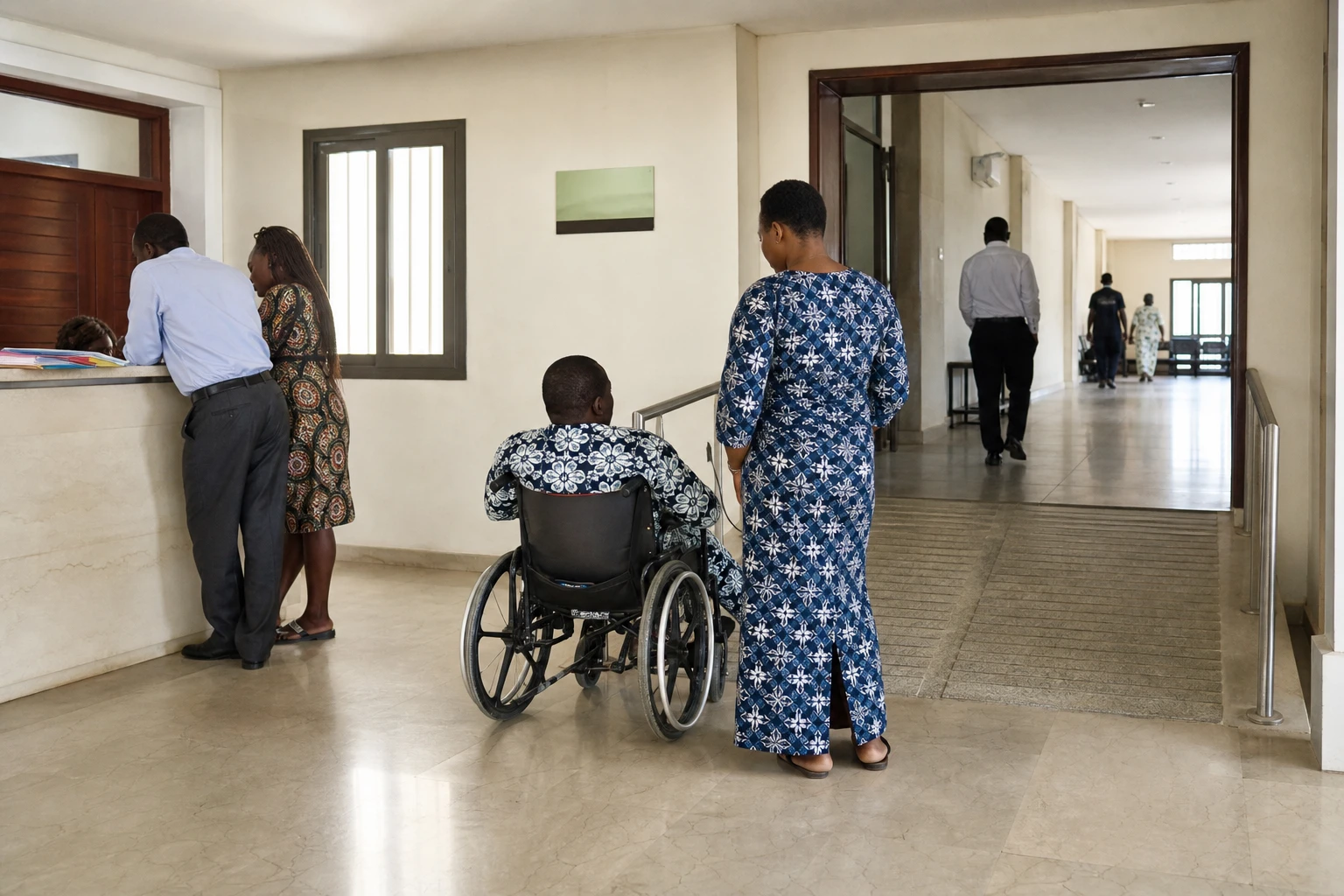
When inclusion stops being an abstract principle
In a country where education, transport and employment still vary according to where people live, the ability to enter a building, pay for schooling or launch an activity can determine an entire life course. In Benin, disability is no longer only a social issue; it is becoming a budgetary, administrative and economic one. At its meeting on Wednesday 2 September 2026, the Council of Ministers moved the issue squarely into that arena, with targeted measures for the education, mobility and entrepreneurship of people with disabilities.
This development is part of a national trajectory already under way. Law No. 2017-06 of 29 September 2017 laid the foundations for protecting and promoting the rights of people with disabilities in the Republic of Benin. Since then, several decrees and orders have set out the details of the equal opportunities card, financial support, access to education and benefits linked to socioeconomic integration. The Ministry responsible for Social Affairs’ Inclusion and Social Integration Platform now brings these implementing texts together.
Decisions addressing three practical levers
The first lever is education. The Beninese government plans to cover the school fees of 5,000 pupils with disabilities and a significant level of incapacity, attending mainstream public secondary schools as well as public specialist centres for blind or deaf children. The decision aims to remove a very practical barrier: the cost of starting and staying in school, which is often even heavier when families already have to pay for transport, assistance or adapted equipment.
The second lever concerns functional independence. The state intends to provide wheelchairs, tricycles, crutches, white canes, walking frames and other assistive devices to around 1,000 of the most vulnerable people with disabilities each year. Here too, the issue goes beyond one-off assistance. A cane or a wheelchair does not solve everything, but it can make travel, attending class, looking for work or accessing a public service possible. Beninese law also provides for reductions in the cost of assistive devices and reasonable accommodations to access healthcare and services.
The third lever is economic. The annual allocation for funding entrepreneurial initiatives led by people with disabilities is to rise from 200 million to 400 million CFA francs. The government aims to expand the number of beneficiaries and support projects capable of creating value, purchasing inputs, funding training or acquiring technology. This approach aligns with the framework established in 2023, when the authorities adopted implementing texts for the 2017 law and provided for exemptions linked to the formalisation of businesses set up by people with disabilities.
A clearer public policy, but one that still demands much
Benin is not inventing the principle of inclusion. It is trying to make it more practical. In 2023, the Council of Ministers had already adopted several decrees implementing the 2017 law to better organise the social integration of people with disabilities. Beninese law provides for rights in education, vocational training, employment, transport, housing, culture, sport and participation in public life. It also provides for the equal opportunities card, a key document for accessing specific benefits and priority measures.
This new phase illustrates a useful shift: inclusion is no longer framed as simple assistance, but as a chain of rights that must be made workable. The challenge now lies in implementation. Beneficiaries must be identified without quietly excluding anyone, equipment must be distributed without delay, and schools, training centres and funding schemes must be genuinely accessible. Otherwise, the announcements will remain powerful on paper but have little impact in villages, outlying neighbourhoods and the poorest households.
The social impact for families is significant. When a child with a disability can attend public secondary school without paying fees, financial pressure eases. When an adult receives mobility equipment, they can resume activities they had stopped. When an entrepreneur secures funding, they are no longer dependent solely on solidarity networks. This is a major difference between a policy of compassion and one of empowerment. Benin is clearly seeking to move towards the latter.
What this means for Benin and West Africa
Regionally, this development also matters for West Africa. ECOWAS has for several years emphasised free movement, economic integration and everyone’s participation in development. But regional mobility is meaningful only if citizens can first travel, train, create and work in their own country. From this perspective, disability inclusion is not a separate issue; it shapes the real quality of economic citizenship.
The issue also resonates with Benin’s international commitments. The United Nations notes that people with disabilities continue to face persistent barriers to education, employment and basic services. In its exchanges with the UN system, Benin itself has referred to annual spending on policies to protect and integrate people with disabilities, as well as recurring financial support for their federation. The new allocation of 400 million CFA francs therefore points to an expansion of efforts already under way.
One essential expectation remains: that the figures translate into measurable results. The coming months will show whether the 5,000 targeted pupils do in fact receive support, whether the 1,000 promised items of equipment reach beneficiaries furthest from urban centres, and whether doubling entrepreneurial funding genuinely broadens the base of people with disabilities active in the formal and informal economies. In a country that has already laid the legal foundations, the challenge is no longer simply to make announcements. Inclusion must now be made visible, lasting and effective, from Porto-Novo to municipalities across the interior.