Algeria
 Egypt
 Libya
 Morocco
 Sudan
 Tunisia
 Benin
 Burkina Faso
 Cabo Verde
 Côte d'Ivoire
 Ghana
 Guinea
 Guinea-Bissau
 Liberia
 Mauritania
 Niger
 Nigeria
 Senegal
 Sierra Leone
 The Gambia
 Togo
 Cameroon
 Central African Republic
 Chad
 DR Congo
 Equatorial Guinea
 Gabon
 Republic of the Congo
 São Tomé and Príncipe
 Burundi
 Comoros
 Djibouti
 Eritrea
 Ethiopia
 Kenya
 Madagascar
 Malawi
 Mauritius
 Mozambique
 Rwanda
 Seychelles
 Somalia
 South Sudan
 Tanzania
 Uganda
 Angola
 Botswana
 Eswatini
 Lesotho
 Namibia
 South Africa
 Zambia
 Zimbabwe
In Léré, movement has become a balance of power
In northern Mali, a blockade does more than close a road. It traps a town, weakens markets, drives up the cost of food and turns every journey into a test. In Léré, in the Timbuktu region, this pressure weighed on families, traders and transporters for months, making the resumption of traffic a political as well as a security issue.
The case forms part of a broader fragmentation of Mali’s transport routes. Since 2025, the Group for the Support of Islam and Muslims, or JNIM, affiliated with al-Qaeda, has stepped up attacks on convoys and military positions from the north towards the centre of the country. The incidents in San, in the Ségou region, and Anéfis, in the north, suggest this is less a linear front than a strategy of pressure on roads, garrisons and supplies.
Local deal follows months of informal siege
According to corroborated information, the lifting of the blockade of Léré was announced after an agreement was reached on 31 August between representatives of the population and interlocutors linked to JNIM. The discussions reportedly lasted about a month. Some sections still need to be cleared of mines before the town can fully reopen.
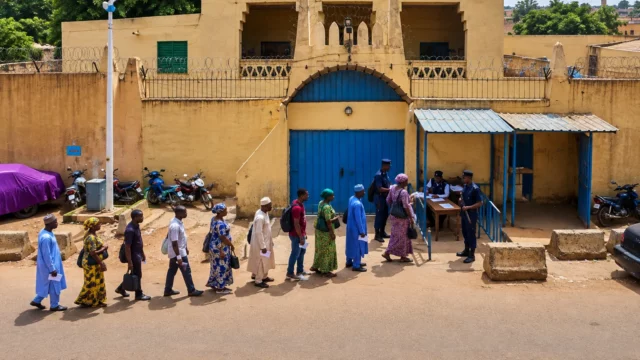
Léré lies in the Niafunké cercle, not far from the Mauritanian border. Its location matters. In an area where roads carry as much weight as front lines, controlling access to a locality means exerting influence over its day-to-day economy. During the blockade, the movement of people and goods in and out was sharply curtailed. Food and essential goods became scarcer.
Residents took part in the discussions through traditional and community leaders. Local military authorities and the Timbuktu governorate also took part in the talks. The precise terms of the agreement have not been made public, but the commitments mentioned concern residents’ security and reopening routes once they have been cleared. This silence is not insignificant: in northern Mali, local arrangements are often negotiated away from microphones because they combine civilian survival, armed power dynamics and tactical calculation.
What Léré reveals about Mali’s war over roads
The blockade began in October 2025, according to available information. During this period, Malian army vehicles continued to move from their position in the town, while civilian vehicles and ordinary convoys remained hindered. This detail matters. It shows that the aim was not only to isolate Léré, but also to distinguish between forms of movement deemed acceptable and those that were not.
JNIM had presented the measure as a response to alleged cooperation between the population and the authorities. Local sources, for their part, described it as collective punishment. This difference in framing says much about how armed groups seek to govern through coercion: they punish an entire territory to influence its loyalties, exchanges and positions. In practice, households, small traders and transporters bear the most immediate cost.
The events in San on 9 August 2026 also shed light on this logic. The Malian army said it had repelled an attack on its military base, while channels affiliated with JNIM claimed to have captured the barracks. APA reported that the assault was launched at about 5.30am and that no independent casualty figures were available at the time. A few weeks later, the San governorate imposed a curfew until further notice, a sign that insecurity remained active around urban centres and major routes in the country’s central region.
The same logic was apparent in attacks on northern convoys. On 18 July, a military convoy between Anéfis and Gao was attacked. Reuters reported that the Malian army had acknowledged the attack and said it had carried out retaliatory strikes, while sources close to the rebels spoke of heavy losses and captured soldiers. Here too, casualty figures were disputed. But the strategic message is clear: armed groups are targeting military and logistical movement to weaken the state along its transport routes.
Since 2025, this pressure has extended beyond garrisons. It has also hit fuel supplies destined for Bamako. APA reported that tanker convoys had been targeted and that hydrocarbon supplies had been disrupted in several regions. Mali’s capital, although far from some areas of fighting, has thus felt the war at the fuel pump, in queues and through price pressures. For a landlocked country, every closed road carries a national cost.
Regional significance extends beyond Timbuktu
Mali is not alone in this sequence of events. Attacks claimed by JNIM extend beyond Timbuktu towards Ségou, Gao and the roads linking the country to its neighbours. Reuters has noted that the group intensified its attacks after the coups of 2020 and 2021, against the backdrop of the military authorities’ promise to restore security. In practice, the security crisis remains a test for Bamako, but also for the Alliance of Sahel States, which is seeking to build its own security doctrine in response to cross-border threats.
The continental implications are clear. When a town such as Léré is cut off, it is not just a local issue. It is a signal of Sahelian states’ ability to hold their transport corridors, protect populations and maintain trade flows. It is also a warning for West Africa, where roads connect markets, ports, capitals and rural areas far more than is often acknowledged. In Mali, the battle has become one over transport routes. And in that battle, the lifting of the blockade of Léré looks less like an end than a pause secured at the cost of an unstable balance of power.