
 Algeria
 Egypt
 Libya
 Morocco
 Sudan
 Tunisia
 Benin
 Burkina Faso
 Cabo Verde
 Ghana
 Guinea
 Guinea-Bissau
 Liberia
 Mali
 Mauritania
 Niger
 Nigeria
 Senegal
 Sierra Leone
 The Gambia
 Togo
 Cameroon
 Central African Republic
 Chad
 DR Congo
 Equatorial Guinea
 Gabon
 Republic of the Congo
 São Tomé and Príncipe
 Burundi
 Comoros
 Djibouti
 Eritrea
 Ethiopia
 Kenya
 Madagascar
 Malawi
 Mauritius
 Mozambique
 Rwanda
 Seychelles
 Somalia
 South Sudan
 Tanzania
 Uganda
 Angola
 Botswana
 Eswatini
 Lesotho
 Namibia
 South Africa
 Zambia
 Zimbabwe
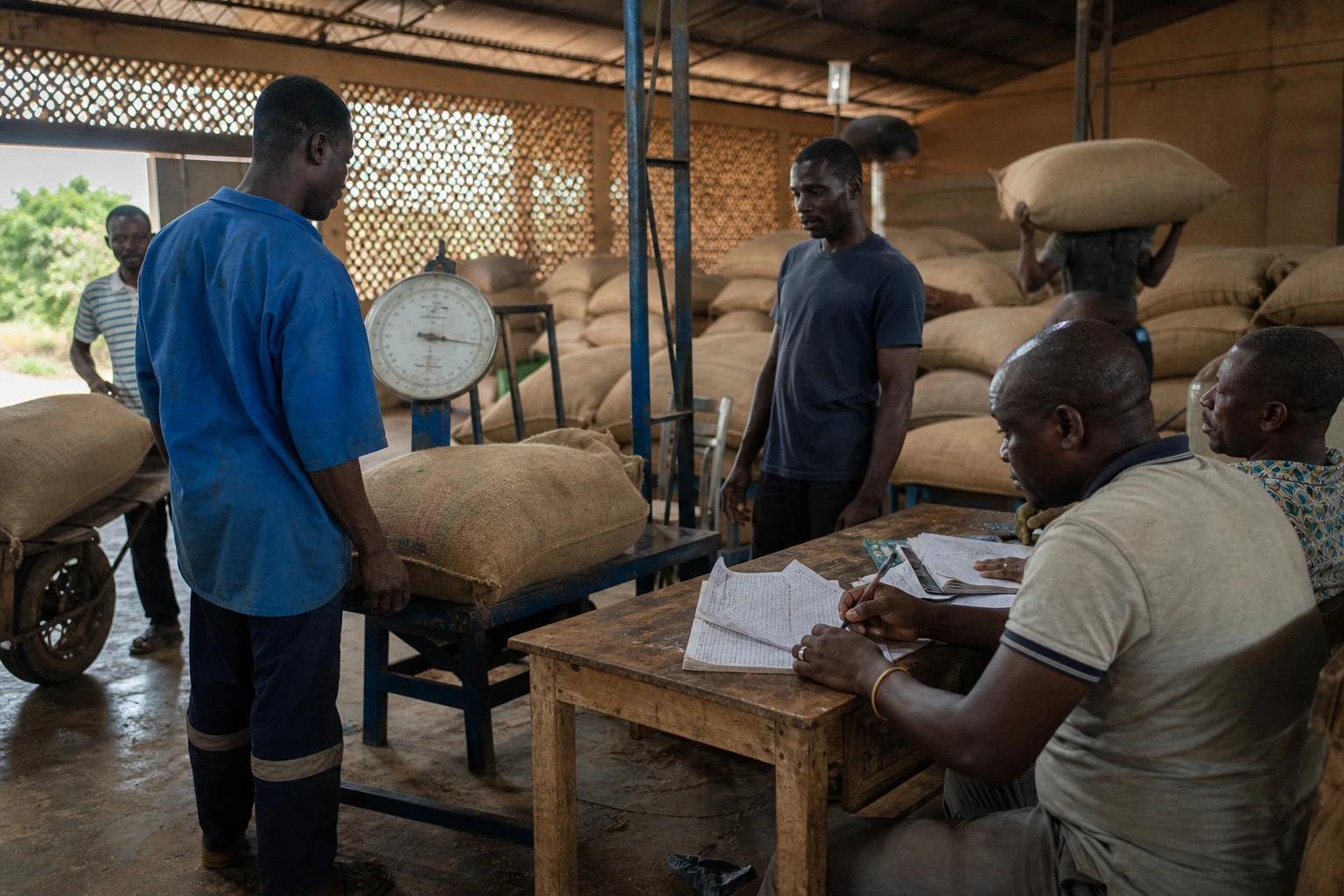
When cocoa’s farmgate price moves in Côte d’Ivoire, it is not only growers’ incomes that are shaken. An entire system adjusts, from the farm to exports, including spending on fertiliser, cooperatives and public finances. The 2026/27 season comes at a time when global prices are normalising after a period of sharp increases, while production costs remain under pressure.
In Côte d’Ivoire, whose political capital is Yamoussoukro, cocoa remains the backbone of the rural economy and a pillar of export revenue. The sector is organised around the Coffee and Cocoa Council, the public body responsible for stabilising marketing, with a guaranteed minimum price set each season. In a country with around 1.2 million cocoa farmers, and where the sector provides a livelihood for nearly eight million people, even the smallest change in the farmgate price has an immediate impact on households, cooperatives and buying areas.
Floor price more than halved in a year
For the 2026/27 main crop season, the guaranteed minimum farmgate price for cocoa has been set at CFAF 1,200 per kilogram. The announcement was made on 1 September 2026 by the Ivorian authorities, which also set the price of coffee at CFAF 1,300 per kilogram. The ministry responsible for agriculture attributes this level to the forward-selling mechanism, under which a large share of the harvest is sold before the season to secure volumes and align the price paid to farmers with sales already completed.
The contrast with the 2025/26 season is stark. The price announced for 2026/27 is down by around 57% from the record CFAF 2,800 per kilogram reached in the previous main crop season. In practice, a tonne of cocoa sold at the guaranteed price will therefore bring in CFAF 1.2 million, compared with CFAF 2.8 million a year earlier. This marks a major change of direction for growers, even though the price remains above levels seen before the surge in global prices.
This is no minor decline. It comes after a period of exceptionally high international prices, followed by a downturn in beverage markets, including cocoa. The World Bank says cocoa prices eased considerably in 2026, after last year’s pressures. In this context, the Ivorian government says it is seeking a price that is “as high as possible” for farmers, but also compatible with budget constraints and the reality of sales already committed.
What the decline means for growers
In the rural areas of the south-west, centre-west and forest zone, cocoa income pays for much more than the harvest. It covers school fees, transport, seasonal labour, plot maintenance and, often, inputs. A study published in February 2026 in Frontiers in Sustainable Food Systems notes that Ivorian cocoa-growing households derive an average of 67% of their net income from bean sales. When the guaranteed price falls sharply, their room for manoeuvre shrinks accordingly.
The shock is all the more acute because the sector remains a major source of rural employment. The Ivorian authorities say it provides a livelihood for around eight million people. In practice, this means the price decline affects not only landowning farmers, but also farm workers, transporters, buying agents, village buyers and small businesses operating around collection points. In Yamoussoukro as in Abidjan, the decision is therefore as much about purchasing power as it is about macroeconomics.
The second impact is on productivity. When incomes rise, producers are better able to buy fertiliser, treat diseases and renew their orchards. When incomes fall, the choices become harder. Côte d’Ivoire already faces several structural vulnerabilities: ageing plantations, swollen shoot disease, climate pressures and the need for replanting. These constraints limit yields and make each pricing decision all the more consequential.
Available data on inputs also show that cocoa directly influences national demand for fertiliser. In 2025, apparent fertiliser consumption in Côte d’Ivoire reached 593,107 tonnes, up 41% year on year, according to data compiled by IFDC. The cocoa sector accounted for more than 150,000 tonnes, or over a quarter of national consumption. The link between farmers’ income and investment in orchards is therefore very tangible: if prices soften, maintenance may be deferred, risking lower yields over the medium term.
Another factor is the expected rise in fertiliser costs. The World Bank projects an increase of more than 30% in its fertiliser price index in 2026, amid higher energy costs and disruptions to shipping through the Strait of Hormuz. For Ivorian producers, this means a double squeeze: less income from sales and higher spending to keep plantations in good condition.
A signal for Côte d’Ivoire’s sector and West Africa
The Ivorian decision reaches beyond the country itself. Côte d’Ivoire and Ghana have long sought to gain greater influence over global prices through the Côte d’Ivoire-Ghana Cocoa Initiative, which together accounts for more than 60% of world production. When Abidjan adjusts its farmgate price, the move is watched in Accra, on trading floors and by European and Asian processors.
The market is now watching three things. First, the Coffee and Cocoa Council’s ability to honour its marketing commitments without undermining producers. Second, developments in the international market, where the correction in cocoa prices could continue for several more months. Finally, the weather and harvest forecasts. Some private projections, including those from StoneX, already point to a decline in Ivorian production in 2026/27, to around 1.77 million tonnes, if climate risks materialise. This estimate should be treated with caution, but it is a reminder that price is not everything: weather, orchard age and plant health matter just as much.
Côte d’Ivoire’s challenge is now to preserve the balance between budget stability, farmers’ incomes and the sector’s competitiveness. It is a delicate equation. If the price is too low, growers’ ability to maintain plantations is undermined. If it is too high, it could weigh on public finances and marketing if forward sales fall short. The future of the Ivorian economy, and of cocoa-producing West Africa as a whole, hinges on finding a balance.



