Algeria
 Egypt
 Libya
 Morocco
 Sudan
 Tunisia
 Benin
 Burkina Faso
 Cabo Verde
 Côte d'Ivoire
 Ghana
 Guinea
 Guinea-Bissau
 Liberia
 Mali
 Mauritania
 Niger
 Nigeria
 Senegal
 Sierra Leone
 The Gambia
 Togo
 Cameroon
 Central African Republic
 Chad
 DR Congo
 Equatorial Guinea
 Gabon
 Republic of the Congo
 São Tomé and Príncipe
 Burundi
 Comoros
 Djibouti
 Eritrea
 Ethiopia
 Kenya
 Madagascar
 Malawi
 Mauritius
 Mozambique
 Rwanda
 Seychelles
 Somalia
 South Sudan
 Tanzania
 Uganda
 Angola
 Eswatini
 Lesotho
 Namibia
 South Africa
 Zambia
 Zimbabwe

A global market in flux
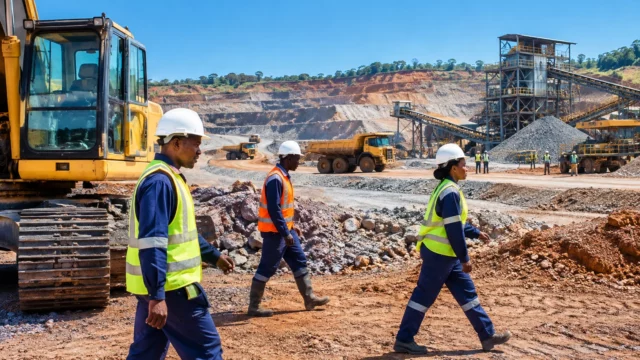
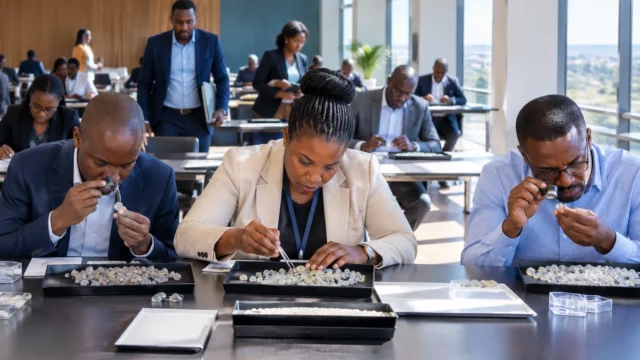
In jewellery windows and public budgets alike, diamonds no longer look the way they did ten years ago. For African producers, the challenge is not just falling prices. It is also the rise of an industry able to manufacture, standardise and deliver laboratory-grown stones on a large scale, at costs and within timeframes that no mine can match. In Botswana, where diamonds remain a pillar of the economy, this shift directly affects jobs, public revenues and the country’s ability to finance its diversification.
Botswana is a member of the Southern African Development Community (SADC), and its economic model has been built around natural diamonds, notably through Debswana, the joint venture between the Botswanan state and De Beers. But that foundation is weakening. Gaborone’s authorities themselves described 2025 as a year of transition, marked by pressure from synthetic diamonds on natural stone prices. The country has also strengthened its strategy to increase local value and protect its mining revenues, proof that this is no longer simply a market debate but an issue of economic sovereignty.
China and India build their lead
The new industrial hub for synthetic diamonds is in China and India. In China, Henan province, around Zhengzhou and Zhecheng, has established itself as a major production centre, thanks to companies able to integrate the manufacture of high-pressure presses, crystal production and some finishing. In India, Surat, already the world capital of natural diamond cutting and polishing, has taken an increasingly prominent role in laboratory-grown stones. Together, these two powers give the market an industrial depth African producers cannot quickly replicate.
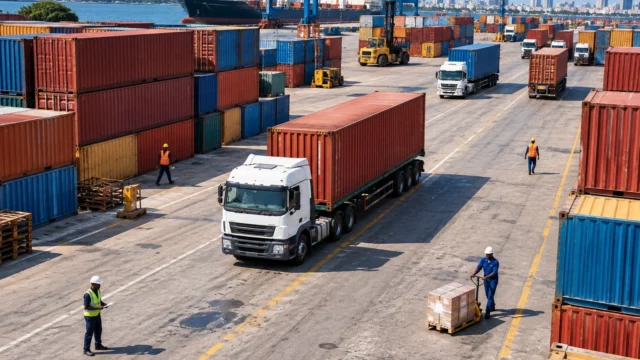
Recent figures confirm this shift. India’s jewellery industry body, the GJEPC, said polished synthetic diamond exports reached $1.13 billion in the 2025-2026 financial year, while polished natural diamond exports fell over the same period. Earlier, Indian exports of laboratory-grown diamonds had already exceeded $923 million between April 2025 and January 2026. This is no niche market. It is a structured export industry, backed by workshops, markets and supply chains already in place.
The sector’s rise is also explained by the nature of the product. A synthetic diamond can be produced without opening a mine, exhausting a deposit or waiting more than a few weeks. As techniques advance, stones are growing in size and quality while remaining far cheaper than natural diamonds. Botswana, like Angola, Namibia, the Democratic Republic of the Congo and South Africa, therefore faces industrial competition based not on geological rarity or mining history, but on price, volume and access to the mass market.
A shock felt as far as Gaborone
The pressure is already evident in public accounts and the decisions of major groups. De Beers announced the planned closure of its Lightbox brand, which sold synthetic diamonds, saying it wanted to focus on higher-value activities. The group has also acknowledged that the price gap between natural and laboratory-grown stones continues to widen. At the same time, falling rough diamond prices are weighing on established producers, with Botswana at the forefront. Lucara Diamond eventually found a buyer for the Motswedi, a 2,488-carat diamond discovered in Botswana in August 2024, but the sale does not erase the difficulties in the more ordinary segment, which sustains the sector’s day-to-day revenues.
For Botswana, the challenge is twofold. The country is trying to defend the symbolic and commercial value of natural diamonds, while also protecting its budgetary resources as mining revenues contract. Official Botswanan documents note that diamonds remain a major source of exports, public revenues and foreign currency. Against this backdrop, the government established a sovereign wealth fund in 2025 to channel some diamond-related revenues into agro-industry, renewable energy and tourism. It is a clear signal: the country wants to reduce its reliance on a single source of revenue.
The social impact is immediate. When sales slow, the pressure spreads to cutting and polishing companies, subcontractors, wages and state revenues. Mining towns and Gaborone first feel the shock through formal employment, while households and the informal economy experience the delayed effects of a tighter budget. By contrast, Chinese and Indian industrial platforms are gaining ground because they rapidly turn global demand into manufacturing activity and exports. The balance of power is therefore geographical as well as economic.
African response: defend provenance, not just price
In response to this pressure, African producers have opted for collective action. In June 2025, Angola, Botswana, Namibia, South Africa, Sierra Leone and the DRC signed the Luanda Agreement. The principle is simple: devote 1% of annual rough diamond sales revenues to a global campaign promoting natural diamonds, led by the Natural Diamond Council. The aim is not merely advertising. It is to highlight origin, geological rarity and the contribution of natural diamonds to African economies.
This choice says much about Africa’s current strategy. Governments are not trying to deny the existence of laboratory-grown diamonds. Instead, they are seeking to better segment the market, defend provenance and capture more value locally. Botswana has also increased the share of its sales handled locally by the Okavango Diamond Company, while the government emphasises domestic processing and marketing. In the SADC, this approach could inspire other mining industries: surviving global competition is not just a matter of extracting more, but of telling the story better, selling better and processing more on the continent.
The continental significance extends beyond diamonds. Botswana’s case encapsulates a broader question for southern Africa and, beyond it, the African Union: how can a mining revenue base be protected when technology, consumer demand and global value chains are changing faster than national economic models? The coming months will be crucial: the implementation of the Luanda Agreement, changes in rough diamond prices and Gaborone’s ability to diversify its economy will show whether natural diamonds can still finance development or must now coexist with an economy less dependent on mining.