Algeria
 Egypt
 Libya
 Morocco
 Sudan
 Tunisia
 Benin
 Burkina Faso
 Cabo Verde
 Côte d'Ivoire
 Ghana
 Guinea
 Guinea-Bissau
 Liberia
 Mali
 Mauritania
 Nigeria
 Senegal
 Sierra Leone
 The Gambia
 Togo
 Cameroon
 Central African Republic
 Chad
 DR Congo
 Equatorial Guinea
 Gabon
 Republic of the Congo
 São Tomé and Príncipe
 Burundi
 Comoros
 Djibouti
 Eritrea
 Ethiopia
 Kenya
 Madagascar
 Malawi
 Mauritius
 Mozambique
 Rwanda
 Seychelles
 Somalia
 South Sudan
 Tanzania
 Uganda
 Angola
 Botswana
 Eswatini
 Lesotho
 Namibia
 South Africa
 Zambia
 Zimbabwe
In Niamey, the return to calm also reflects the fragility of the political moment
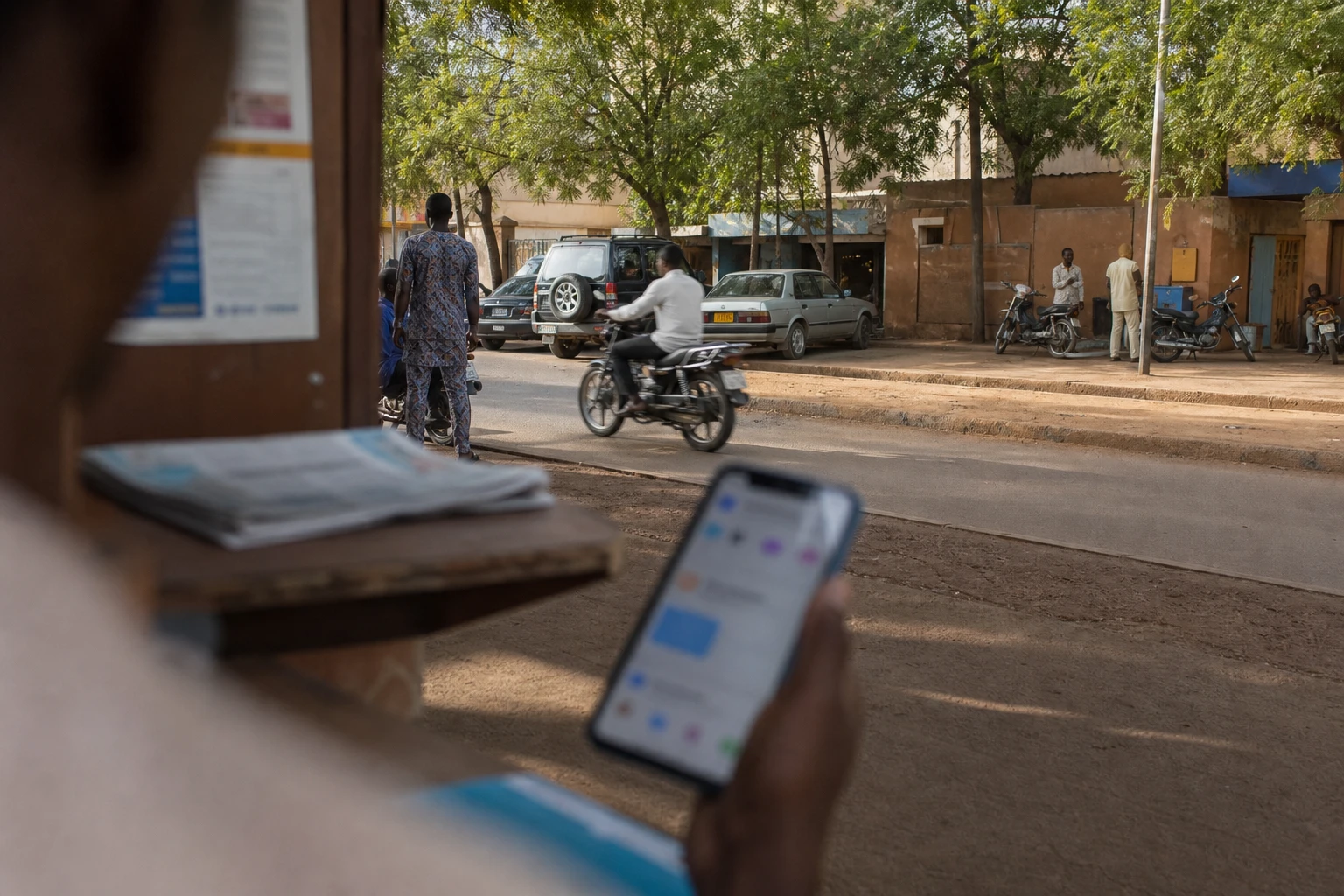
On Sunday, Niamey looked like a capital keen to get back to its usual rhythm. Shops reopened, the main market resumed activity and access to sensitive sites became clear again after gunfire and explosions were reported on the night of 28–29 August 2026. The contrast is striking: within a few hours, urban routine had resumed, but the Nigerien capital also recalled just how precarious security remains in a country already under intense armed pressure.
Niger has been under the leadership of General Abdourahamane Tiani since the coup d’état of 26 July 2023. In this context, Niamey is not merely the country’s administrative centre. The city is also home to symbols of power, major logistical routes and strategic military installations, including Air Base 101 and the presidential palace. Every security alert there offers a measure of the transitional authorities’ actual control.
What happened on the night of 28–29 August
According to Niger’s defence ministry, gunfire targeted several sensitive sites in Niamey before the Defence and Security Forces gradually regained control. Minister of State Salifou Mody described it as a “mood-driven movement” by some soldiers, which was quickly contained. The Alliance of Sahel States, or AES — the organisation founded by Niger, Mali and Burkina Faso — meanwhile referred to an attempted destabilisation by a group of military personnel, targeting Air Base 101 in particular.
Several international and African media outlets reached the same conclusion: clashes continued into the morning before calm returned. The Associated Press reported that a mutiny had briefly threatened the ruling junta, while APAnews and the Agence Nigérienne de Presse each confirmed that the authorities had regained control of the affected sites.
Residents described a city under heightened surveillance, with checks at the entrance to the presidential palace and around Diori Hamani International Airport. Accounts collected by news agencies are consistent: after a night of anxiety, commercial activity resumed and the capital’s main roads returned to normal traffic levels, although a visible military presence was maintained.
Figures on casualties should be treated with caution. The authorities and several news reports referred to soldiers killed or arrested, but gave no consolidated figure that could immediately be verified by an independent source. In incidents of this kind, the details may change as internal investigations proceed and official statements are issued.
Why this episode matters beyond the barracks
This latest outbreak of tension shows one thing clearly: Niger’s stability depends not only on political statements, but on the actual cohesion of its security apparatus. Since 2023, the transitional government has significantly reshaped its foreign alliances. It has moved closer to Russia and distanced itself from France and some of its former Western partners. At the same time, the authorities have emphasised sovereignty, institutional renewal and cooperation across the Sahel.
In practice, this political course has produced a more centralised military environment, but not necessarily one that is easier to govern. Niger still faces a longstanding jihadist threat, with repeated attacks in several regions. Incidents around Niamey airport in June 2026 had already shown that the capital is not beyond reach. The fact that a mutiny, rather than only an external armed attack, affected the capital points to a different vulnerability: command and internal discipline.
For the population, the stakes are tangible. In Niamey, the opening of shops, the functioning of the market and freedom of movement are immediate barometers of a return to normality. But the capital is not cut off from the rest of the country. When tensions rise in Niamey, rumours quickly spread to the regions, markets become unsettled and trust in the state weakens. Conversely, a swift return to activity reassures households, transport operators and small traders who live day to day.
The signal is regional, too. Neighbouring Nigeria expressed “deep concern” and called for an inclusive and participatory return to stability and constitutional order. Algeria, for its part, deployed Russian-made patrol aircraft on a support mission. These responses show that, in the Sahel, an incident in Niamey is immediately viewed through the prism of border dynamics, counter-terrorism, arms movements and human mobility.
A test for Niger, and for the Sahel region
Niger now occupies a distinctive place in the Sahel’s political architecture. Alongside Mali and Burkina Faso, it forms the Confederation of Sahel States, which is seeking to build its own political and security mechanisms. The first ordinary session of its confederal parliament opened in Niamey in late August 2026, just as gunfire shook the capital. The coincidence captures the moment: institutional renewal is under way, but remains exposed to internal and external shocks.
For Niger’s African partners, the episode is a reminder that no security framework can endure without discipline in the chain of command, trust between institutions and a clear understanding of the causes of discontent. For the population, it raises a more immediate question: how can strategic infrastructure, centres of power and economic routes be protected without turning the capital into a city under permanent military tutelage? The balance between claimed sovereignty and lived stability is now at stake.
What happens next will depend less on announcements than on the concrete measures taken after this episode: internal investigations, clarification of who was responsible, security at sensitive sites and efforts to prevent further divisions within the forces. Across the Sahel, every crisis of this kind also shapes the calculations of neighbouring countries, regional organisations and foreign military actors present in or linked to the region. Calm has returned to Niamey. But the matter remains unresolved.