Algeria
 Libya
 Morocco
 Sudan
 Tunisia
 Benin
 Burkina Faso
 Cabo Verde
 Côte d'Ivoire
 Ghana
 Guinea
 Guinea-Bissau
 Liberia
 Mali
 Mauritania
 Niger
 Nigeria
 Senegal
 Sierra Leone
 The Gambia
 Togo
 Cameroon
 Central African Republic
 Chad
 DR Congo
 Equatorial Guinea
 Gabon
 Republic of the Congo
 São Tomé and Príncipe
 Burundi
 Comoros
 Djibouti
 Eritrea
 Ethiopia
 Kenya
 Madagascar
 Malawi
 Mauritius
 Mozambique
 Rwanda
 Seychelles
 Somalia
 South Sudan
 Tanzania
 Uganda
 Angola
 Botswana
 Eswatini
 Lesotho
 Namibia
 South Africa
 Zambia
 Zimbabwe
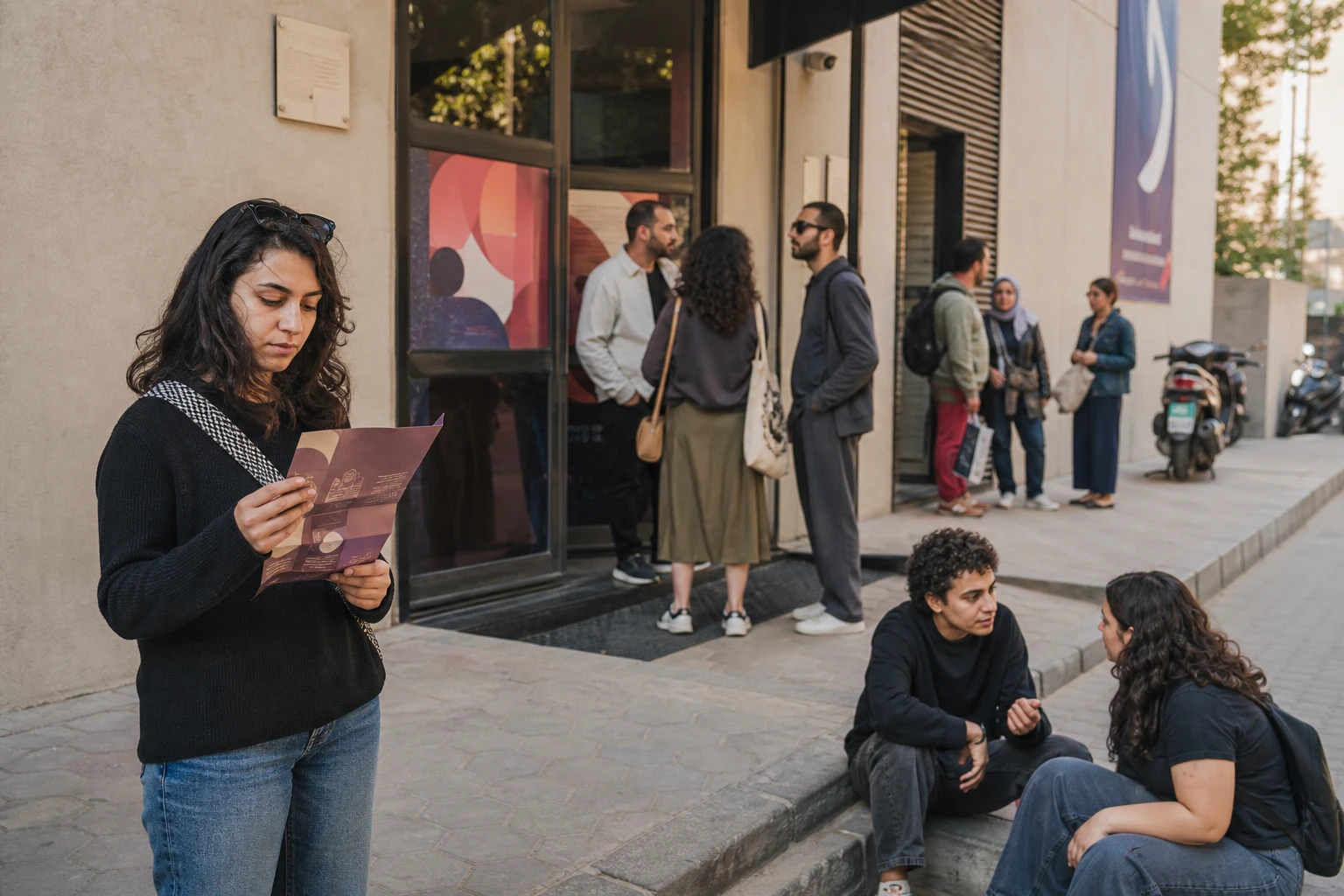
When theatre takes on what ordinary words cannot always express
A bare stage, a family story, a list of small joys. On paper, the set-up seems light. In reality, it touches on a weighty subject: depression, suicide, and the need to keep standing when life begins to fracture. That is precisely where the Arabic version of Every Brilliant Thing finds its strength.
Duncan Macmillan’s play has travelled to many countries. In Arabic, it has taken on a new life thanks to Egyptian director Ahmed El Attar. The adaptation was conceived for Arabic-speaking audiences, with a performance built on interaction and simple, direct, almost familiar language. The result is a show that speaks not only about private suffering. It also questions how societies view psychological distress, the silence surrounding the subject and the space given to speaking openly in public. The World Health Organization notes that depression is a common disorder, that it can lead to suicide and that it is still too often inadequately treated.
Ahmed El Attar, an Egyptian voice in contemporary Arab theatre
In Egypt, Ahmed El Attar occupies a distinctive place. A playwright, director and cultural producer, he has built an ecosystem from Cairo that extends beyond the stage. His organisations have supported artists, creative venues and festivals in the Egyptian capital. The cultural portal Orient Productions describes the independent theatre founded by El Attar in 1993 as the oldest link in this network. The Avignon Festival also notes that he founded and runs a training and residency venue in Cairo, as well as the Downtown Contemporary Arts Festival.
This trajectory matters to understanding the adaptation of Every Brilliant Thing. El Attar did more than translate a play. He situated it in an Egyptian and Arab theatre scene where contemporary theatre often serves as a social laboratory. In an interview published in Egypt, Al-Ahram Online notes that the play’s Arabic premiere took place at Rawabet Art Space in Cairo in May 2022, followed by performances in Beirut and Sharjah, and a tour in Egypt in 2025.
The choice is significant in a country where Cairo’s cultural scene remains a centre of gravity for North Africa and the Arab world. The Egyptian capital brings together institutions, independent venues, festivals and production networks. It is also where works are created that can then travel to Beirut, Tunis, Paris or the Gulf. The play is therefore part of a broader regional trend: an Arab theatre that no longer merely translates Europe, but makes it its own, shifts it and reshapes it.
The artistic proposition: an intimate story becomes a collective experience
Every Brilliant Thing tells the story of a child who tries to lift their mother’s spirits by making a list of everything worth living for. The form is fluid, almost playful. But the heart of the story remains grave: a mother facing suicidal depression, a family exposed to psychological vulnerability, a child turning an inventory of everyday life into a tool for survival. Al-Ahram Online aptly sums up this tension between lightness and gravity, noting that the play is built around interaction with the audience and a deliberately bare stage.
The Arabic version gives the show its own character. It incorporates local cultural references to create an immediate connection with Arabic-speaking audiences. The set-up is simple. There is no elaborate scenery or spectacular effects. Everything rests on speech, rhythm and audience participation. This restraint strengthens the impact of the message. It suggests that mental health is not an abstract subject reserved for specialists. It is a matter for families, schools, neighbourhoods and workplaces; of words that are missing and eyes that look away. The WHO also stresses that effective treatments exist and that stigma remains a major barrier to accessing care.
The play’s circulation across several Arab cities also demonstrates the vitality of a transnational cultural circuit. It has been performed in Cairo, Beirut and Sharjah, and then in other Egyptian cities. It subsequently found an audience in France, in Aurillac, as part of the international street theatre festival run by ÉCLAT, a French national centre recognised for its residencies and for welcoming artists from a wide range of backgrounds.
What this adaptation means for Egypt and beyond
For Egyptians, the stakes go beyond the success of a single show. This adaptation confirms that a work from the West can be fully rewritten in Cairo without losing its universal reach. It also shows that Egypt does not merely host imported forms. It creates its own cultural bridges to the Arab world and Europe. In a country where public institutions, independent collectives and private stages sometimes coexist uneasily, this kind of project is a reminder of contemporary art’s ability to connect very different audiences.
The subject is all the more sensitive because mental health remains a blind spot in many societies across the region. In Egypt, the World Health Organization says the government is seeking to improve mental health services and has supported the launch of a national online mental health platform. This does not solve the problem, but it points to a useful shift: access to care is gradually becoming a matter of public policy, rather than solely a private concern.
In this context, theatre has a specific role. It does not replace treatment or prevention. But it can break isolation, give a name to what remains unspoken and create a form of collective listening. This is where the Arabic version of Every Brilliant Thing takes on continental significance. It engages with a generation of African and Arab artists working on family wounds, social norms, gender relations and inherited silences. Ultimately, it is a reminder that in North Africa, as elsewhere, culture is not a backdrop. It is a space in which a society looks at itself, understands itself and sometimes begins to heal.