Algeria
 Egypt
 Libya
 Morocco
 Sudan
 Tunisia
 Benin
 Burkina Faso
 Cabo Verde
 Côte d'Ivoire
 Ghana
 Guinea
 Liberia
 Mali
 Mauritania
 Niger
 Nigeria
 Senegal
 Sierra Leone
 The Gambia
 Togo
 Cameroon
 Central African Republic
 Chad
 DR Congo
 Equatorial Guinea
 Gabon
 Republic of the Congo
 São Tomé and Príncipe
 Burundi
 Comoros
 Djibouti
 Eritrea
 Ethiopia
 Kenya
 Madagascar
 Malawi
 Mauritius
 Mozambique
 Rwanda
 Seychelles
 Somalia
 South Sudan
 Tanzania
 Uganda
 Angola
 Botswana
 Eswatini
 Lesotho
 Namibia
 South Africa
 Zambia
 Zimbabwe
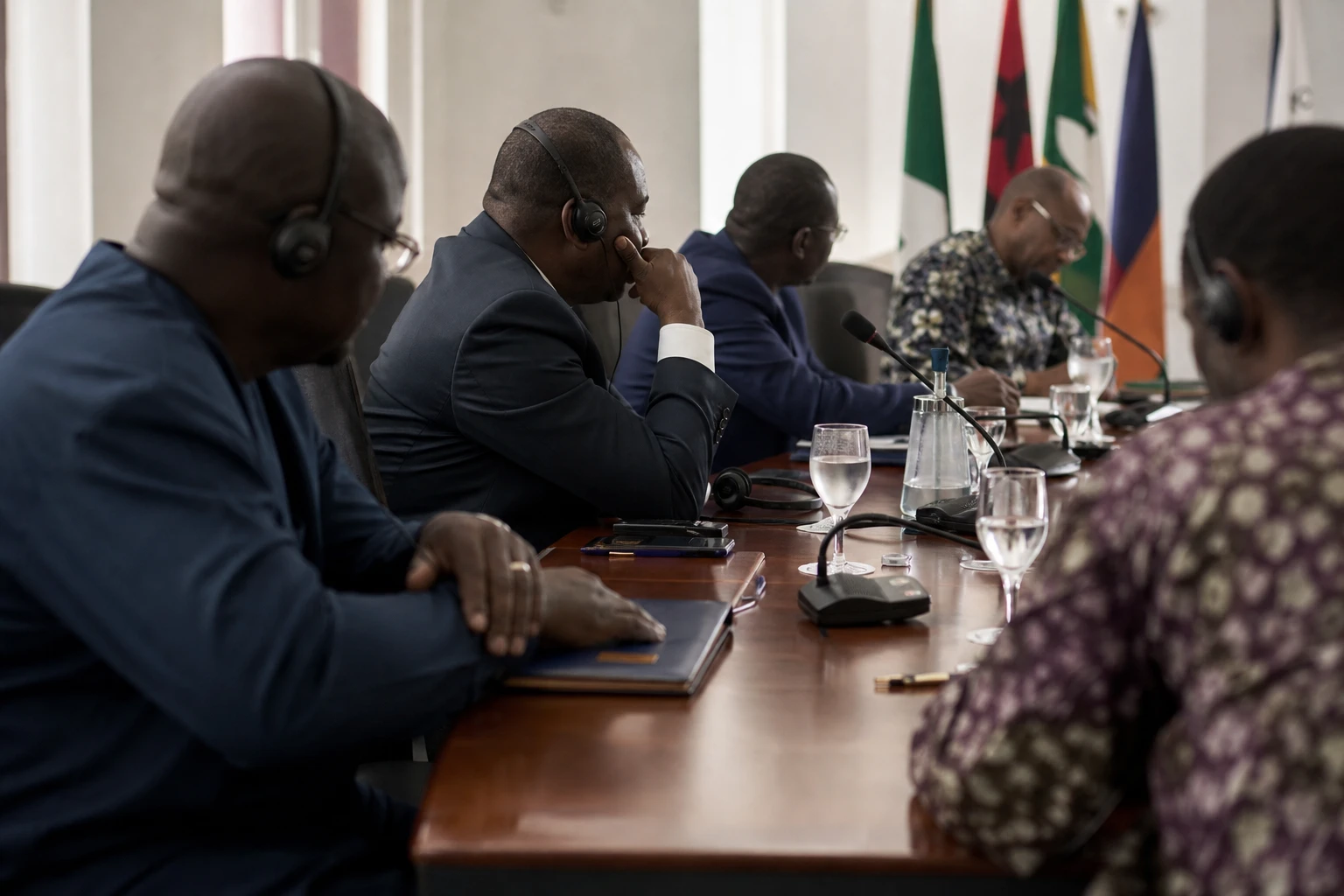
In Bissau, a vote that goes beyond the constitution
On the eve of the vote, many people in Guinea-Bissau are not debating only a legal text. Above all, they are asking who will hold the real centre of power in the months ahead, and what guarantees there will be for political parties, parliament and the public. The referendum scheduled for Sunday 30 August 2026 will decide between two very different visions of the end of the transition: a strengthened executive, presented as a remedy for instability, or an institutional structure its opponents consider too centralised.
The context is fraught. Guinea-Bissau, a West African country bordering Senegal and Guinea, has experienced a succession of coups and institutional crises since independence. The African Development Bank notes that the country has suffered four successful coups and 16 coup attempts since 1974. That history continues to shape how local actors view every institutional reform.
A military transition seeking to close the chapter through the ballot box
The official timetable sets the constitutional referendum for 30 August 2026, followed by general elections on 6 December 2026. ECOWAS, the Economic Community of West African States, is closely monitoring the process and has reminded the transitional authorities of the need for transparency, inclusivity and a return to constitutional order. The African Union has also expressed concern about restrictions imposed on political parties, civil society actors and private media.
The text put to the vote was introduced by the National Transitional Council, the legislative body established after the coup of 26 November 2025. According to authoritative analyses of the process, the draft provides, among other things, for a reduction in the number of MPs from 102 to 65 and in the number of constituencies from 29 to 12. The stated aim is to simplify the institutional structure and make executive power more clearly defined.
Under the transition’s proposals, the executive would be given a markedly greater role. The president would chair the Council of Ministers, where the main decisions are taken, and would have wider scope to appoint the prime minister. Supporters say this shift would put an end to jurisdictional conflicts that often set the president against the head of government under the former semi-parliamentary system.
Supporters cite efficiency, opponents warn of hyper-presidentialism
Supporters of the reform say they want to address a longstanding weakness of the Guinean-Bissauan state: a fragmented institutional apparatus, regularly paralysed by rivalries between elected institutions and military instability. In this view, the new constitution should give the executive the means to act quickly, stabilise the administration and prevent the deadlocks that have fuelled public distrust. This logic is part of a wider debate in West Africa, where several recent transitions are seeking to reconcile constitutional order, security and electoral credibility.
Critics, however, see a risk of excessive concentration of power. The PAIGC, the main historic opposition party, has called for a boycott of the referendum. It says a government that came to power in a coup has no legitimacy to rewrite the fundamental law without a clear electoral mandate. Other opposition groups, as reported by African media and in civil society statements, have also denounced a tense political climate, marked by pressure on critical parties and a restricted public sphere.
The heart of the dispute comes down to a simple question: who sets the rules of the game, and when? Opponents point out that ECOWAS’s Supplementary Protocol on Democracy and Good Governance prohibits changes to electoral rules without consensus in the six months before an election. They argue that holding a referendum just months before general elections creates a balance of power in favour of the incumbent authorities, particularly when they have not been elected.
A practical issue for institutions, parties and voters
Institutionally, the referendum is about more than the balance of powers set out in the text. It will determine parliament’s role, the place of political parties and the future prime minister’s real autonomy. If the reform is approved, the executive could gain speed in decision-making, but also greater ability to lock down political competition. If it is rejected, the transition will have to find another way to organise December’s elections without falling back into the old institutional deadlocks.
For citizens, the stakes are more tangible than they might seem. In urban areas, especially Bissau, the contest is playing out in the media, among party networks and at public gatherings. In rural regions, where access to information remains more uneven, the campaign depends more heavily on local intermediaries, radio stations and local administrations. This imbalance matters, because a constitutional reform has democratic value only if voters understand what they are approving or rejecting.
The regional factor remains decisive. ECOWAS, which has already intervened in several crises in Guinea-Bissau, has appointed Senegal as mediator and is seeking guarantees on the release of detained political figures. The African Union, for its part, is calling for inclusive national dialogue involving political parties, civil society, women and young people. In other words, Guinea-Bissau’s transition will be credible in the eyes of its West African neighbours only if it is based on shared rules, not just a timetable.
What Bissau will tell the region
Guinea-Bissau is not an isolated case. Its referendum comes at a time when fragile institutions, military transitions and respect for constitutions remain at the centre of political tensions in West Africa. For ECOWAS and the African Union, the test is clear: can a transition genuinely restore constitutional order without creating a new form of hyper-presidentialism under the guise of an electoral process?
The coming days will show whether the 30 August 2026 vote serves as a springboard to credible elections on 6 December, or creates a new grey area between legality, military control and popular consent. In Bissau, then, the question is not simply whether to vote yes or no. It is what kind of state Guinea-Bissau wants to rebuild after another rupture in its political history.