Algeria
 Egypt
 Libya
 Morocco
 Sudan
 Tunisia
 Burkina Faso
 Cabo Verde
 Côte d'Ivoire
 Ghana
 Guinea
 Guinea-Bissau
 Liberia
 Mali
 Mauritania
 Niger
 Nigeria
 Senegal
 Sierra Leone
 The Gambia
 Togo
 Cameroon
 Central African Republic
 Chad
 DR Congo
 Equatorial Guinea
 Gabon
 Republic of the Congo
 São Tomé and Príncipe
 Burundi
 Comoros
 Djibouti
 Eritrea
 Ethiopia
 Kenya
 Madagascar
 Malawi
 Mauritius
 Mozambique
 Rwanda
 Seychelles
 Somalia
 South Sudan
 Tanzania
 Uganda
 Angola
 Botswana
 Eswatini
 Lesotho
 Namibia
 South Africa
 Zambia
 Zimbabwe
A monetary promise that goes beyond technical debate
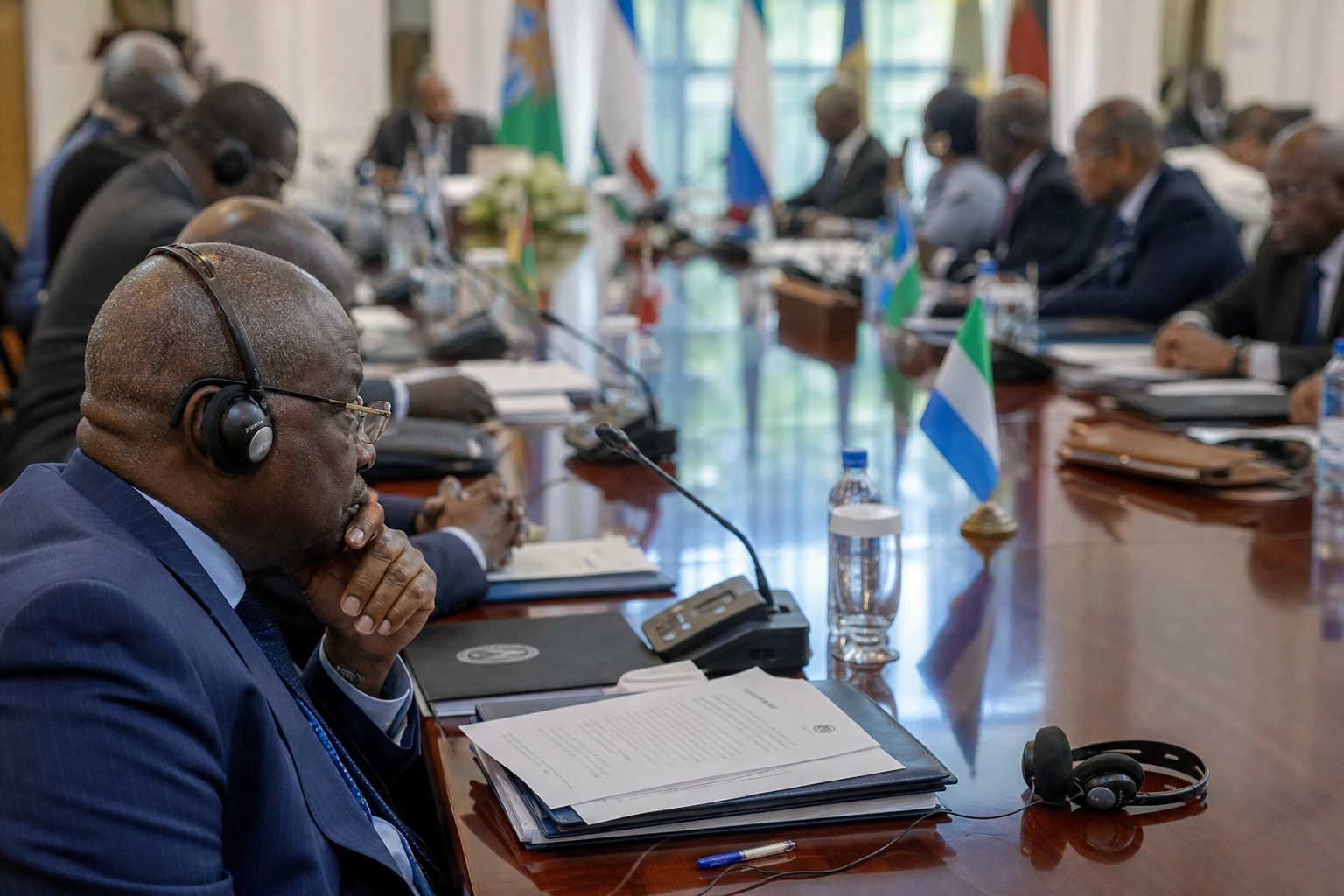
In Freetown, Sierra Leone, ECOWAS heads of state have put the ECO back at the centre of the agenda. The project is back with a date, 2027, and a more cautious approach: start with the countries that are ready, then expand later. This time, the question is not only whether the common currency will be launched. It is also about who can join the first phase, and on what terms.
In a region where trade is still held back by exchange costs, inflation differentials and dependence on foreign currencies, a regional currency would be a major tool for integration. But in West Africa, currency is never just an accounting instrument. It touches on sovereignty, state credibility and the daily lives of businesses, traders and households. The issue is therefore as much about economic policy as public trust.
What ECOWAS has decided, and why the issue remains open
On 19 July 2026, at the Freetown summit, ECOWAS reaffirmed its goal of launching the ECO in 2027. The final communiqué refers to a phased implementation, with an initial group of countries meeting the macroeconomic convergence criteria, including inflation, fiscal discipline and monetary stability. At the same time, the organisation said several questions remain under discussion, notably the structure of the future central bank and decision-making rules. The final communiqué of the ECOWAS summit set this course, while regional media confirmed the option of a gradual launch.
This decision does not come in a vacuum. ECOWAS had already adopted a roadmap in 2021, setting 2027 as its target. But since then, the regional context has become more strained. Burkina Faso, Mali and Niger have left ECOWAS and grouped together within the Confederation of Sahel States. These three countries nevertheless remain in WAEMU, where the CFA franc continues to circulate. This situation complicates the mechanics of a West African currency intended eventually to cover different economic and political realities. ECOWAS now has 12 member states, down from 15 before the Sahelian withdrawals.
Another development drew attention: the registration of the “ECO” trademark with OAPI, the African Intellectual Property Organization, which covers 17 states in West Africa, Central Africa and the Indian Ocean. This registration protects a name, not a currency. But it shows that the project is also advancing on legal and symbolic fronts. In African monetary affairs, this step matters. It prevents another actor from appropriating the name while technical discussions are still incomplete.
Between the CFA franc’s legacy and the demands of a credible union
The debate over the ECO cannot be separated from the history of the CFA franc. In 2019, the eight WAEMU countries agreed to reform their monetary cooperation with France. The BCEAO then explained that the name of the WAEMU currency was to become ECO when the Union’s states joined the new ECOWAS zone. The central bank also said that the centralisation of foreign exchange reserves at the French Treasury would end and that French representatives would leave decision-making bodies, while the fixed parity with the euro and the convertibility guarantee would remain in place. In other words, the reform moved several pieces without dismantling the stability framework that still reassures some decision-makers.
This is where the issue becomes sensitive. For some governments, a common currency could reduce transaction costs, simplify payments and facilitate intra-regional trade. For others, it could become a straitjacket if economies do not converge sufficiently. ECOWAS itself has long struggled with this question. As early as 2019, its experts noted poor performance by states against the convergence criteria and the region’s economies’ vulnerability to external shocks. In 2025, finance ministers and central bank governors reviewed the roadmap again. The idea has therefore never disappeared. It has mainly been pushed from one stage to the next, in line with budgetary and political realities.
BCEAO data help explain why caution remains strong. In its recent projections for WAEMU, the Union’s overall budget deficit is expected to fall from 3.3% of GDP in 2025 to 3.2% in 2026, then to 2.9% in 2027. This trajectory is in line with regional convergence criteria, but it also shows how tight the adjustment remains. A single currency requires more coordinated public finances, lasting discipline and clear solidarity mechanisms. Without these, the ECO could reproduce the imbalances it is meant to correct.
A test for West African integration and the wider West African economy
For businesses, the stakes are tangible. A well-designed regional currency could lower conversion costs, make cross-border invoicing smoother and make the pricing of goods clearer. For markets, it could also reduce monetary uncertainty. But households will see the benefits only if the currency comes with contained inflation, a clear policy and banks able to support the transition. Otherwise, the promise of integration risks remaining abstract.
The informal sector, which is widespread in West African economies, would be directly affected. Small cross-border traders, transport operators, retail importers and the women who run a large share of distribution networks need simple rules and predictable costs. This is where the project could prove meaningful, or fail. A common currency has political value only if it genuinely reduces everyday frictions. Otherwise, it will remain another symbol in a regional space already rich in acronyms and promises.
The continental significance is clear. The ECO is being watched well beyond ECOWAS because it raises the question of whether African monetary integration is feasible in a context of strong national sovereignty and uneven economic cycles. The African Continental Free Trade Area needs more efficient means of payment, but it cannot replace the monetary choices made by regional blocs. In West Africa, the next test will come before the December 2026 summit, with the technical consultations announced by ECOWAS. That is when it will become clear whether 2027 remains a political target or becomes a genuinely credible path.