Algeria
 Egypt
 Libya
 Morocco
 Sudan
 Tunisia
 Benin
 Burkina Faso
 Cabo Verde
 Côte d'Ivoire
 Ghana
 Guinea
 Guinea-Bissau
 Liberia
 Mali
 Mauritania
 Niger
 Nigeria
 Senegal
 Sierra Leone
 The Gambia
 Togo
 Cameroon
 Central African Republic
 Chad
 DR Congo
 Equatorial Guinea
 Republic of the Congo
 São Tomé and Príncipe
 Burundi
 Comoros
 Djibouti
 Eritrea
 Ethiopia
 Kenya
 Madagascar
 Malawi
 Mauritius
 Mozambique
 Rwanda
 Seychelles
 Somalia
 South Sudan
 Tanzania
 Uganda
 Angola
 Botswana
 Eswatini
 Lesotho
 Namibia
 South Africa
 Zambia
 Zimbabwe
Complaints reveal more than a simple network problem
When calls drop, data slows down or coverage disappears at the wrong moment, it is more than a technical inconvenience. It is a very real obstacle to mobile payments, online public services, small businesses and the everyday activities of Gabonese people, in Libreville and across the country’s interior. In Gabon, telecoms service quality is now being treated as a regulatory issue, but also as a question of real access to digital services.
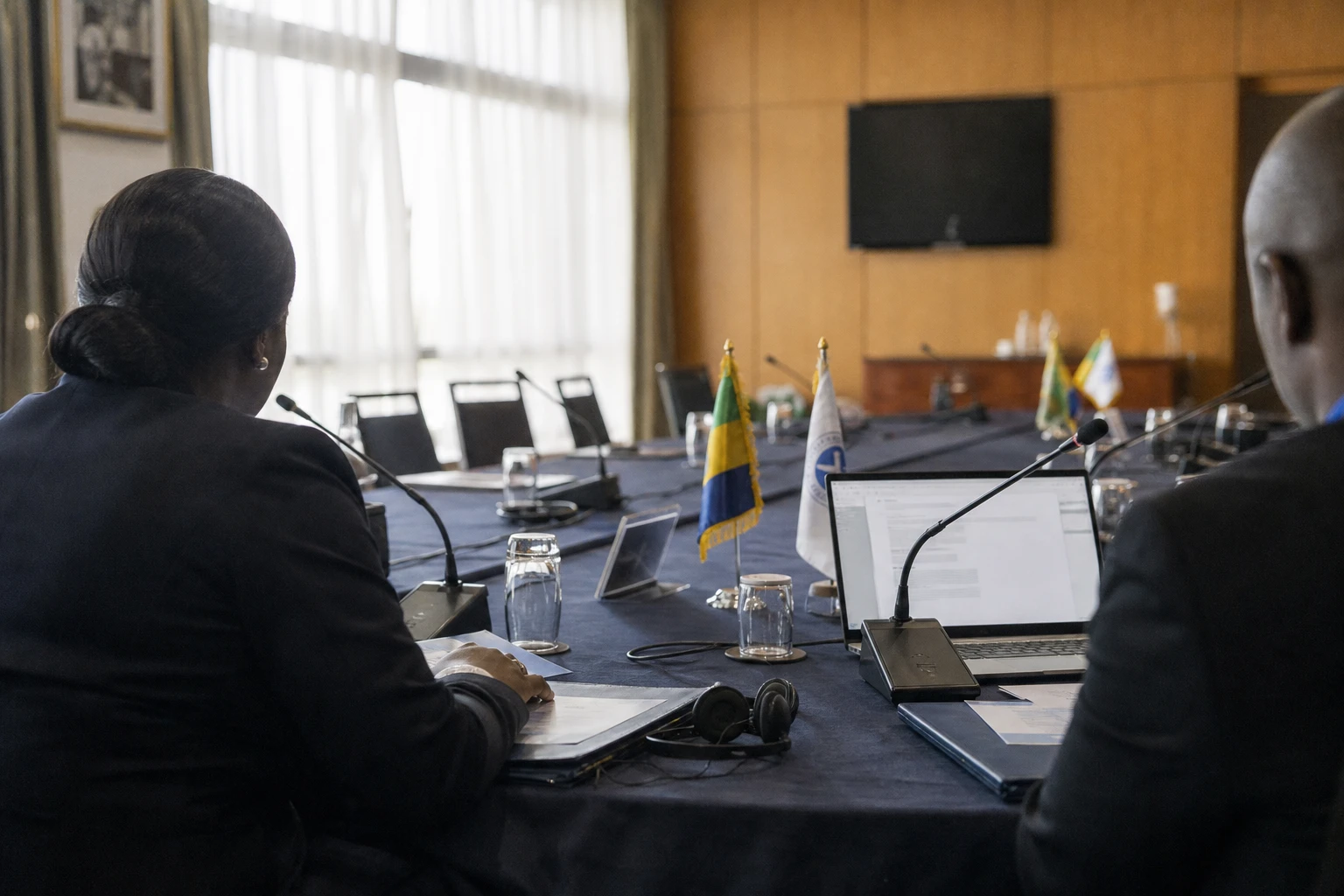
On 20 August 2026, in Libreville, the Regulatory Authority for Electronic Communications and Posts, ARCEP, brought together operators, service providers and consumer associations as part of a wider network-monitoring framework. The timing is significant. In a country engaged in institutional reform since 30 August 2023, the quality of essential services, whether water, electricity or mobile, has become a political as well as an economic indicator.
Libreville refines its regulatory toolkit
The announcement centres on several measures. First, the short number 1331 has been reactivated to inform and guide consumers. The DQoS Gabon app allows users to report incidents and quality problems encountered on electronic communications networks and services. A dedicated email address also receives complaints. ARCEP stresses one simple point: the operator remains the subscriber’s first point of contact, and the regulator steps in when the conditions for referring a complaint have been met.
These channels are complemented by a dialogue committee bringing together ARCEP, operators, service providers and consumer associations. According to the regulator, the body, established by a decision of the Regulatory Council in March 2026, is intended to help identify recurring problems, monitor operators’ commitments and make recommendations. The aim is clear: to move from regulation that is solely reactive to more continuous monitoring, based both on technical measurements and users’ experiences.
This approach follows a course of action already under way. In June 2025, ARCEP summoned a mobile operator after major disruptions were observed on its network in late May, reminding it of its contractual obligations on coverage, continuity of service and quality. In June 2026, the regulator also approved an infrastructure-sharing agreement between Airtel Gabon and Moov Africa Gabon Telecom, presenting it as a step towards more efficient network management. The new monitoring framework therefore extends an existing line of action: monitor, document, correct.
Why service quality is becoming an economic issue
The debate goes far beyond individual convenience. In Gabon, as elsewhere in Central Africa, mobile has become a basic infrastructure. It carries calls, messaging, digital financial services and a growing share of administrative procedures. When connectivity falters, commercial activity, payments and relations between the state and citizens slow down. In urban areas, the issue is often congestion and data instability. In less densely populated areas, coverage and continuity are also concerns.
Gabon’s regulator is following an approach shared by other authorities. France’s ARCEP, for example, publishes mobile service quality surveys and makes its data available as open data. The GSMA, for its part, notes that the quality of a mobile service depends on several factors, including speed, packet loss, latency and jitter, as well as network load, the device and the propagation environment. In other words, perceived quality cannot be reduced to a single signal bar.
For operators, the issue is a sensitive one. Overly rigid regulation can complicate network management. But a lack of monitoring fuels customer dissatisfaction and ultimately weighs on revenue. The GSMA also points out that a good-quality mobile service supports the digital experience, consumer confidence and the adoption of new uses. In Gabon, where infrastructure investment remains a central issue, service quality is therefore becoming a practical test of how effectively spending in the sector is being used.
The regional context adds to the importance of the issue. ARCEP Gabon has recently highlighted its commitment to African digital integration, taking part in a regional workshop in Lagos organised with the ECOWAS Commission, ARTAO and Smart Africa, and then discussing a future extension to the CEMAC zone. Gabon has also reported frequency-coordination agreements with Equatorial Guinea and its involvement in free roaming in CEMAC. In this environment, service quality is no longer a purely national concern: it also affects interconnection, data flows and continuity of the user experience across borders.
A message to operators and users alike
The message to operators is twofold. They must respond more quickly to complaints and document their performance more effectively. They are also being encouraged to make their commitments clearer to subscribers. By reactivating 1331, promoting DQoS Gabon and setting up a dialogue committee, ARCEP aims to bring problems reported on the ground into regulatory decision-making. This is a monitoring method, but also a way to rebalance the relationship between consumers and service providers.
For subscribers, the issue is the ability to assert a simple right: to pay for a service that actually works. This matters all the more as the country’s digital transformation advances. The more administrations, banks and businesses move online, the more network quality becomes a factor of inclusion or exclusion. In Libreville, the pressure is evident in the most connected neighbourhoods. In the provinces, it is often measured by signal stability and the real cost of a service that remains unreliable.
At continental level, the Gabonese case illustrates a distinctly African tension: how to raise service standards without holding back investment or placing the entire burden of outages on users. Gabon’s response is better-equipped regulation, closer to conditions on the ground and more open to dialogue. The next step will be implementation: ARCEP’s ability to use the data, operators’ speed in correcting problems and the committee’s capacity to deliver visible results. In a digital market where trust is built minute by minute, service quality has become a marker of institutional credibility.