Algeria
 Egypt
 Libya
 Morocco
 Sudan
 Tunisia
 Benin
 Burkina Faso
 Cabo Verde
 Côte d'Ivoire
 Ghana
 Guinea
 Guinea-Bissau
 Liberia
 Mali
 Mauritania
 Niger
 Nigeria
 Senegal
 Sierra Leone
 The Gambia
 Togo
 Cameroon
 Central African Republic
 Chad
 DR Congo
 Equatorial Guinea
 Gabon
 Republic of the Congo
 São Tomé and Príncipe
 Burundi
 Comoros
 Djibouti
 Eritrea
 Ethiopia
 Kenya
 Madagascar
 Malawi
 Mauritius
 Mozambique
 Rwanda
 Seychelles
 Somalia
 South Sudan
 Uganda
 Angola
 Botswana
 Eswatini
 Lesotho
 Namibia
 South Africa
 Zambia
 Zimbabwe
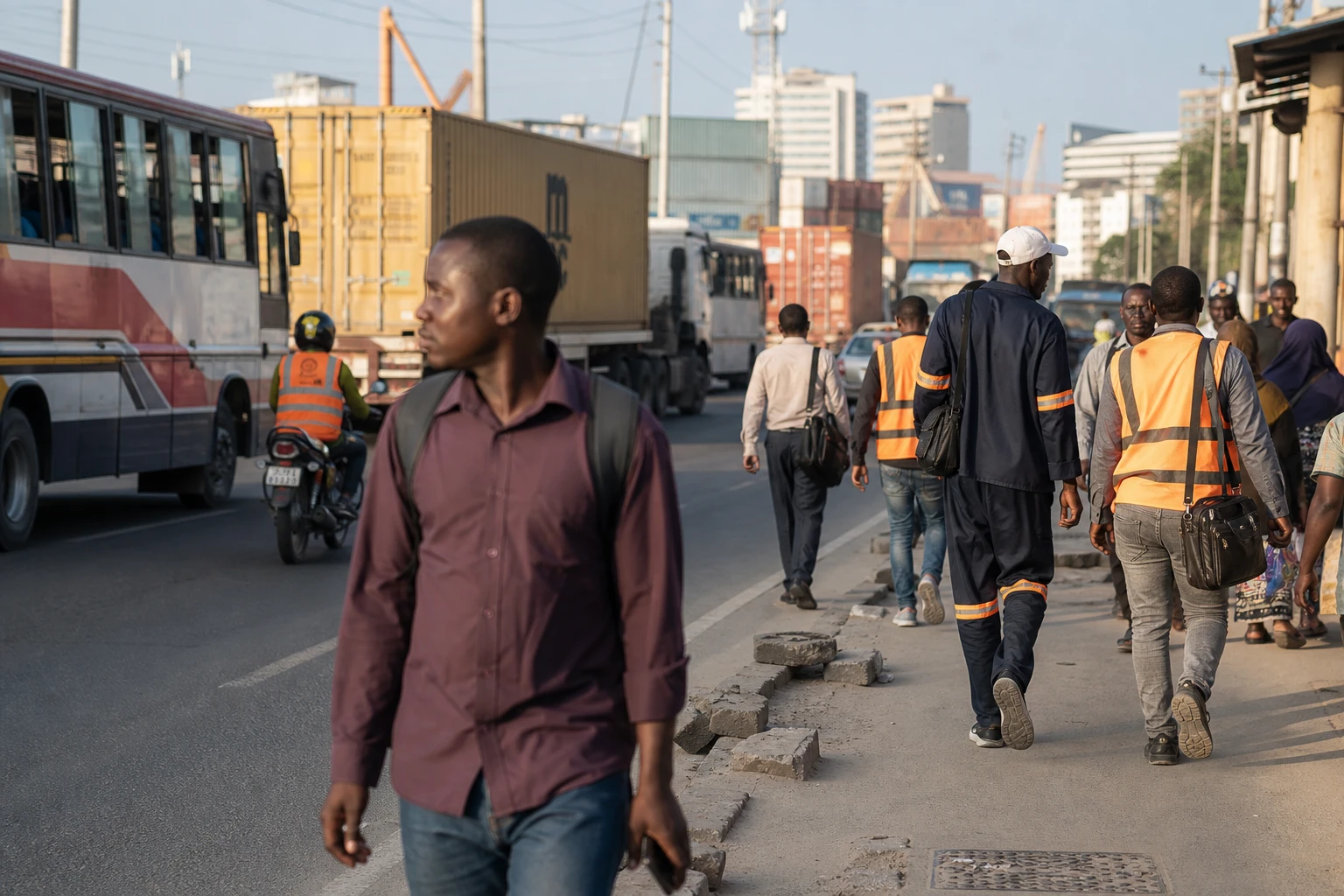
Dar es Salaam, a port at the centre of a regional contest
On the East African coast, a port no longer just handles containers. It also determines the pace of economies, the cost of transport and access to landlocked markets. In Tanzania, Dar es Salaam serves as a strategic gateway for the country and several neighbouring hinterland states, including Zambia, Burundi, Uganda, Rwanda and the Democratic Republic of the Congo. The port handles the bulk of Tanzania’s foreign trade, with a logistics role that extends far beyond the coast.
This expansion is part of a wider regional trend. In the East African Community, corridors have become an issue of economic sovereignty as much as infrastructure. Tanzania and Kenya are competing for flows bound for the continent’s interior, as Mombasa also steps up investment and roads, railways and dry ports reshape value chains.
A new phase of modernisation at Terminal 1
Modernisation of Dar es Salaam’s Terminal 1 began in August 2026, with work commissioned from EDECS Group by DP World, the concessionaire operating this part of the port. The project includes the design and construction of seven cargo-handling yards, covering a total area of 90,000 sq m, as well as associated works, a fire-protection system and high-mast lighting. The stated aim is simple: to handle more cargo and streamline operations.
This phase is part of the concession agreement signed in 2023 between DP World and the Tanzanian authorities. The Emirati group had then announced an initial investment of more than $250 million to modernise the port, with funding that could reach as much as $1 billion over the 30-year concession. The agreement was intended to transform the port’s performance and improve logistics services to the hinterland.
Terminal 1 is not a standalone project. It builds on a longer effort to increase the capacity of Dar es Salaam port. Public documents from the Tanzania Ports Authority state that the port is the country’s main maritime infrastructure, with a stated nominal capacity of 14.1 million tonnes of dry cargo and 6 million tonnes of liquid bulk, while serving about 95% of Tanzania’s international trade.
Figures point to growing pressure
Modernisation is a response to a clear rise in volumes. According to a recent statement from the Tanzania Ports Authority, Dar es Salaam is expected to handle 33.7 million tonnes by the end of the 2025/2026 financial year, up from 27.7 million tonnes over the same period a year earlier. The port has already handled 30.8 million tonnes in the first 11 months of the financial year, showing a clear and sustained increase.
DP World points to another strong indicator: a rapid improvement in productivity at Terminal 1 since it began operations in April 2024. The group says it has cut cargo unloading times by more than 90% and achieved record vessel performance. These figures should be understood as operator data, but they confirm the acceleration that the Tanzanian authorities are seeking.
DP World’s longer-term projections are ambitious. The group expects vessel waiting times to fall from five days to 24 hours, and cargo clearance to drop from 60 hours to about 12 minutes. It also forecasts traffic of up to 47.57 million tonnes by 2032-2033. These targets remain projections, but they indicate the port’s industrial direction: to move from a congested facility to a synchronised one.
Rail, the dry port and the corridor contest
The issue goes beyond the quay. In Tanzania, the port’s competitiveness also depends on how quickly it can move goods inland and into neighbouring states. This is where the standard-gauge railway, or SGR, and the Kwala dry port in the Coastal Region come in. The Tanzanian authorities have launched this inland terminal to ease congestion in Dar es Salaam and better connect the port to the modern rail network.
On 31 July 2025, President Samia Suluhu Hassan officially inaugurated the Kwala dry port and SGR freight service between Dar es Salaam and Dodoma. The event marked an important step in the national integrated logistics strategy, designed to reduce truck queues in the commercial capital and speed up the movement of goods. The authorities describe Kwala dry port as a logistics extension of the seaport, not simply an off-site warehouse.
For economic operators, the stakes are tangible. A faster port reduces the costs of cargo sitting idle, improves delivery times and protects the competitiveness of importers and exporters alike. For road hauliers, however, the shift towards rail and dry ports could redistribute volumes. For Dar es Salaam’s urban residents, it could also ease some of the congestion around port roads.
What this modernisation says about East Africa
The implications extend beyond Tanzania. Across the region, ports are becoming tools of economic integration. Mombasa port also saw a sharp increase in traffic in 2025, confirming active competition between East African maritime hubs. As volumes rise, each country is seeking to secure its corridors, attract transit flows and capture more logistics value.
For Tanzania, there are two challenges. First, it must maintain the pace of investment at Dar es Salaam port. It must then ensure the quay, railway, dry ports and customs services work together. Without this coordination, capacity gains could be lost to bottlenecks on land. With it, Dodoma can pursue a clear ambition: to make Dar es Salaam a credible transit hub for East and Central Africa, rather than merely a national gateway.
The next phase will therefore be judged less by announcements than by delivery. In a regional landscape where every hour saved matters, Terminal 1’s modernisation will be measured by its actual ability to move goods faster without weakening the rest of the logistics chain. That is where Tanzania’s place in regional trade will be determined in practical terms.