Algeria
 Egypt
 Libya
 Morocco
 Sudan
 Tunisia
 Burkina Faso
 Cabo Verde
 Côte d'Ivoire
 Ghana
 Guinea
 Guinea-Bissau
 Liberia
 Mali
 Mauritania
 Niger
 Nigeria
 Senegal
 Sierra Leone
 The Gambia
 Togo
 Cameroon
 Central African Republic
 Chad
 DR Congo
 Equatorial Guinea
 Gabon
 Republic of the Congo
 São Tomé and Príncipe
 Burundi
 Comoros
 Djibouti
 Eritrea
 Ethiopia
 Kenya
 Madagascar
 Malawi
 Mauritius
 Mozambique
 Rwanda
 Seychelles
 Somalia
 South Sudan
 Tanzania
 Uganda
 Angola
 Botswana
 Eswatini
 Lesotho
 Namibia
 South Africa
 Zambia
 Zimbabwe
When deposits grow faster than loans
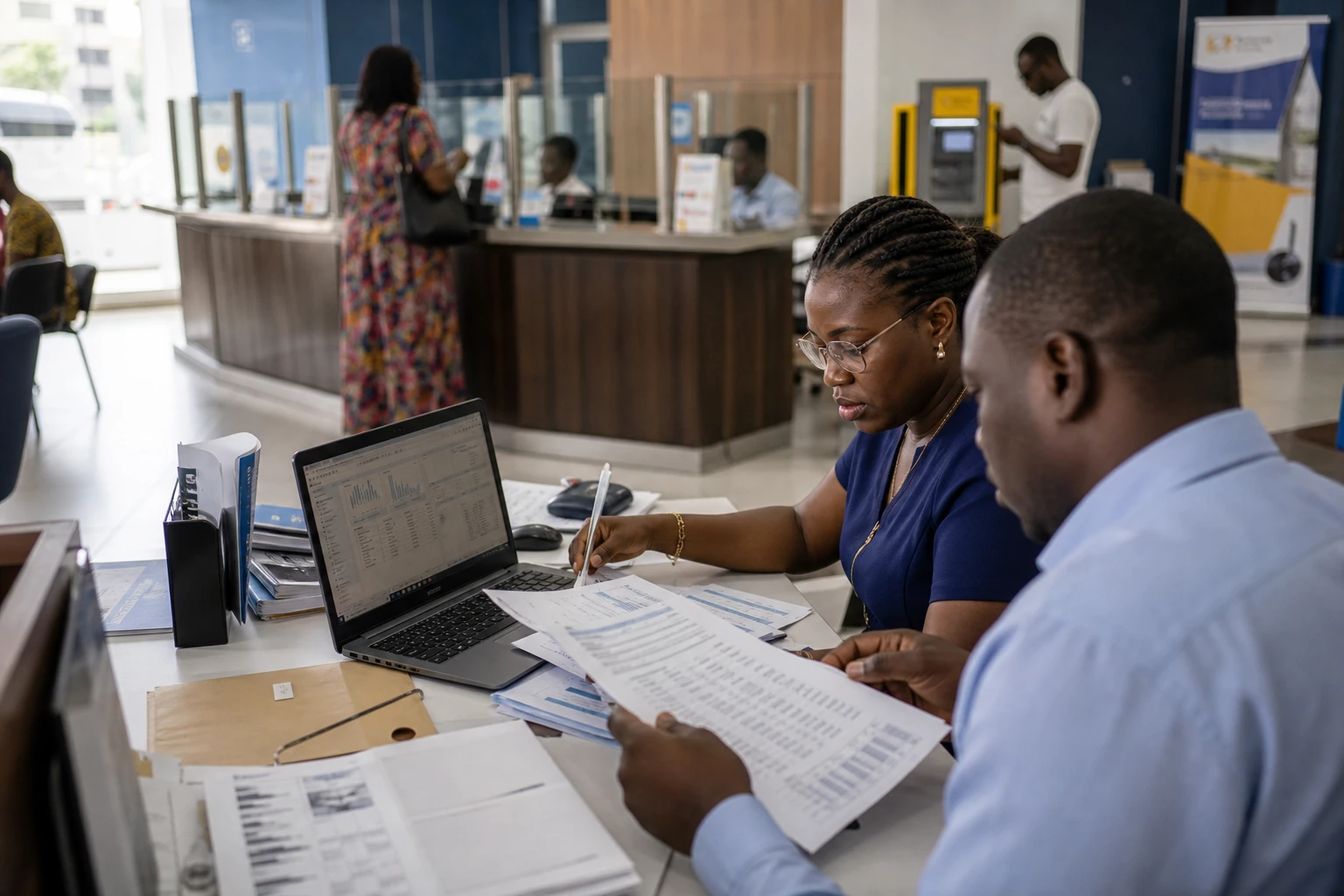
In the West African Monetary Union, bank branches receive more savings than they convert into productive financing. This is a useful signal for understanding the real economy: when bank resources grow faster than loans, the system expands, but this does not automatically boost businesses, households or investment projects.
The WAMU comprises Benin, Burkina Faso, Côte d’Ivoire, Guinea-Bissau, Mali, Niger, Senegal and Togo. Banking supervision is carried out by the WAMU Banking Commission, which is attached to the BCEAO, the joint central bank headquartered in Dakar, while the Commission is based in Abidjan. This regional framework provides a common view of a financial market still highly concentrated in a few centres.
What the 2025 figures show
At the end of December 2025, deposits and borrowings of WAMU credit institutions reached CFAF 56,200.2 billion, up 16.0% year on year. Over the same period, loans to customers rose by just 5.5%, to CFAF 38,731.6 billion. In other words, resources collected grew nearly three times faster than financing extended to customers. The banking system’s total balance sheet stood at CFAF 82,298.8 billion, up 14.1%.
The breakdown helps explain this growth. Demand deposits surged by 21.8% to CFAF 33,142.8 billion, while term deposits and borrowings rose by 8.7% to CFAF 23,057.4 billion. Deposits and borrowings thus accounted for 83.3% of the banking system’s resources. Net equity also increased, by 11.9%, to CFAF 7,765.8 billion, while other resources grew by 37.1% to CFAF 3,493.9 billion.
This trend is not due solely to stronger deposit collection. It also reflects banks’ choices as they strengthen their cash positions, invest more resources in securities and diversify their uses of funds. Other uses of funds rose by 17.1% in 2025, to CFAF 31,384.3 billion, and the securities portfolio reached CFAF 25,796 billion. Securities’ share of uses of funds increased from 35.3% to 36.8%. In practice, this suggests a growing preference for investments that are more liquid or offer more immediate returns than conventional lending.
Lending remains uneven across countries and sectors
Loan growth was not uniform across the Union. Six countries recorded an increase. Côte d’Ivoire led the way, with a rise of CFAF 1,590 billion, or 11.9%. Benin followed with CFAF 283 billion and Senegal with CFAF 280 billion. Guinea-Bissau posted a smaller increase in absolute terms, but a rapid one in percentage terms. By contrast, loans fell by CFAF 184 billion in Burkina Faso and CFAF 67 billion in Niger. The picture is clear: momentum is there, but it remains highly uneven across the eight countries.
| Country | Change in loans to customers in 2025 |
|---|---|
| Côte d’Ivoire | +CFAF 1,590 billion (+11.9%) |
| Benin | +CFAF 283 billion (+8.3%) |
| Senegal | +CFAF 280 billion (+3.6%) |
| Mali | +CFAF 66 billion (+0.9%) |
| Togo | +CFAF 57 billion (+2.4%) |
| Guinea-Bissau | +CFAF 40 billion (+23.1%) |
| Burkina Faso | -CFAF 184 billion (-4.0%) |
| Niger | -CFAF 67 billion (-5.4%) |
Bank financing is also highly concentrated by sector. Three branches account for 66% of loans: commerce, restaurants and hotels lead with 30%, followed by community services and social sectors with 24%, then manufacturing with 12%. This structure limits the role of lending in industrial transformation and in agricultural value chains, particularly in economies where long-term investment needs remain high.
Loan maturities confirm this cautious approach. Short-term loans reached CFAF 17,833.1 billion, up 8.9%. Medium-term loans grew more slowly, to CFAF 17,146.5 billion, a rise of 3.0%. Long-term loans increased by just 0.8%, to CFAF 1,756.3 billion. Banks are therefore financing working-capital cycles above all, and major investments much less.
A useful reading of the regional economy
The concentration of assets reinforces this picture. At the end of 2025, Côte d’Ivoire accounted for 37.9% of the WAMU banking system’s assets and Senegal for 19.2%. They were followed by Burkina Faso with 12.5%, Mali with 11.0%, Benin with 9.2%, Togo with 6.6%, Niger with 3.0% and Guinea-Bissau with 0.6%. The system has 161 licensed credit institutions. In other words, two markets alone account for more than half of regional assets.
For businesses, this configuration matters more than it does for bank balance sheets. In economies dominated by SMEs, informal trade or urban services, the availability of bank resources is not enough. Those resources must also be converted into accessible loans, with suitable maturities and realistic collateral requirements. Without this, banks can report strong deposit collection while remaining cautious about financing investment.
The regional picture is therefore mixed. The WAMU banking system is expanding, its resources are growing and its volumes are increasing. But the structure of lending still points to a cautious market, highly concentrated geographically and focused on sectors that are already well served. The challenge for the region is not simply to mobilise more savings. Above all, it is to turn this liquidity into long-term financing without undermining banks’ prudential balance.