Algeria
 Libya
 Morocco
 Sudan
 Tunisia
 Benin
 Burkina Faso
 Cabo Verde
 Côte d'Ivoire
 Ghana
 Guinea
 Guinea-Bissau
 Liberia
 Mali
 Mauritania
 Niger
 Nigeria
 Senegal
 Sierra Leone
 The Gambia
 Togo
 Cameroon
 Central African Republic
 Chad
 DR Congo
 Equatorial Guinea
 Gabon
 Republic of the Congo
 São Tomé and Príncipe
 Burundi
 Comoros
 Djibouti
 Eritrea
 Ethiopia
 Kenya
 Madagascar
 Malawi
 Mauritius
 Mozambique
 Rwanda
 Seychelles
 Somalia
 South Sudan
 Tanzania
 Uganda
 Angola
 Botswana
 Eswatini
 Lesotho
 Namibia
 South Africa
 Zambia
 Zimbabwe
An age-old resource, a highly topical industrial choice
In the Western Desert, far from Cairo’s pace, Egypt is pursuing a simple strategy: export less raw rock and more processed products. The country wants to derive greater value from its phosphate, a resource available in abundance but still too often sold without local processing. The new Abu Tartour complex is part of this move up the value chain.
The project is significant for a country seeking to diversify its foreign-currency earnings, support its industry and better organise its mining sectors. Phosphate is used mainly in fertilisers, and thus agriculture, exports and part of the region’s food security. In North Africa and beyond, this kind of investment affects the trade balance, as well as Egypt’s place in the agricultural-inputs value chain.
Abu Tartour at the heart of a value chain Cairo wants to keep at home
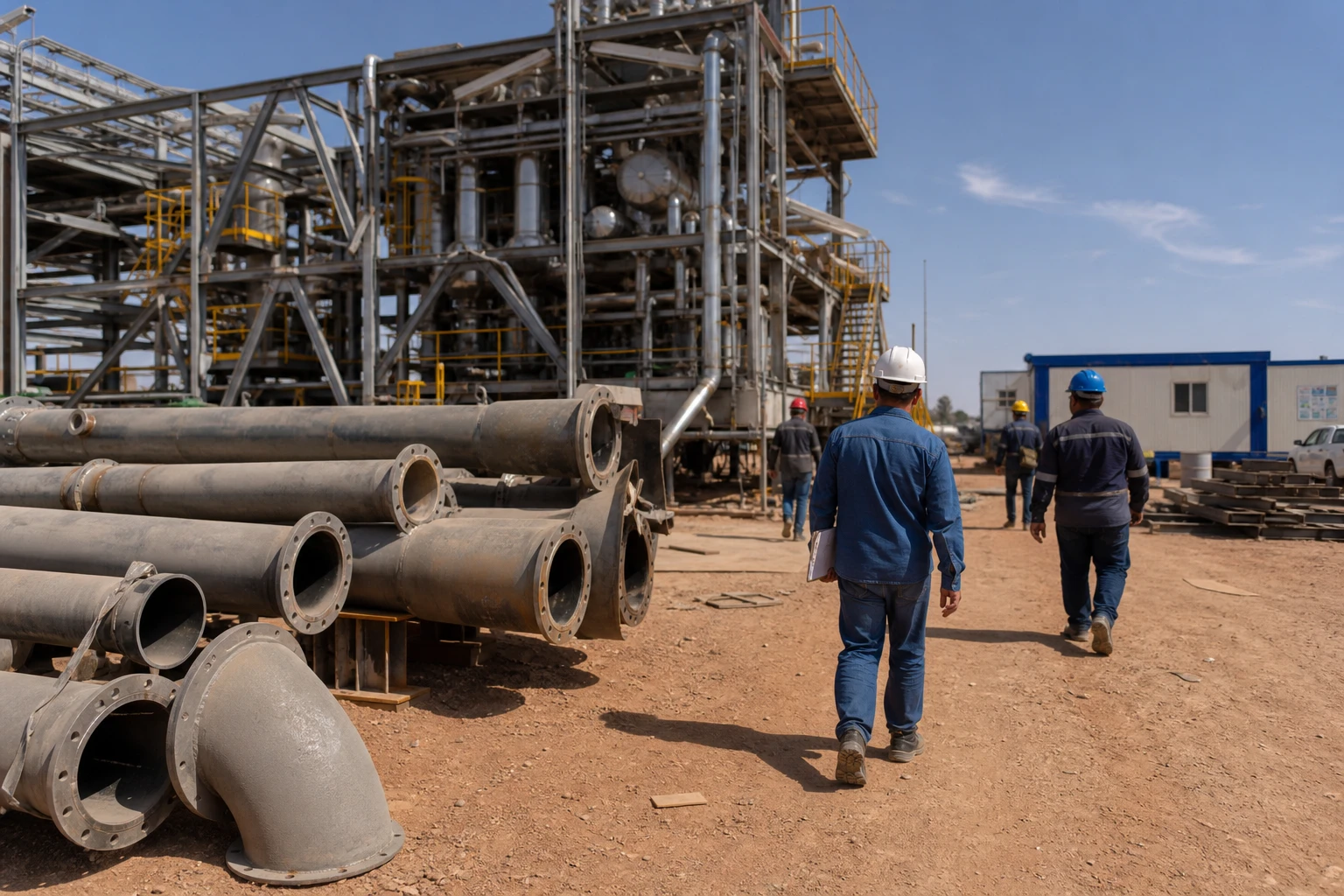
On Wednesday 19 August 2026, Egypt’s Ministry of Petroleum and Mineral Resources announced the laying of the foundation stone for a phosphoric acid production complex at Abu Tartour, in New Valley Governorate. The investment is valued at $658 million. The first phase is expected to produce 250,000 tonnes a year of high-concentration commercial phosphoric acid. Construction is expected to take 30 months.
The project brings together Egyptian public-sector and financial players, including Phosphate Misr, Abu Qir Fertilizers and Chemical Industries Company, Helwan Fertilizers Company, Al Ahly Capital Holding and the National Investment Bank. Engineering and construction have been entrusted to the Chinese groups CSCEC and ECEC. Production is to be shipped to international markets via the Red Sea port of Safaga, generating foreign currency. The ministry also cites more than 3,000 direct and indirect jobs.
The complex has not emerged out of nowhere. Cairo had already announced a phosphoric acid plant project at Abu Tartour in 2019, with CSCEC and Wengfu Group. That earlier, more ambitious plan was valued at about $1 billion and presented as one of the area’s major industrial projects. The 2026 announcement therefore signals a revival, with a revised structure but the same ambition: to process the raw material locally.
What the strategy means for Egypt’s economy
The political message is clear. Minister Karim Badawi has presented Abu Tartour as a symbol of the shift from exporting raw ore to downstream industries—that is, facilities that turn raw materials into higher-value products. The ministry also links the project to a broader reform: transforming the former mining authority into an economic entity to facilitate investment and better integrate mining and industry.
This approach responds to a concrete constraint. In 2024, Egypt was among the world’s leading phosphate rock producers and ranked third globally for reserves, behind Morocco and China. The USGS estimates its reserves at 2.8 billion tonnes. In other words, the country has a rare geological asset, but is still seeking to turn this advantage into sustainable industrial revenues.
The wager is twofold. On the one hand, the government wants to capture more added value and limit exports of raw phosphate. On the other, it hopes to boost exports of fertilisers and chemicals, more profitable sectors that are more useful to macroeconomic stability. The ministry also emphasises job creation and the development of New Valley, a vast, sparsely populated region often far from major decision-making centres. In practice, this could support local activity, subcontractors, transport and services, while leaving the familiar pressures on water, energy and logistics infrastructure unresolved.
The stakes are also social. For the state-owned companies involved, the project is intended to strengthen their position in downstream mining. For private investors, it opens up a market linked to fertilisers and exports. For residents of the Western Desert, the impact will depend above all on the project’s actual ability to hire locally, create lasting economic activity and avoid becoming an isolated industrial enclave. The figure of 3,000 jobs should therefore be read as an announced potential, not an outcome already secured.
Regional significance beyond Egypt’s own market
Across Africa, this project matters beyond Egypt alone. North Africa remains a strategic region for agricultural inputs, Mediterranean and Red Sea ports, and logistics corridors to sub-Saharan Africa and Asia. By investing in local phosphate processing, Egypt is seeking to consolidate its industrial position in a sector where Morocco already dominates the global phosphate fertiliser market.
The continental implications are therefore clear. If Abu Tartour expands, Cairo could strengthen its influence in value chains linked to African agriculture, a central issue as countries across the continent seek to secure inputs and develop industrial capacity. The project is also part of a broader trend seen in Egypt in recent months: prioritising integrated mining projects, attracting international partners and keeping more processing within the country. It is this shift, more than the laying of the foundation stone itself, that will need to be watched in the coming months.