Algeria
 Egypt
 Libya
 Morocco
 Sudan
 Tunisia
 Benin
 Burkina Faso
 Cabo Verde
 Côte d'Ivoire
 Ghana
 Guinea
 Guinea-Bissau
 Liberia
 Mali
 Mauritania
 Niger
 Nigeria
 Senegal
 Sierra Leone
 The Gambia
 Togo
 Cameroon
 Central African Republic
 Chad
 DR Congo
 Equatorial Guinea
 Gabon
 Republic of the Congo
 São Tomé and Príncipe
 Burundi
 Comoros
 Djibouti
 Eritrea
 Ethiopia
 Kenya
 Madagascar
 Mauritius
 Mozambique
 Rwanda
 Seychelles
 Somalia
 South Sudan
 Tanzania
 Uganda
 Angola
 Botswana
 Eswatini
 Lesotho
 Namibia
 South Africa
 Zambia
 Zimbabwe
When silk becomes a language of everyday life
It is rare for work made from fabric scraps, free samples and patient handiwork to find a place in major international collections. Yet that is what has happened with Billie Zangewa, a Malawi-born artist whose work makes domestic gestures a subject of attention and power. Her art does not seek spectacle. It begins in a bedroom, a kitchen, a female body, then quietly widens the frame.
Her trajectory resonates far beyond the studio. It also speaks to a continent where textile forms, long relegated to decoration or craft, are taking a central place in contemporary art. And it speaks to Malawi, often absent from major global cultural narratives, even as artists from the country now move between Johannesburg, Dakar, Paris, London and New York.
A Malawian artist in the South African art world
Billie Zangewa was born in 1973 in Blantyre, Malawi. Institutional biographies describe her as a Malawian artist based in Johannesburg, with periods of residence and work in London. They also note that her career is connected to southern Africa, a region where artistic mobility has a long history and is structured by SADC, the Southern African Development Community. Malawi is a founding member.
She spent her childhood between Zimbabwe and Botswana, then studied fine art at Rhodes University in South Africa, graduating in 1995. This was a significant moment. South Africa was emerging from apartheid and reshaping its institutions, cultural hierarchies and art scene. For a young artist from Malawi, Johannesburg offered a market, networks and broader visibility, but also a tougher field of competition.
Zangewa went on to work at the intersection of fashion, advertising and art. Moving between these worlds helps explain the precision of her compositions and her attention to the relationship between surface and narrative. She did not choose silk as a stylistic flourish. She turned to it out of material necessity, and then discovered its aesthetic potential.
Sewing as a way of speaking out
In the early 2000s, a visit to a fabric supplier in Johannesburg proved a turning point. Zangewa collected silk samples and began assembling them by hand. Her process remains entirely artisanal: preparatory drawing, pattern-making, cutting, pinning and sewing, with no machine. Some pieces are tiny, but the overall effect is expansive, almost painterly.
This choice of textile is no trivial matter. It unsettles a long-established boundary between so-called major arts and so-called minor crafts. It also overturns a familiar expectation in the reception of African artists: that they should first tell stories of war, violence or trauma. Zangewa takes the opposite approach. She puts ordinary life at the centre: preparing a meal, bathing a child, the quiet of an interior. The Smithsonian’s National Museum of African Art, as well as the Centre Pompidou, have highlighted this way of turning serenity into a critical subject.
This position came at a cost at first. In Johannesburg’s art scene, her work could be judged too decorative. But that judgement says more about the blind spots of some markets: work rooted in textiles, care, the home or femininity is still too often undervalued before it is recognised. By bringing these spaces to light, Zangewa does not idealise them; she makes them visible as places where society is made.
From the female body to Black history
In 2010, The Rebirth of the Black Venus marked a turning point. The work engages with Botticelli’s The Birth of Venus, as well as the history of Sara Baartman, a Khoikhoi woman exhibited in Europe in the 19th century in racist spectacles. Here, the nude self-portrait is not gratuitous provocation. It asserts the reclamation of the Black female body by the person representing it.
From then on, Billie Zangewa’s work focused more closely on intimacy as a political space. Motherhood, the home, slow time and the autonomy of the female gaze became her main themes. In Ma Vie en Rose, The Swimming Lesson and Birthday Party, she presents family life as part of a creative continuum. The message is clear: artistic production does not stand in opposition to care; it can coexist with it.
Her work also forms part of a broader examination of the Black body and the roles assigned to women. Choosing tranquil scenes erases nothing; it simply refuses to let the outside gaze alone decide what it means to be an African Black woman in contemporary art. That refusal is itself a political act.
Recognition first internationally, then across the continent
Zangewa’s career took shape on international circuits from the mid-2000s, notably after her participation in the Dakar Biennale in 2006. Her works are now held in major collections, including the Centre Pompidou, Tate, the Smithsonian National Museum of African Art, the Stedelijk Museum in Amsterdam and the Musée d’Art moderne de Paris. She is also represented by galleries in Paris, Brussels, New York, Hong Kong, Seoul and London.
This geography of recognition says much about the contemporary African art market. Dakar, Johannesburg, Paris, London and New York play different roles. Art fairs, biennales and museums on the continent open doors, but validation still often comes through Western centres. Zangewa’s case shows something else, however: an artist can draw on a distinctly Malawian and southern African experience, then establish a language that travels without losing its individuality.
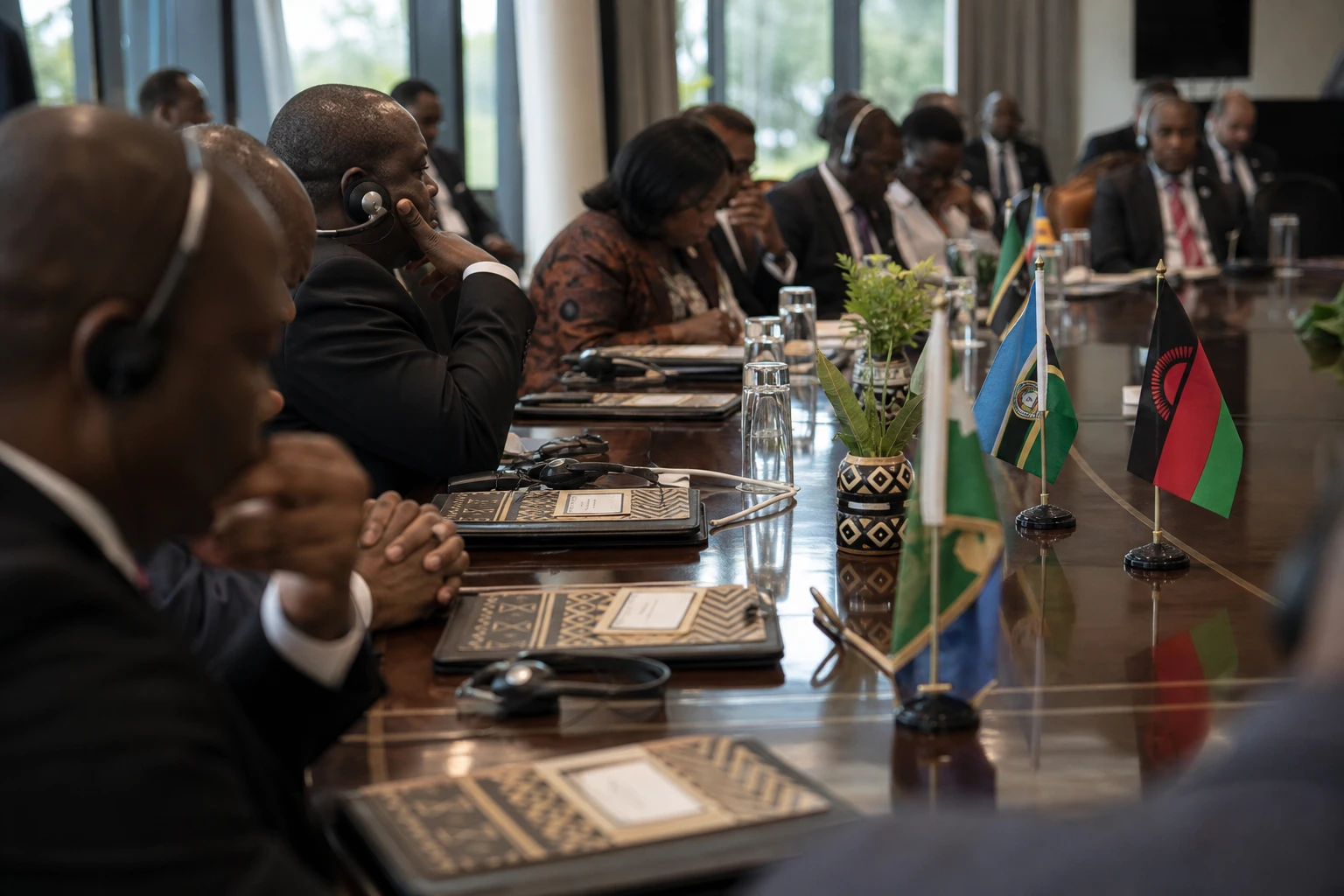
The regional context also matters. SADC, which brings together 16 southern African states, sets out growth, integration, peace and quality of life as its objectives. In this region, cultural exchange accompanies economic and political mobility. Zangewa’s career illustrates this reality: southern Africa is not only a bloc defined by extractive industries or diplomacy, but also a place of creation, education and the circulation of ideas.
For Malawi, this visibility has particular value. It is a reminder that the country cannot be reduced either to its economic vulnerabilities or to narratives imposed from outside. It also produces cultural reference points capable of entering the world’s major collections. For the African art scene, the challenge remains to strengthen these careers without severing them from their local roots. That is where a part of the continent’s cultural narrative is now being shaped.