Algeria
 Egypt
 Libya
 Morocco
 Sudan
 Tunisia
 Benin
 Burkina Faso
 Cabo Verde
 Côte d'Ivoire
 Ghana
 Guinea
 Guinea-Bissau
 Liberia
 Mali
 Mauritania
 Niger
 Nigeria
 Senegal
 Sierra Leone
 The Gambia
 Togo
 Cameroon
 Central African Republic
 Chad
 DR Congo
 Equatorial Guinea
 Gabon
 Republic of the Congo
 São Tomé and Príncipe
 Burundi
 Comoros
 Djibouti
 Eritrea
 Ethiopia
 Kenya
 Malawi
 Mauritius
 Mozambique
 Rwanda
 Seychelles
 Somalia
 South Sudan
 Tanzania
 Uganda
 Angola
 Botswana
 Eswatini
 Lesotho
 Namibia
 South Africa
 Zambia
 Zimbabwe
A diploma is only worth as much as the trust it inspires
In Madagascar, the question is not just who has obtained a diploma. It is broader: who can still prove, beyond dispute, that the documents submitted in an administrative file are genuine? In a country where access to a public-sector job, an equivalence or a promotion often depends on a chain of checks, document fraud undermines the entire machinery of the state. The case uncovered in Antananarivo shows just how easily forgery can infiltrate the most sensitive parts of the system.
Madagascar is seeing a broader offensive against fraudulent practices in education and the civil service. In December 2025, the Independent Anti-Corruption Bureau, BIANCO, launched Operation Fôsika to report fake diplomas and other university irregularities. In spring 2026, the same body documented similar cases in other administrations. The judicial response in Antananarivo, the capital, is therefore part of a verification campaign that goes beyond a single case.
An investigation triggered by a simple request for certification
The case began on 5 August at the Baccalaureate Office in Antananarivo, when a young woman came in to have a copy of a diploma certified. A university official noticed irregularities in her file. According to corroborated information, the candidate had never obtained the baccalaureate and had failed the 2024 session. This initial check then paved the way for a wider investigation, which traced the matter back to what was described as a structured network.
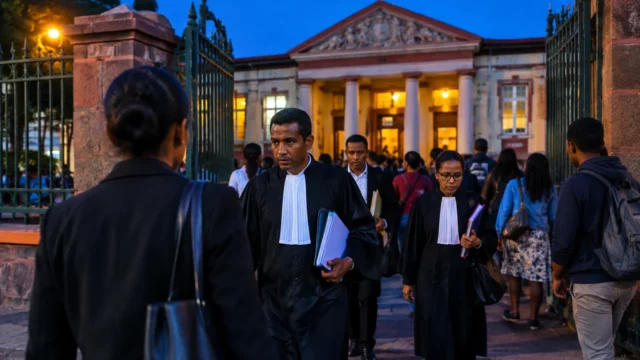
At the centre of the operation, investigators cite the director of a private school, an employee of the Baccalaureate Office and several staff members at the University of Antananarivo. Eleven people are involved in the proceedings, according to the information available. Five officials have been remanded in custody at Antanimora Central Prison, while the candidate is under judicial supervision. Five other employees have been released. In legal terminology, a remand order means pre-trial detention.
The scheme described by the authorities is familiar in several African administrations: a forged document serves as a passport to social advancement, then is added to a recruitment, reclassification or degree-recognition file. In another recent case involving the maritime administration, BIANCO has already described a comparable mechanism, with fake bachelor’s and master’s degrees used to secure unfair professional advantages. This recurrence points less to isolated cases than to a document-fraud market adapting to gaps in oversight.
The anti-corruption drive now extends to schools and universities
This crackdown did not come out of nowhere. On 21 July 2026, the Ministry of National Education and BIANCO signed a new three-year agreement, renewable, to strengthen corruption prevention in the education sector. A few weeks earlier, the authorities had already said they wanted to secure recruitment, human-resources management and public procurement at the ministry. Meanwhile, the ministry responsible for higher education launched the Fôsika platform in December 2025 to report fake diplomas and fraudulent practices.
The logic is clear: if diplomas circulate without reliable checks, the entire hierarchy of merit is thrown off balance. Honest candidates lose a legitimate advantage. Administrations recruit people whose qualifications do not match those claimed. And institutions risk seeing their credibility with the public erode. In Madagascar, where formal employment is scarce and highly competitive, the stakes concern both the quality of public services and young graduates’ confidence in the rules of the game.
The phenomenon is not new. As early as 2017, investigations in Madagascar were already reporting dozens of fake diplomas uncovered in the civil service. In late 2025, a dedicated BIANCO campaign received 272 complaints in one month, suggesting a scale far beyond an individual case. The figures should be treated with caution, as they concern reports, not convictions. But they show one simple thing: diploma fraud is no longer just a rumour. It has become a public issue.
What the case says about Madagascar, and beyond
For families, students and junior civil servants, the stakes are immediate. Tighter checks can slow procedures, but they also protect those who play by the rules. For institutions, the challenge is more delicate: they must impose sanctions without treating every person under review as a suspect. In the Malagasy capital, as in other regions, the message sent by this case is that the administration is trying to regain control of qualifications, equivalences and recruitment.
Madagascar is not alone in the region. The country belongs to SADC, the Southern African Development Community, a bloc where student and professional mobility increasingly depends on the recognition of qualifications. The reliability of diplomas therefore also affects university exchanges, civil-service examinations and the movement of skills. If checks improve, the country strengthens its place in these networks. If they weaken, suspicion spreads across the entire system.
The next steps will play out in court and in the departments responsible for authenticating documents. A public portal for verifying documents issued by the Malagasy authorities already exists, showing that the technical tools are not necessarily lacking. What remains essential is regular use, coordination between administrations and the ability to process files without delay or favouritism. That is where the real significance of a fake-diploma case in Antananarivo will be measured.