Algeria
 Egypt
 Libya
 Morocco
 Sudan
 Tunisia
 Benin
 Burkina Faso
 Cabo Verde
 Côte d'Ivoire
 Ghana
 Guinea
 Guinea-Bissau
 Liberia
 Mali
 Mauritania
 Niger
 Nigeria
 Senegal
 Sierra Leone
 The Gambia
 Togo
 Cameroon
 Central African Republic
 Chad
 DR Congo
 Equatorial Guinea
 Gabon
 Republic of the Congo
 São Tomé and Príncipe
 Burundi
 Comoros
 Djibouti
 Eritrea
 Ethiopia
 Kenya
 Malawi
 Mauritius
 Mozambique
 Rwanda
 Seychelles
 Somalia
 South Sudan
 Tanzania
 Uganda
 Angola
 Botswana
 Eswatini
 Lesotho
 Namibia
 South Africa
 Zambia
 Zimbabwe

In Toamasina, a fuel stock says much more than a simple unloading
In Madagascar, fuel is more than just a commodity. It is a means of ensuring continuity for water, electricity and transport, and ultimately for economic activity in cities and rural areas alike. When a vessel carrying diesel is reserved for JIRAMA, the public water and electricity company, the everyday economy as a whole is at stake in a port.
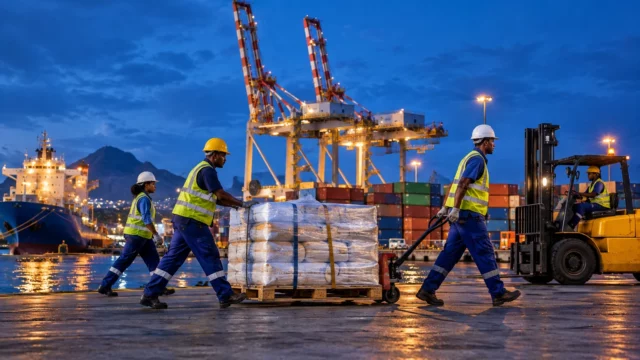
Toamasina port, the country’s main maritime gateway, is where these issues converge. This is where cargoes intended to secure national supplies have been received and unloaded, in a country that imports almost all its refined petroleum products and still relies heavily on thermal power plants to generate electricity.
On 12 August 2026, the Malagasy state received the tanker Sunda 1 in Toamasina, carrying 67 million litres of diesel intended exclusively for JIRAMA. According to available information, this volume is expected to cover around six months of the public company’s needs. The operation comes after the state of energy emergency was reactivated across the national territory on 17 July 2026, amid tensions in the oil market linked to the situation in the Middle East.
This cargo did not arrive by chance. In late July 2026, the authorities opened a new phase of cooperation with Oman on the supply of immediately available fuel. At the same time, the government confirmed its intention to take back control of a downstream sector long structured around private operators, with a clear aim: to prioritise volumes for essential services.
A reform disrupting a sector long driven by private operators
The change of course is based on a reform adopted on 1 July 2026, which provides for the nationalisation of fuel imports previously handled by private operators. This shift does not start from scratch. Madagascar’s downstream oil sector has long operated under liberalisation rules, regulated by the Malagasy Office of Hydrocarbons.
The authorities present this change as a response to the vulnerability exposed by recent shortages. They are seeking to guarantee priority supplies of the diesel needed by JIRAMA’s power plants, to prevent power cuts and difficulties supplying water from becoming more widespread. In practice, the issue is not just a budgetary one. It is also social and political, because outages weigh first on households, small businesses, workshops, local shops and transport operators.
Colonel Michael Randrianirina, head of state of the Refoundation, made immediate supply a stated priority during talks with an Omani delegation on 21 July 2026. The authorities discussed secure access to fuel, as well as water management and the operating needs of public services. This sequence shows that energy is now an issue that extends beyond the ministry directly responsible. It has a direct bearing on the stability of public action.
JIRAMA remains at the heart of the problem. The public company still bears the burden of a generation fleet heavily dependent on diesel and heavy fuel oil. The IMF has already documented the scale of public transfers linked to energy, while other institutional sources note that thermal power plants continue to play a major role in Madagascar’s electricity mix.
In this context, the arrival of the Sunda 1 is as much a logistical test as a political signal. It is intended to show that the state can buy, transport and reserve fuel for a strategic service without disrupting the commercial market or blocking cargoes already scheduled by private operators. This is where the issue becomes concrete: storage capacity, berths, unloading slots and coordination with transport operators matter just as much as the decision itself.
The real challenge: ensuring one public supply chain does not block another
The Madagascar Petroleum Group said that the requisitioning of the oil terminal’s storage capacity on 4 August had complicated the unloading of another cargo expected in Toamasina. The state, for its part, believes the two supply chains can coexist. The first is intended to safeguard an essential service; the second supplies the ordinary market. The problem is therefore less legal than practical: limited port infrastructure cannot absorb an unlimited number of simultaneous arrivals without careful coordination.
This tension also sheds light on the balance of power between the state and the private sector. Oil operators fear that commercial stock replenishment will slow if unloading is poorly coordinated. The authorities, meanwhile, want to show they can protect JIRAMA without leaving the market solely in private hands. For consumers, the questions are simple: the actual availability of fuel, pump prices and the reliability of essential services.
In Antananarivo, where water and electricity cuts have already caused social tensions, the effects are quickly felt. In other regions, the impact is transmitted through transport, distribution chains and the cost of basic goods. Artisans, small traders and informal businesses bear the brunt of delivery delays and increased spending on generators.
The reform is taking place within a broader regional framework. Madagascar is a member of SADC, the Southern African Development Community, and the African Union. In these forums, energy security, resilient supply chains and reduced dependence on imports are recurring issues. For an island such as Madagascar, energy sovereignty also depends on the ability to negotiate quickly, maintain appropriate stocks and secure maritime flows.
The episode’s continental significance is clear. Many African states remain exposed to international energy shocks, even when they are not major importers. Madagascar highlights a shared reality: dependence on refined products, combined with limited infrastructure and constrained public finances, turns every cargo into a strategic issue. The coming weeks will show whether public purchasing can coexist with private imports without creating a new shortage.