Algeria
 Egypt
 Libya
 Morocco
 Sudan
 Tunisia
 Benin
 Burkina Faso
 Cabo Verde
 Côte d'Ivoire
 Ghana
 Guinea
 Guinea-Bissau
 Liberia
 Mali
 Mauritania
 Niger
 Nigeria
 Sierra Leone
 The Gambia
 Togo
 Cameroon
 Central African Republic
 Chad
 DR Congo
 Equatorial Guinea
 Gabon
 Republic of the Congo
 São Tomé and Príncipe
 Burundi
 Comoros
 Djibouti
 Eritrea
 Ethiopia
 Kenya
 Madagascar
 Malawi
 Mauritius
 Mozambique
 Rwanda
 Seychelles
 Somalia
 South Sudan
 Tanzania
 Uganda
 Angola
 Botswana
 Eswatini
 Lesotho
 Namibia
 South Africa
 Zambia
 Zimbabwe
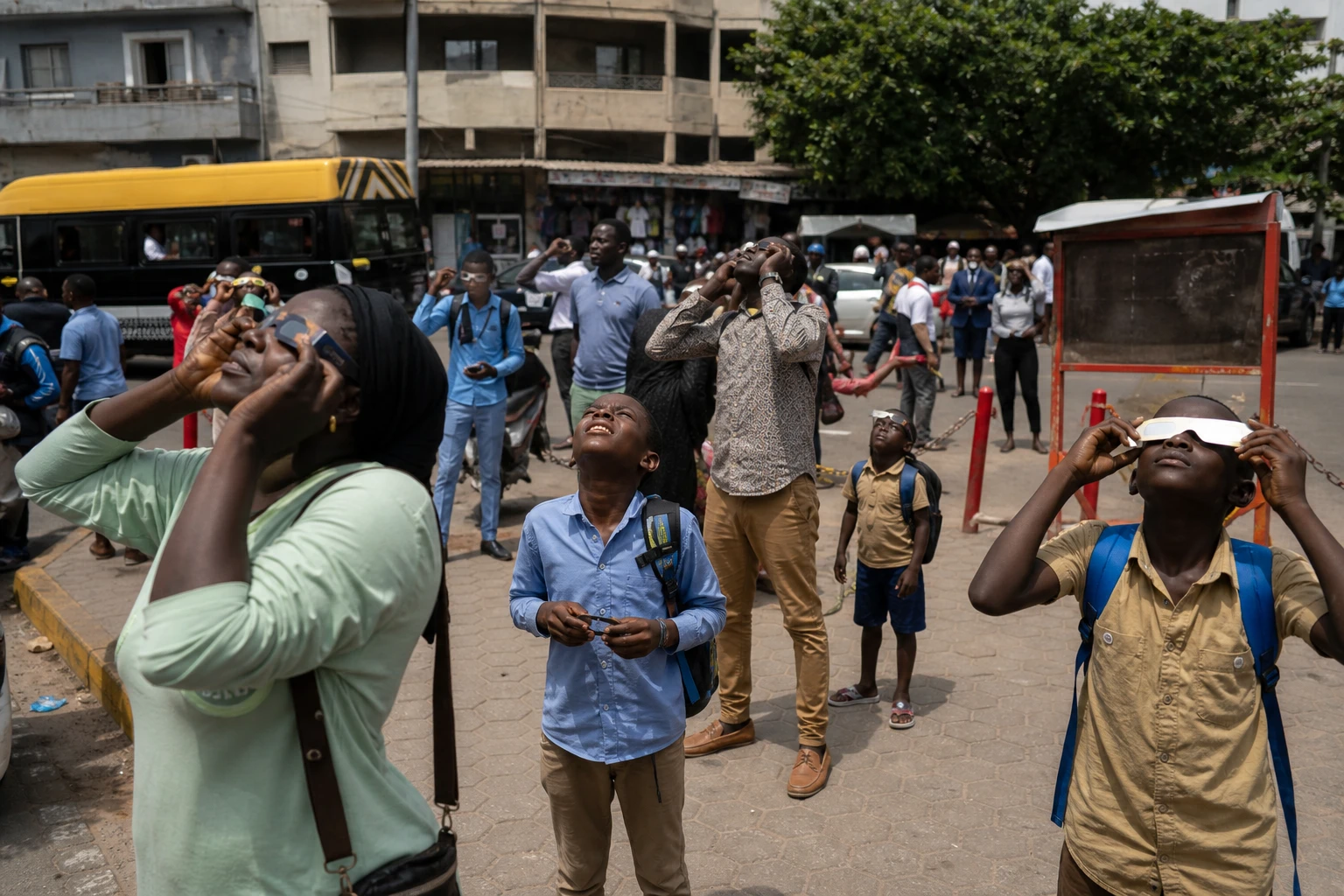
When the sky brings the city to a halt
In Dakar, a celestial phenomenon briefly slowed the usual pace of late afternoon. Residents stopped, looked up and shared the same impulse: to watch together something the city does not see every day. On Wednesday 12 August 2026, a partial solar eclipse was visible in Senegal, with about 37% of the Sun’s disc obscured in Dakar at the time of the observed maximum.
This kind of moment says something beyond the spectacle itself. In a capital where pupils, vendors, motorists, employees and families are all on the move at once, the eclipse creates a shared pause. It is also a reminder that an astronomical event is experienced differently depending on whether people are in the city, its outskirts or a more rural area, where access to information and suitable glasses remains uneven.
A phenomenon visible across a broad swathe of Africa
The eclipse of 12 August 2026 affected a large part of the northern hemisphere, with partial visibility in several countries in Africa, Europe and North America. NASA says Tunis saw about 50% of the Sun obscured, while Dakar reached 37%; Tunisia’s National Institute of Meteorology, for its part, announced a maximum obscuration of 59.06% in Tabarka, in the country’s north-west.
Figures vary according to the observation point, as is normal for a partial eclipse: the percentage depends on the city, the geometry of the alignment and the time chosen for the maximum. In Dakar, independent astronomical calculators put maximum obscuration at around 36.6% to 36.7%, confirming the approximate figure given by NASA.
The phenomenon of 12 August 2026 is part of a series of eclipses closely monitored by scientific institutions. NASA notes that a partial eclipse occurs when the Moon passes between the Sun and the Earth without a perfect alignment, leaving only part of the Sun’s disc visible. In other words, the result is not total darkness, but a marked change in the light, enough to draw crowds.
In Dakar, curiosity is the immediate response
In the Senegalese capital, the occasion went beyond its scientific significance. Passers-by, families and onlookers gathered to watch the sky, often commenting on the drop in light, the shape of the Sun and the need to protect their eyes. This collective response is typical of what major natural phenomena can bring about in urban settings: they create a shared space, however briefly, where public conversation shifts from everyday life to observation.
Senegal is also in a region where astronomy is gaining public visibility, particularly through researchers, science communicators and institutions dedicated to public outreach. This matters. It shows that an event such as an eclipse is not merely entertainment. It can also become an opportunity for education, provided information about timings, risks and safe viewing practices is shared early enough.
On the same day, Tunisia experienced greater obscuration in the north-west than in the central and southern regions, a reminder of an often-overlooked reality: the same event does not have the same intensity everywhere. This is true of astronomy, as it is of access to public services. In Tabarka, the eclipse was more pronounced than in Dakar; elsewhere on the continent, the experience varied further according to latitude and the time of sunset.
What this episode says about Africa’s public space
A partial eclipse is not a trivial subject. It says something about how public spaces are used in Africa today. In a major city such as Dakar, the event can bring together people who do not always cross paths: young people, families, technicians, passers-by and pupils. It can also highlight a very tangible divide between those with access to reliable scientific information and those who receive it only at the last moment.
It is also a reminder of a straightforward public health issue: the Sun must not be viewed without suitable protection. NASA stresses the use of eclipse glasses or appropriate solar filters during the partial phase. In large cities, the risk is often understood. In less connected areas, awareness depends more on local networks, schools, radio stations and institutions on the ground.
The contrast between Dakar and Tabarka also illustrates how the same sky can give rise to several African stories. In Senegal, the eclipse was experienced above all as a shared moment of curiosity. In Tunisia, the National Institute of Meteorology provided precise reference points, particularly for Tabarka. In both cases, institutions provided useful data to accompany the phenomenon, helping to prevent inaccuracies or alarmist claims from spreading.
An event to watch in the regional scientific calendar
The eclipse of 12 August 2026 marks the start of a broader period for skywatchers in North and West Africa. Upcoming events visible in the region will vary by country, but the public interest generated by a phenomenon like this shows that scientific literacy advances when information is presented simply, with local data and clear reference points.
For capitals such as Dakar, these moments have particular value. They offer a rare scene in which science leaves the laboratory and enters the street. They also show that an event observed with the naked eye, even partially, can become a moment of continental conversation between Sahelian countries, North Africa and the Atlantic coast, provided information circulates accurately.