Algeria
 Egypt
 Libya
 Morocco
 Sudan
 Tunisia
 Burkina Faso
 Cabo Verde
 Côte d'Ivoire
 Ghana
 Guinea
 Guinea-Bissau
 Liberia
 Mali
 Mauritania
 Niger
 Nigeria
 Senegal
 Sierra Leone
 The Gambia
 Togo
 Cameroon
 Central African Republic
 Chad
 DR Congo
 Equatorial Guinea
 Gabon
 Republic of the Congo
 São Tomé and Príncipe
 Burundi
 Comoros
 Djibouti
 Eritrea
 Ethiopia
 Kenya
 Madagascar
 Malawi
 Mauritius
 Mozambique
 Rwanda
 Seychelles
 Somalia
 South Sudan
 Tanzania
 Uganda
 Angola
 Botswana
 Eswatini
 Lesotho
 Namibia
 South Africa
 Zambia
 Zimbabwe
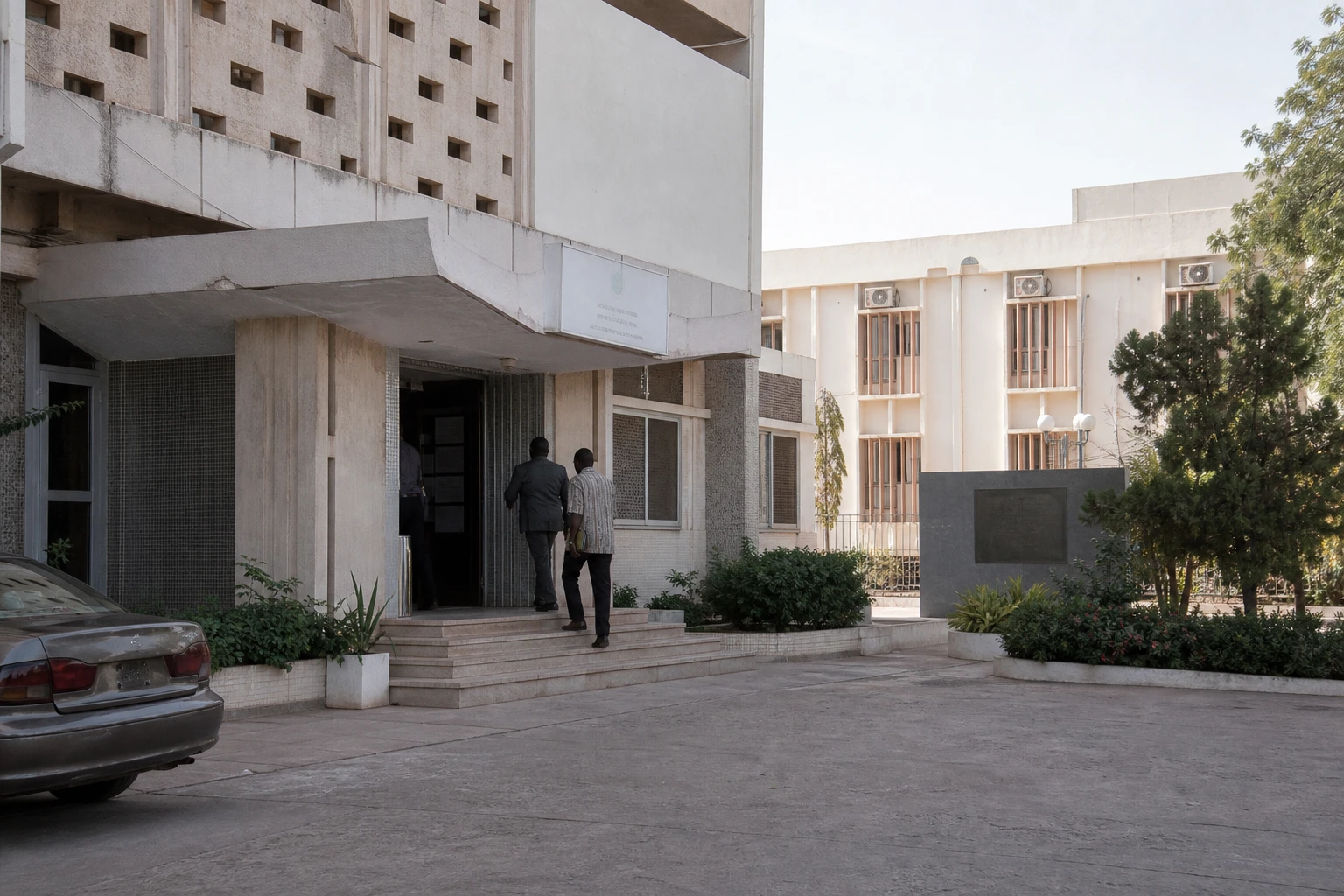
When earth builds, it also tells a story of how people live
In several regions of West and Central Africa, earth has never served merely to close off a wall. It has sustained cities, religious practices, lineages and skills. This is what makes banco architecture so distinctive: it is not simply a relic of the past, but an intelligent response to the climate, social customs and local resources.
From Mali to Benin, Ghana to Cameroon, these built forms are a reminder of an often-forgotten truth: African architectural innovation did not begin with concrete. It is rooted in collective maintenance techniques, the passing down of knowledge within families, and a close understanding of rainfall, heat and soil. This continuity explains the survival of monuments such as the Old Town of Djenné, the Tomb of Askia and the cultural landscape of Koutammakou.
From Djenné to Koutammakou: monuments shaped by a demanding environment
The regional context is clear. In the Sahel, wide temperature swings, the rainy season and erosion call for materials that are flexible, breathable and repairable. Earth architecture meets this need. It relies on communities that maintain buildings rather than freeze them in time. UNESCO also emphasises that the value of these sites lies as much in the buildings as in the practices surrounding them.
In Mali, the Great Mosque of Djenné is the best-known example of this tradition. The Old Towns of Djenné have been on the World Heritage List since 1988. UNESCO notes that the city has been inhabited since 250 BC and developed as a major trading centre on the trans-Saharan route. The current mosque dates from 1907, following a reconstruction carried out under French colonial administration based on plans provided by the architect Ismaïla Traoré. To this day, its upkeep depends on an annual replastering before the rains, a collective practice that is as much a civic ritual as a technical one. The site has been on the List of World Heritage in Danger since 2016.
Mali is also home to the Tomb of Askia, in Gao. UNESCO dates it to 1495, under Askia Mohammed, when Gao became the capital of the Songhai Empire. The monument combines funerary and religious functions. It is a reminder that in West Africa, monumental architecture long served to assert political power as well as spiritual belonging.
Further east, northern Benin and north-eastern Togo share the cultural landscape of Koutammakou, the Land of the Batammariba. Inscribed in 2004 and extended into Benin in 2023, this territory is renowned for its takienta, earth tower-houses that combine living space, storage and ritual functions. The extension approved by UNESCO in 2023 strengthened the site’s historical continuity and confirmed its cross-border character. Here, architecture is not separate from the landscape: it is its grammar.
Fortified homes, roadside mosques and floodplain dwellings: earth as social intelligence
In Burkina Faso, the Royal Court of Tiébélé, added to the World Heritage List in 2024, illustrates another aspect of this architecture. Located at the foot of Tchébili Hill, on the edge of the Ghanaian border, the Kasena people’s architectural complex forms a defensive enclosure. Women decorate the façades with geometric patterns passed down from generation to generation. The site’s value lies as much in its social organisation as in its design.
In Niger, the old Birni quarter in Zinder preserves the palace of the Sultan of Damagaram. Built between 1850 and 1852 during the reign of Suleymane Dan Tanimoune, it is a reminder that a regional capital could be organised around political power, a trading route and an earth architecture that was both restrained and hierarchical. This urban heritage is precious in a country where cities in the south and centre now face intense demographic and climate pressures.
In Ghana, the Larabanga Mosque remains one of the most widely discussed landmarks of Sudano-Sahelian architecture. The Ghana Museums and Monuments Board describes it as the “Mecca of West Africa”. Its date is disputed, but it is generally placed in the 15th century. Restored controversially in the 1970s and then weakened by a partial collapse in 2000, it shows that conserving earth heritage requires specialist skills. Without rigorous maintenance, the monument deteriorates quickly.
Finally, in Cameroon, the famous Musgum mud huts in the Far North tell us much about the ingenuity of floodplain dwellings. The Cameroonian ministry responsible for arts and culture describes them as part of the country’s traditional heritage. These conical structures, made of earth and grass, are designed to withstand flooding from the Logone and to ventilate their interiors naturally. Their highly distinctive shape is also a survival technique adapted to a fragile environment.
What these buildings tell us today: climate, transmission and the local economy
These seven complexes are not merely monumental heritage. They tell the story of a development model based on locally available materials, energy efficiency and community management. This is a highly relevant lesson at a time when African cities are expanding rapidly, cement sometimes dominates without regard for the climate, and vernacular skills are declining for lack of transmission.
The issue is also economic. In Djenné, Zinder and Larabanga, historic architecture attracts visitors and supports guides, craftspeople and small businesses. When security deteriorates or restoration is poorly handled, local incomes disappear. Conversely, when communities remain at the heart of conservation, heritage supports employment, urban identity and civic pride.
Across the continent, these sites are a reminder that African states already possess their own heritage expertise, often carried by communities, national museums, heritage services and UNESCO. The real question, then, is not how to save “exotic monuments”. It is how to protect living systems: walls, certainly, but also hands, songs, gestures and maintenance calendars.
In the Sahel, along the Gulf of Guinea and on the Logone plains, banco is not a sign of a bygone past. It remains a cultural technology. And that is precisely why it deserves to be seen as heritage for the future.