Algeria
 Egypt
 Libya
 Morocco
 Sudan
 Tunisia
 Benin
 Burkina Faso
 Cabo Verde
 Ghana
 Guinea
 Guinea-Bissau
 Liberia
 Mali
 Mauritania
 Niger
 Nigeria
 Senegal
 Sierra Leone
 The Gambia
 Togo
 Cameroon
 Central African Republic
 Chad
 DR Congo
 Equatorial Guinea
 Gabon
 Republic of the Congo
 São Tomé and Príncipe
 Burundi
 Comoros
 Djibouti
 Eritrea
 Ethiopia
 Kenya
 Madagascar
 Malawi
 Mauritius
 Mozambique
 Rwanda
 Seychelles
 Somalia
 South Sudan
 Tanzania
 Uganda
 Angola
 Botswana
 Eswatini
 Lesotho
 Namibia
 South Africa
 Zambia
 Zimbabwe
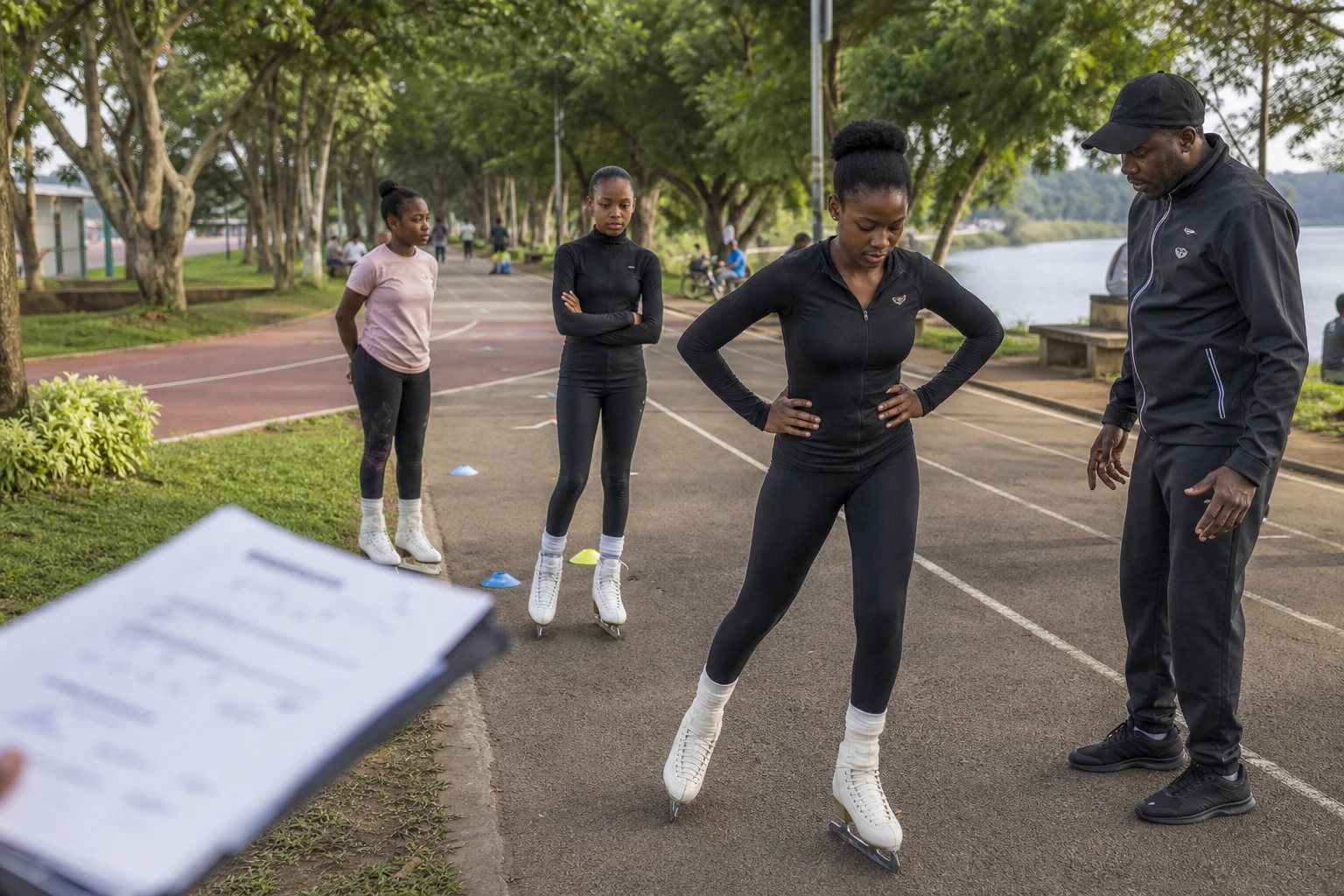
When the ice becomes a stage for representation
In elite sport, the question is not only how to win. It is also how to find your place in an environment that has long told the story of performance through the same faces, bodies and codes. Figure skating illustrates this divide well. In this discipline, which receives extensive media coverage in Europe, an athlete from an African family also tells a story of mobility, integration and high standards. Maé-Bérénice Méité grew up in Vitry-sur-Seine, in the Paris region, in a working-class city that has made its municipal ice rink a genuine place for passing on sporting skills.
Her journey is part of a wider context. In France, families from Côte d’Ivoire, Congo and other African countries have profoundly shaped urban neighbourhoods, sports clubs and educational paths. At the same time, ice sports remain marked by high costs, scarce facilities and highly prescribed representations. In Vitry, the municipality has also fostered this connection between sport, public space and local pride by honouring the skater in a mural, showing how a local facility can become a source of shared stories.
A path forged beyond stereotypes
Maé-Bérénice Méité was born in Paris on 21 September 1994. The sources consulted agree on one point: she is a six-time French individual champion, with national titles won over several seasons, and has represented France at three editions of the Winter Olympic Games: Sochi in 2014, PyeongChang in 2018 and Beijing in 2022. Her best Olympic result remains 10th place in Sochi.
Her family history matters, too. Her parents are from Côte d’Ivoire and Congo. She discovered skating at a very young age in Vitry-sur-Seine, in Val-de-Marne, where the municipal ice rink served as the gateway to a sport she never left. This detail is important: in many suburban towns, access to a quality facility can change a child’s sporting destiny. Here, the ice is not a distant backdrop. It becomes a place of learning, then of ambition.
Yet this path was forged in defiance of stereotypes. European figure skating is still often associated with a highly prescribed image, in which Black women remain scarcely visible at the highest level. The legacy of Surya Bonaly, a French skater of West Indian origin, remains central to this story. She left her mark on the discipline through her international standing, European podium finishes, Olympic appearances and ability to challenge the aesthetic norms of French skating. Méité belongs to this lineage, not as a copy, but as a continuation.
This continuity matters for representation. In sport, Black athletes or athletes of African origin are still too often portrayed as exceptions. But the idea of an exception explains nothing. What explains this story is the combination of several factors: hard work, local support, daily discipline, visibility and the ability to last in a selective environment. In Vitry, the city has extended its recognition beyond her record, linking the skater to its facilities, municipal events and urban identity.
What her journey says about sport, diaspora and social mobility
Méité’s story reveals a broader reality. In African diasporas settled in France, sporting success is often one of the few fields where visibility is immediate. But that visibility comes at a price: it depends on a high level of performance, media exposure that can be reductive, and particular pressure linked to skin colour, origin and the idea of representation. Her journey shows that individual talent can be supported by a strong local environment, but must also contend with external expectations that go beyond sport.
In this context, the phrase she often repeats about the extra effort required of Black women takes on social significance. It does not refer only to personal experience. It says something about how some sporting environments continue to distribute opportunities, attention and legitimacy. This is no abstract reading: it can be seen in the scarcity of role models, the slow pace of change and the need many young people have to see themselves in figures who look like them.
We must also consider what this changes for local communities. In Vitry-sur-Seine, a working-class city in the south-east of Paris, the existence of a municipal ice rink and a club that develops young skaters gives equal access to sport a different meaning. A neighbourhood facility can produce a champion, but it can also sustain social ties, open up opportunities for children and place the city on a less stereotyped map of the suburbs. The mural dedicated to Méité shows precisely this: individual success becomes a shared story when a community chooses to recognise it.
An impact that extends beyond France
Beyond the French case, this journey also resonates across the African continent. It is a reminder that diasporas are not merely communities of departure or arrival. They are spaces of movement, reinterpretation and influence. An athlete born in France to Ivorian and Congolese parents can become a face of European sporting achievement while symbolically carrying an African story of heritage, family courage and social mobility. This kind of journey matters to young people on the continent as well as those in the diaspora. It shows that African visibility is not confined to football stadiums or athletics, the more expected disciplines.
Its continental significance is also political in the broad sense. Questions of representation, access to facilities and legitimacy run through African and Afro-descendant sport. Where public systems invest in local facilities, clubs and qualified coaches, talent emerges more quickly. Where access depends solely on family resources, inequalities are reproduced. Maé-Bérénice Méité’s journey therefore serves as a useful reminder of an obvious truth: diversity is not decreed; it is built. And in sport, as elsewhere, it needs places, resources and visible role models.