Algeria
 Egypt
 Libya
 Morocco
 Sudan
 Tunisia
 Benin
 Burkina Faso
 Cabo Verde
 Côte d'Ivoire
 Ghana
 Guinea
 Guinea-Bissau
 Liberia
 Mali
 Mauritania
 Niger
 Nigeria
 Senegal
 Sierra Leone
 The Gambia
 Togo
 Cameroon
 Central African Republic
 Chad
 Equatorial Guinea
 Gabon
 Republic of the Congo
 São Tomé and Príncipe
 Burundi
 Comoros
 Djibouti
 Eritrea
 Ethiopia
 Kenya
 Madagascar
 Malawi
 Mauritius
 Mozambique
 Rwanda
 Seychelles
 Somalia
 South Sudan
 Tanzania
 Uganda
 Angola
 Botswana
 Eswatini
 Lesotho
 Namibia
 South Africa
 Zambia
 Zimbabwe

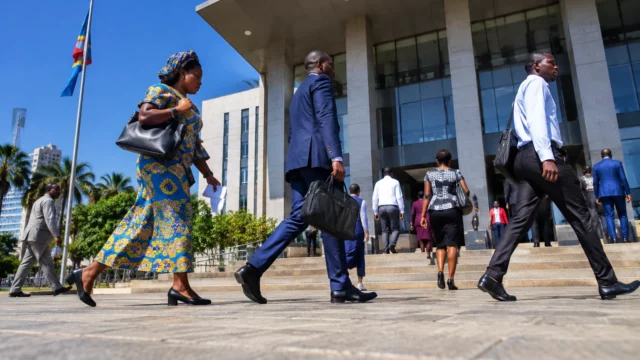
In Kinshasa, constitutional debate runs up against the country’s urgent needs
In the Democratic Republic of the Congo, major political battles rarely take place on neutral ground. They often arise when security, justice and daily life are already demanding the state’s full attention. Against this backdrop, 65 civil society organisations have asked President Félix Tshisekedi not to complete the referendum process. They fear a new legal framework could one day be used to reopen the 2006 Constitution.
The message is clear: for these groups, the priority is not to rewrite the rules of the institutional game, but to address the crises weighing on Congolese people, especially in the east. This view forms part of a long-running debate in Kinshasa over the stability of the constitutional framework, the role of the president and the limits on any revision.
A sensitive text at the heart of a fragile institutional balance
The 2006 Congolese Constitution, amended in 2011, strictly regulates revisions. Article 218 provides that a revision approved by parliament may be put to a referendum at the call of the president of the republic. Article 219 prohibits any revision during a state of war, emergency or siege, as well as in certain other situations of institutional deadlock.
In practice, the bill setting out the conditions for organising a referendum passed constitutional review on 28 July 2026. The Constitutional Court declared it consistent with the Constitution, but attached interpretative reservations to several provisions. Radio Okapi and Actualité.cd confirmed the decision, while Congolese media specified that the text had been adopted after parliamentary review.
This legal and political safeguard is what the 65 organisations gathered in Kinshasa are now challenging. They include LUCHA-RDC, Filimbi, Civil Bridge and Génération Z RDC. They are asking the head of state not to promulgate the law and are calling for inclusive national dialogue, arguing that the country is already facing too many sources of tension to open another institutional front.
What the civil society organisations fear
In their view, the issue is not merely technical. A referendum governed by a specific law could, in practice, become a gateway to broader changes to the constitutional architecture. That is precisely what these organisations want to prevent; they also see a risk that the timetable set out in the 2006 Constitution could be thrown into confusion.
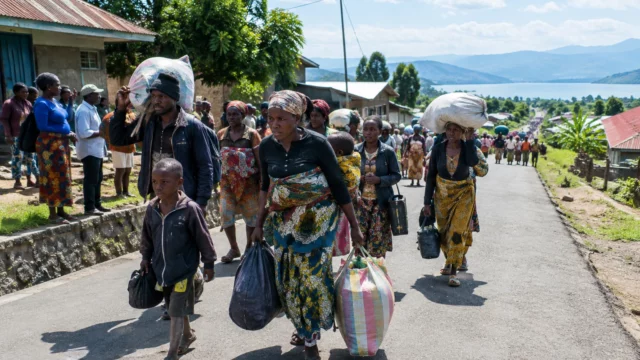
They put forward another, more political argument: the country is not short of urgent issues. Violence in the east, civilian protection, mass displacement and the humanitarian crisis continue to engage the United Nations and humanitarian actors. The UN estimates that nearly 15 million people in the DRC will need humanitarian assistance in 2026, while UNHCR describes a massive and protracted displacement crisis.
In other words, the signatories are not simply challenging a timetable. They are challenging the order of priorities. In their view, the capital can debate a referendum, but the eastern provinces are still living with clashes, impossible returns, blocked roads and weakened public services. MONUSCO reported in April 2026 that fighting was continuing in North Kivu and South Kivu, with persistent threats to civilians.
The government defends the need for a legal framework
The presidential party, the UDPS, supports the law. Its position is straightforward: a referendum cannot be improvised. A legal framework is needed to organise it and fill a gap, according to this view. The president’s camp therefore stresses the need for a clear procedure, rather than focusing solely on the political substance.
This disagreement reflects a recurring tension in Congolese institutional life: on one side, the stated desire to modernise or adjust institutions; on the other, the fear that reform could be used to shift the constitutional boundaries. This concern has grown over recent months, as several political and social forces in Kinshasa have warned of a possible drift towards revising the Constitution.
The Constitutional Court’s ruling has therefore not ended the controversy. It has merely shifted the debate to the next stage: promulgation, followed by the law’s practical use. In a political system where trust between institutions, the opposition and civil society remains weak, every article becomes a potential fault line.
Significance beyond Kinshasa
Beyond the DRC, the case matters across Central Africa. How Kinshasa handles it will say much about the strength of constitutional revision mechanisms in a region where debates over terms of office, transitions and the balance of power remain sensitive. It will also show whether citizen consultations can still carry weight against the calculations of a majority.
The DRC is not only a large country in crisis. It is also a pivotal state for regional stability, for SADC and for the balance of power in Central Africa. When a constitutional debate gains momentum there, its impact is quickly felt beyond the country’s borders. Neighbours, partners and regional organisations will be watching for a simple signal: will the country prioritise institutional de-escalation, or open a new, high-risk political front?
The answer now depends on the president’s next move. Between promulgating the law, maintaining the course on inclusive national dialogue announced on 17 July 2026, and facing pressure from civil society to address more urgent priorities, Kinshasa faces a decisive political choice.