Algeria
 Libya
 Morocco
 Sudan
 Tunisia
 Benin
 Burkina Faso
 Cabo Verde
 Côte d'Ivoire
 Ghana
 Guinea
 Guinea-Bissau
 Liberia
 Mali
 Mauritania
 Niger
 Nigeria
 Senegal
 Sierra Leone
 The Gambia
 Togo
 Cameroon
 Central African Republic
 Chad
 DR Congo
 Equatorial Guinea
 Gabon
 Republic of the Congo
 São Tomé and Príncipe
 Burundi
 Comoros
 Djibouti
 Eritrea
 Ethiopia
 Kenya
 Madagascar
 Malawi
 Mauritius
 Mozambique
 Rwanda
 Seychelles
 Somalia
 South Sudan
 Tanzania
 Uganda
 Angola
 Botswana
 Eswatini
 Lesotho
 Namibia
 South Africa
 Zambia
 Zimbabwe
A new signal for Egyptian industry
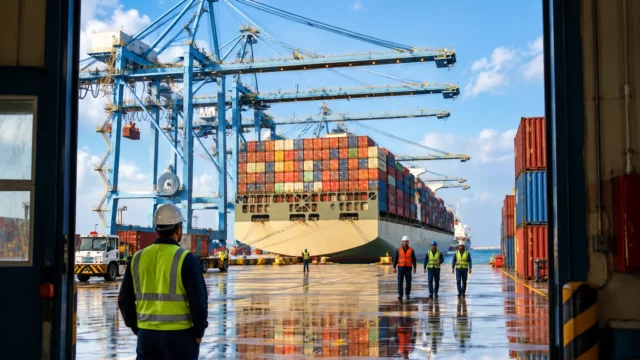
In the Suez Canal Economic Zone, the battle is no longer being fought only on quays and among containers. It is also being fought in workshops, where lead times, quality and added value are determined. For Egypt, the stakes are clear: produce more, export more and capture a larger share of global textile and garment supply chains.
This movement is part of a trend that is already well under way. For several months, the industrial zone of Qantara West has been attracting Chinese, Turkish, Greek and German capital, all focused on exports. The zone, administered by the Suez Canal Economic Zone, was designed as a manufacturing hub connected to ports, making it useful for Mediterranean, European and Middle Eastern markets.
What the Jasan Group project entails
The project announced by Jasan Group involves an integrated textile complex in Qantara West, in the Suez Canal Economic Zone. The information provided refers to an investment of $117 million. The official announcement consulted in December 2025, however, put the figure at $100 million. This discrepancy is worth noting. In either case, it is a major industrial project, covering 300,000 sq m and to be carried out in three phases.
The complex is to bring together several links in the supply chain: spinning, weaving, garment-making, sportswear, socks, accessories, dyeing and the manufacture of seamless products, a technical segment that features prominently in modern garment exports. According to information made public, the project aims to create around 6,000 direct jobs in the long term and to send 90% of its production to international markets. This confirms an export-oriented factory model, rather than one focused solely on Egypt’s domestic market.
Geography matters as much as the investment amount. Qantara West is in an area designed to bring industrial units closer to the Suez Canal’s logistics corridors. For a textile investor, this location cuts dispatch times, facilitates export flows and brings production closer to consumer markets. This is also one reason why the zone has seen a series of agreements in the sector since 2025.
Why Cairo is backing the sector
The Egyptian government is seeking to make textiles and ready-to-wear clothing a more robust engine of growth. Figures published by the Clothing Export Council show a clear rise: ready-to-wear exports increased by 15% in the first four months of 2026, to $1.15 billion, compared with $1.002 billion over the same period in 2025. For the whole of 2025, they reached $3.394 billion, according to the same sources.
Against this backdrop, the targets set for 2026 and 2030 are ambitious. The sector is aiming for $4.4 billion in exports in 2026, followed by $11.5 billion a year by 2030. The idea is simple: turn an activity with a long history in Egypt’s economy into a source of foreign currency, jobs and industrial integration. The textile sector is indeed structured around several public and private players, including the Textile Export Council of Egypt, established to support and promote the sector’s exports.
The signal being sent to foreign investors is significant. Since April 2026, the SCZONE has also announced an agreement with two Turkish companies for a garment factory in the same zone, covering 21,000 sq m, with 90% of production destined for export and around 700 jobs expected. Textile contracts in Qantara West have therefore followed one another in 2025 and 2026, showing that the authorities are seeking to create a complete ecosystem rather than a collection of isolated projects.
The practical impact and regional significance
For Egypt, the expected benefits are threefold. First, direct and indirect jobs. Second, foreign-currency earnings. Finally, industrial upgrading, since integrated textile production makes it possible to retain more value locally, from fibre to finished garment. This is particularly strategic in a country where the import bill and the search for foreign currency remain major economic policy concerns.
For workers, the impact will depend on the commissioning schedule, skill levels and the social conditions offered by subcontractors. For exporters, reliability is key: lead times, quality and the ability to fulfil orders from major brands. For public authorities, the challenge will be to maintain the zone’s appeal without letting it become merely a low-margin subcontracting platform. This is where local added value, inputs made in Egypt and skills development become decisive.
The significance, however, extends beyond Egypt. In North Africa and around the Mediterranean, several countries are seeking to capture the partial relocation of supply chains. Egypt has a rare logistical advantage here: direct access to the Suez Canal, and therefore to a global trade corridor. At continental level, this type of investment also fuels competition among African industrial hubs, while the AfCFTA, the African Continental Free Trade Area, has yet to deliver its full impact on intra-African trade.
The next point to watch will be the actual pace of implementation across the three phases and the ability of the Qantara West zone to absorb these projects without infrastructure, training or supply-chain bottlenecks. If the announcements translate into stable production, Egypt will be able to consolidate a leading textile export hub in the region. If delays mount, the risk will be a proliferation of promises without a lasting transformation of the industrial structure.