Algeria
 Egypt
 Libya
 Morocco
 Sudan
 Tunisia
 Benin
 Burkina Faso
 Cabo Verde
 Côte d'Ivoire
 Ghana
 Guinea
 Guinea-Bissau
 Liberia
 Mali
 Mauritania
 Niger
 Nigeria
 Senegal
 Sierra Leone
 The Gambia
 Togo
 Cameroon
 Central African Republic
 Chad
 DR Congo
 Equatorial Guinea
 Gabon
 Republic of the Congo
 São Tomé and Príncipe
 Burundi
 Comoros
 Djibouti
 Eritrea
 Ethiopia
 Kenya
 Madagascar
 Malawi
 Mauritius
 Mozambique
 Rwanda
 Seychelles
 Somalia
 South Sudan
 Tanzania
 Uganda
 Botswana
 Eswatini
 Lesotho
 Namibia
 South Africa
 Zambia
 Zimbabwe
When waste becomes raw material
In Luanda, a generation of artists looks at markets before looking at museums. In the second-hand clothing stalls, they see more than a trade that helps people survive: a mirror of global excess, but also a space for invention. It is here that Angolan artist Ana Silva has developed a distinctive visual language, combining painting, sewing, embroidery and salvaged materials. Her work is part of an artistic scene that engages with Lisbon, Paris, Milan and Madrid, while remaining firmly rooted in the Angolan experience.
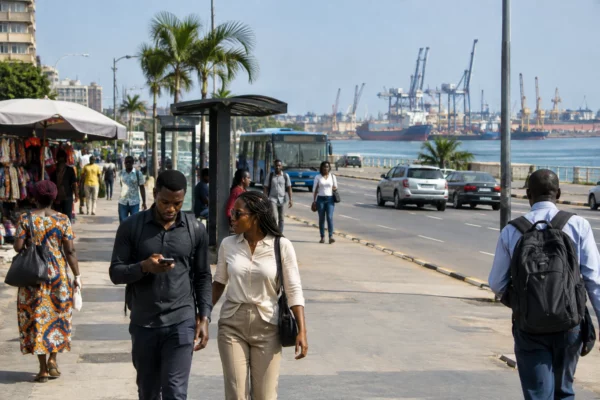
This perspective takes on particular significance in Angola, a founding member of SADC, the Southern African Development Community. Luanda is not only the political capital; it is also a trading hub where popular markets absorb a visible share of imported second-hand clothing. Available trade data show that Angola continues to import second-hand goods, with recorded flows from several partners, including South Africa and Brazil. At the same time, regional authorities and the United Nations are now promoting a more structured circular economy, to turn waste into resources rather than a burden for African cities.
A journey between Luanda and Lisbon
Ana Silva was born in Angola and studied in Lisbon at AR.CO, an independent art school where she developed her skills in drawing, painting and art history. Available sources place her residence and part of her work in Lisbon, while also noting her attachment to Luanda and to the material landscapes of her country of origin. This movement between the two shores of the Atlantic is not just a backdrop: it shapes her practice.
In her work, she uses woven plastic bags, canvas, wood, metal, acrylic and, above all, used fabrics. A work listed in 2023 shows her embroidering on woven plastic bags, while several collection and gallery records describe a practice centred on discarded materials, reclaimed textiles and the memory of places. This is therefore more than a formal investigation. It is a way of giving voice to objects already condemned by the throwaway economy.
Her relationship with textiles also has its roots in childhood. She says she learned embroidery from her grandmother, in a tradition closer to Portuguese influence, involving lace and crochet. She later shifted this practice to the sewing machine, a tool often associated with men in Angolan craftwork. This change matters. It does not only alter the technique; it also shifts roles. The artist works with embroiderers, mostly from Congo according to her account, turning a craft skill into a space for collaboration.
Used textiles, popular economies and the ecological crisis
Her work begins in African markets, where second-hand clothes from far away are sold. The artist describes these garments as discards rather than simply second-hand goods. She points to a reality increasingly documented by international organisations: the influx of used textiles can support jobs and provide affordable clothing, but it also generates large volumes of waste when items cannot be sold or are too damaged. The United Nations Environment Programme is now working on distinguishing reusable textiles from those destined for disposal, a sign that the issue reaches far beyond the art world.
In Angola, this economy is not abstract. A recent economic article on the second-hand clothing market discusses the pressures created by import taxes and exchange-rate fluctuations, which complicate the margins of importers and resellers. A 2024 NGO report also notes that the used-clothing sector supports a large number of people, from transport workers to market sellers. For Ana Silva, this commercial chain reveals a contradiction: what arrives in the Global South as “recycling” can be experienced locally as a form of dumping.
Her work does not merely illustrate this contradiction. It gives it material form. Tablecloths, kitchen accessories, scraps of fabric and plastic bags all become image-bearing surfaces. The works are often large. Empty spaces matter as much as the embroidered surfaces. The result creates visual breathing room, while also leaving space for unease. The beauty of the piece does not erase the violence of the economic circuit it evokes.
A woman’s voice, a wider social issue
In Ana Silva’s account, the personal and the political move forward together. She speaks of a difficult experience of motherhood, a period of disorientation, and then a return to a renewed creative practice. This is not incidental. It speaks to the fragility of women artists’ careers when they encounter family responsibilities, a lack of recognition or professional isolation. In her words, Angolan women remain central: they hold households together, yet society still gives them little visibility. This perspective echoes a broader point often made by African women artists themselves: art is not only a space for expression, but also a place to speak out.
The subject also touches on the local reception of contemporary art. Sources agree on one point: Ana Silva was initially better received abroad than in Angola, where a practice that departs from classical painting can still be disconcerting. This gap says a great deal about how artistic forms circulate on the continent. A work created in Luanda may be understood in Paris or Lisbon before it is fully read at home. This does not diminish its strength; rather, it reveals the uneven paths of cultural recognition.
But her work is not limited to observing what is lacking. It proposes another way of looking. Where the market sorts, discards or throws away, she preserves, assembles and passes things on. Where the circulation of textile goods can fuel dependency, she creates new value from what seemed lost. This approach aligns with the continent’s current shift towards circularity. The African Union has launched a circular economy action plan for 2024-2034, and SADC emphasises regional cooperation and productive transformation. In this context, Ana Silva’s art acts as a sensitive form of economic education.
The reach of this approach extends beyond the studio. It speaks to urban Angola, Luanda’s markets, women who keep families going, embroiderers working with sewing machines, young artists seeking paths beyond academic frameworks, and an entire region grappling with the weight of second-hand imports. What is at stake here is not merely aesthetics. It is the possibility for African creativity to turn the world’s leftovers into its own story, without apology, without reducing itself, and without waiting for external validation to exist.