Algeria
 Egypt
 Libya
 Morocco
 Tunisia
 Benin
 Burkina Faso
 Cabo Verde
 Côte d'Ivoire
 Ghana
 Guinea
 Guinea-Bissau
 Liberia
 Mali
 Mauritania
 Niger
 Nigeria
 Senegal
 Sierra Leone
 The Gambia
 Togo
 Cameroon
 Central African Republic
 Chad
 DR Congo
 Equatorial Guinea
 Gabon
 Republic of the Congo
 São Tomé and Príncipe
 Burundi
 Comoros
 Djibouti
 Eritrea
 Ethiopia
 Kenya
 Madagascar
 Malawi
 Mauritius
 Mozambique
 Rwanda
 Seychelles
 Somalia
 South Sudan
 Tanzania
 Uganda
 Angola
 Botswana
 Eswatini
 Lesotho
 Namibia
 South Africa
 Zambia
 Zimbabwe
In Khartoum, the display of armoured vehicles signals more than a simple reinforcement
In Sudan’s war, political signals are now conveyed through military convoys and parades as well. In Khartoum, the display of new armoured vehicles served as a clear message: the army wants to show that it is taking the initiative, as the front shifts towards Kordofan and Darfur, two regions that have become decisive to the outcome of the conflict. The display comes as fighting remains intense around Al Obeid, in North Kordofan, and population movements towards Chad continue.
Sudan is entering a phase in which the war can no longer be read solely through the front lines, but also through the regional alliances that support or constrain it. The stakes are not only military. They also concern the country’s sovereignty, the flow of aid and the diplomatic balance between Gulf players, African neighbours and continental institutions.
Sudan’s conflict is becoming increasingly regionalised
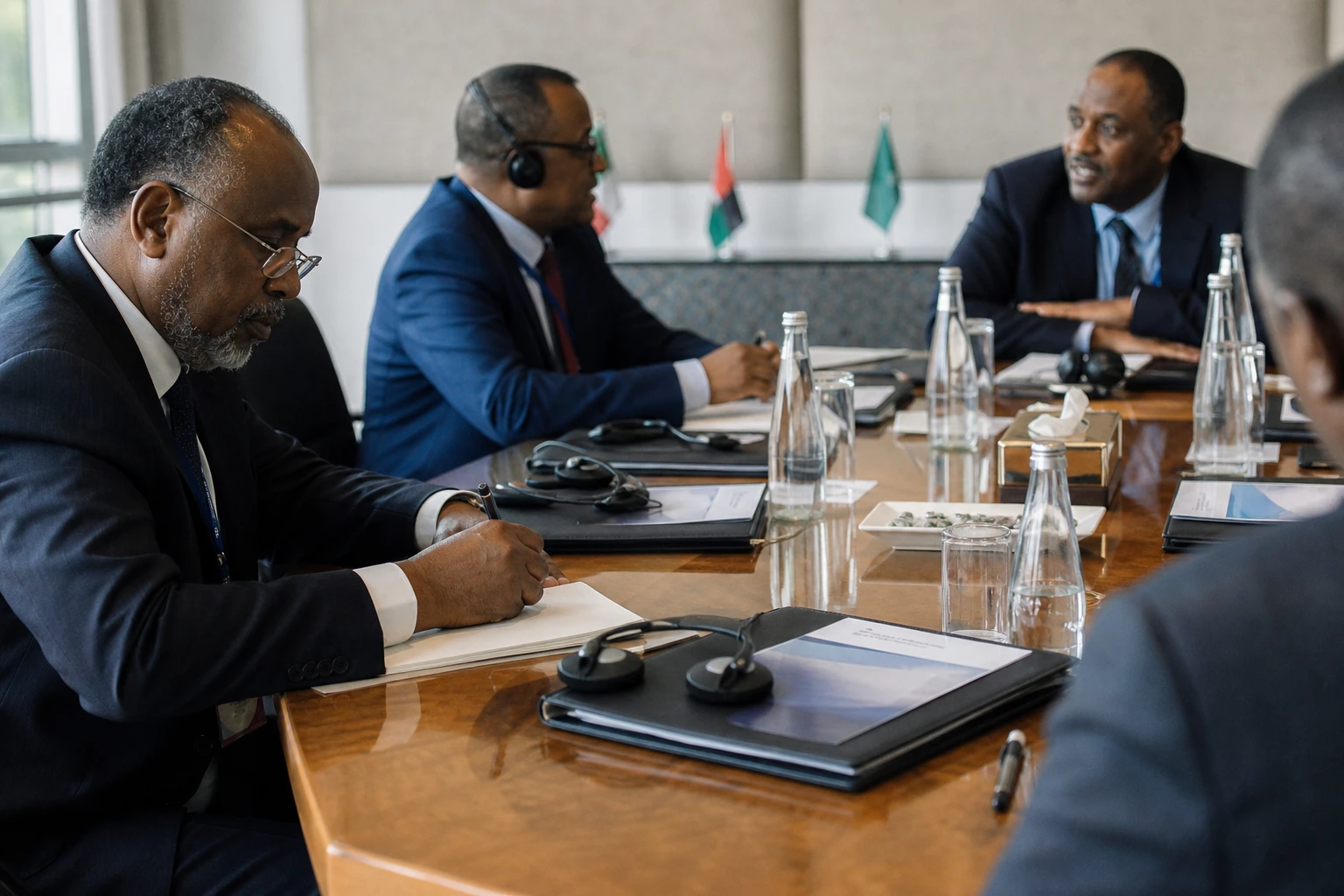
Since April 2023, the war has pitted the Sudanese Armed Forces, led by General Abdel Fattah al-Burhan, against the Rapid Support Forces of Mohamed Hamdan Dagalo, known as Hemedti. The conflict remains centred on Sudan, but its effects extend well beyond the country’s borders. The African Union recently reaffirmed its commitment to Sudan’s unity and called on external actors not to exacerbate the crisis. The so-called Quintet format, which brings together the African Union, IGAD, the Arab League, the European Union and the UN, continues to call for de-escalation and inclusive intra-Sudanese dialogue.
This diplomatic framework is essential, because the military and political fronts are not separate. In North Kordofan, the advances claimed by the army are aimed at securing the route linking the country’s centre to Darfur. Ultimately, this road determines access to cities, logistics bases and humanitarian corridors. Control of this route therefore matters as much to the war as it does to aid for civilians.
Vehicles from Pakistan, financing from Riyadh
The key fact is this: the Sudanese army has received Mohafiz V light armoured vehicles, manufactured by Pakistan Military Industries. An international news outlet, citing Pakistani security sources, had already reported in April 2026 that Islamabad had put a $1.5bn arms sale to Sudan on hold following an objection from Saudi Arabia, with Riyadh saying it would not finance the deal. This precedent sheds light on the current sequence of events: it shows that money, diplomacy and arms are moving within the same strategic arena.
At the same time, Sudan’s military authorities chose to display the vehicles in Khartoum, a sign that they want to turn a military supply into a political message. The aim is not only to reinforce ground units. It is also to show their adversaries, and their external backers, that the army can still obtain modern equipment to conduct operations in vast, fluid and difficult terrain such as Kordofan and Darfur.
Riyadh occupies a distinctive position here. Saudi Arabia has mediated in the Sudanese crisis, notably through the Jeddah process. But available documentation also shows that it remains an actor capable of shaping financing and regional balances. The shift between civilian aid, mediation and indirect support for the military effort reflects a flexible strategy, dictated by the balance of power at any given time.
On the ground, Kordofan and Darfur remain the real test
Forceful rhetoric does not change the reality on the ground. On 26 July, a senior military official said the army chief had ordered an offensive to “cleanse” the country as far as the border with the Central African Republic. The same military account said regular forces were seeking first to secure North and West Kordofan before pushing towards Darfur, where paramilitary forces still control large areas. This movement explains why every delivery of armoured vehicles matters.
North Kordofan has become a strategic hub. It links Khartoum to the centre of the country and opens the route to Darfur. When this area erupts, the effects are felt far beyond the front lines. Markets become scarce, roads close and hospitals receive fewer patients but more severely wounded people. The military escalation therefore adds to the pressure on civilian services, already weakened by more than three years of war.
On 7 August, military officials also declared their determination to continue operations, while Prime Minister Kamel Idriss spoke of ongoing efforts to “liberate Darfur”. In such a fragmented conflict, statements of this kind are intended to maintain cohesion within the government’s camp, but they also serve to prepare public opinion for a longer war.
The humanitarian crisis is spreading towards the borders
As military columns advance, civilians continue to flee. In West Darfur, the IOM estimated that 6,005 people had left Kulbus and three neighbouring villages after threats from the RSF. Most crossed the border into Chad. This displacement adds to an already severe regional crisis, as Chad has hosted several hundred thousand Sudanese refugees since the start of the war, with new arrivals every month.
The Adré crossing between Sudan and Chad remains a vital point. Khartoum renewed its opening for three months from 29 June 2026, to maintain the flow of aid to the west of the country, despite the RSF presence in West Darfur. In other words, the military and humanitarian fronts overlap. When one shifts, the other wavers.
What Sudan tells Africa and the continent
Sudan’s case goes beyond a rivalry between two strongmen. It raises questions about the ability of the African Union, IGAD and Arab states to influence a war in which external support, arms deliveries and financial decisions continually alter the balance of power. The continent is also watching the spillover effects: pressure on Chad, strain on humanitarian corridors, weakening national institutions and mass displacement.
In the short term, the real question remains simple: can the army turn its gains in Kordofan into a lasting breakthrough towards Darfur without further worsening the civilian catastrophe? The coming weeks will show whether the armoured vehicles displayed in Khartoum herald real progress or merely a new phase of wartime messaging. But one thing is already clear: in today’s Sudan, every military move redraws the front, regional diplomacy and the map of displacement.