Algeria
 Egypt
 Libya
 Morocco
 Sudan
 Tunisia
 Benin
 Burkina Faso
 Cabo Verde
 Ghana
 Guinea
 Guinea-Bissau
 Liberia
 Mali
 Mauritania
 Niger
 Nigeria
 Senegal
 Sierra Leone
 The Gambia
 Togo
 Cameroon
 Central African Republic
 Chad
 DR Congo
 Equatorial Guinea
 Gabon
 Republic of the Congo
 São Tomé and Príncipe
 Burundi
 Comoros
 Djibouti
 Eritrea
 Ethiopia
 Kenya
 Madagascar
 Malawi
 Mauritius
 Mozambique
 Rwanda
 Seychelles
 Somalia
 South Sudan
 Tanzania
 Uganda
 Angola
 Botswana
 Eswatini
 Lesotho
 Namibia
 South Africa
 Zambia
 Zimbabwe
A drum recovered, a memory returned to the centre of public life
In Yopougon, a heritage object can become a political event. On 7 August 2026, the 66th anniversary of independence, Côte d’Ivoire chose to place the Djidji Ayôkwé at the heart of the national parade, as if to say that memory is not mere backdrop, but part of the Ivorian public narrative. The talking drum, seized in 1916 during French colonial rule, is the first cultural artefact to be returned to Abidjan after a long diplomatic and legal process.
The gesture comes at a particular moment. For several years, the Ivorian government has championed a policy of promoting national symbols, from culture to urban development, with particular attention to major occasions for public gatherings. The choice of Yopougon, a popular district and the country’s most populous commune, is no accident. It places the celebration in an area that carries considerable social, electoral and symbolic weight in Abidjan.
From Paris to Abidjan, a return years in the making
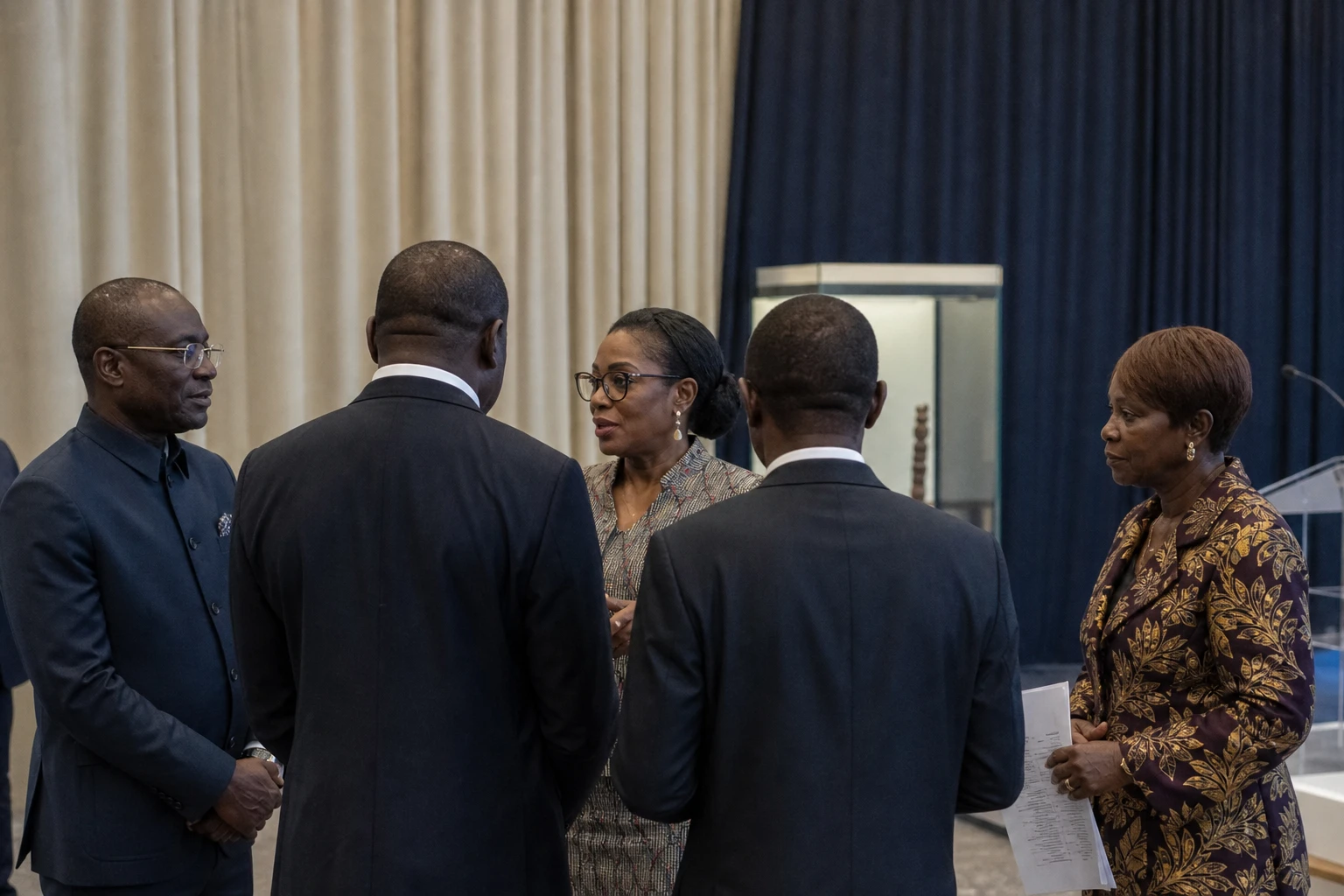
The Djidji Ayôkwé was officially returned to Côte d’Ivoire in February 2026, at a ceremony at the Musée du quai Branly, and physically transferred to Abidjan in March. The French authorities provided for the restitution under a law adopted in 2025, which allowed an exception to the principle that public collections are inalienable. The Ivorian government presented the return as the culmination of a heritage campaign pursued for years.
This drum is no ordinary object. Among the Atchan people, it served as a means of communication and a spiritual marker. Its removal in 1916 remains associated with colonial violence and cultural dispossession. That is why its restitution goes beyond museum practice. It touches on symbolic sovereignty, recognition of a local history long told from outside, and the role of the communities concerned in managing the national heritage.
The case also has regional significance. In West Africa, several states have for years been seeking the return of objects taken during the colonial period. The Ivorian case shows that negotiations can succeed when the state, heritage specialists and the communities concerned speak with one voice. It also underlines that the restitution debate is not being fought only in European museums, but also through African countries’ ability to prepare for the conservation, display and transmission of recovered works.
In Yopougon and Adjamé, the drum’s return took on political significance
The public presentation of the Djidji Ayôkwé, during both the military and civilian parades, gave the ceremony a distinctly political dimension. The government sought to link heritage, national unity and popular visibility. In an economic capital often divided along party lines, the message was clear: the state intends to make cultural memory a language of unity, not merely a subject for experts.
The choice of Yopougon reinforces this reading. The commune was long seen as an opposition stronghold before coming under the administration of the RHDP, the ruling party. Holding a ceremony on this scale there means addressing a socially dense, politically sensitive and electorally decisive area. It also sends a signal to residents of working-class neighbourhoods: the national story is not confined to the institutional quarters of the Plateau or to the political capital, Yamoussoukro, but also unfolds where most urban residents live.
The presence of opposition figures and officials from other parties also mattered. In a country where memories of political crises remain vivid, presenting shared heritage can provide a space for symbolic rapprochement. But it does not erase tensions. Part of the opposition continues to denounce the high cost of living, the situation of political detainees and the narrowing of space for dialogue. The drum’s return will not resolve any of this on its own, but it gives the government a platform to show that it can also speak in the language of unity.
What the return changes for the state, communities and region
For the Ivorian state, the restitution of the Djidji Ayôkwé opens a broader chapter. The government has already said it wants to recover other cultural assets still held abroad. That requires a long-term strategy: inventory, expertise, diplomacy, conservation and then promotion through national institutions. Without this, restitution would remain an isolated symbol. With it, it could become a lasting public policy.
For the Atchan communities and, more broadly, for Ivorians, the stakes are twofold. First, this is a form of moral, if partial, redress. Second, it is a matter of transmission. A heritage object returned to the country has meaning only if it can be seen, explained, protected and included in cultural education. Otherwise, the return remains ceremonial. The authorities have announced that the drum will be welcomed at the Museum of Civilisations, linking restitution to the national cultural infrastructure.
Across the continent, the Ivorian case could set an example. It shows that a West African country can turn a heritage claim into a diplomatic success without giving up its own account of history. It also serves as a reminder that restitution is not solely a Franco-African issue. It concerns the entire continent, from ECOWAS to the African Union, because it touches on cultural sovereignty, the memory of independence and Africa’s place in the global movement of works and knowledge.
On 7 August 2026, Côte d’Ivoire therefore did more than celebrate a founding date. It presented a broader idea: a country celebrating its independence can also repair part of its dispossession, and turn an ancient object into a contemporary marker of national continuity. In the months ahead, the real test will be less the ceremony than what follows from the restitution, in Abidjan and in the other African capitals still seeking the return of their cultural assets.