Algeria
 Egypt
 Libya
 Morocco
 Sudan
 Tunisia
 Benin
 Burkina Faso
 Cabo Verde
 Côte d'Ivoire
 Ghana
 Guinea
 Guinea-Bissau
 Liberia
 Mali
 Mauritania
 Niger
 Senegal
 Sierra Leone
 The Gambia
 Togo
 Cameroon
 Central African Republic
 Chad
 DR Congo
 Equatorial Guinea
 Gabon
 Republic of the Congo
 São Tomé and Príncipe
 Burundi
 Comoros
 Djibouti
 Eritrea
 Ethiopia
 Kenya
 Madagascar
 Malawi
 Mauritius
 Mozambique
 Rwanda
 Seychelles
 Somalia
 South Sudan
 Tanzania
 Uganda
 Angola
 Botswana
 Eswatini
 Lesotho
 Namibia
 South Africa
 Zambia
 Zimbabwe
In Nigeria, a continental project tests the credibility of Africa’s single market
In Abuja, a 20-year contract is about more than software and scanners. It also says something broader: how capable Africa is of moving goods faster, with less paperwork, less arbitrariness and fewer losses. Under the logic of AfCFTA, digitising customs is not a technical detail. It is a lever of economic sovereignty.
The deal comes at a time when trade integration is advancing, but slowly. According to an African Union report, 49 state parties had ratified the agreement and deposited their instruments of ratification by June 2025. The organisation also said intra-African trade reached $220.3 billion in 2024, up 12.4%. These figures show the scale of the challenge: the market exists, but its workings remain too fragmented to deliver its full potential.
What the contract signed in Abuja entails
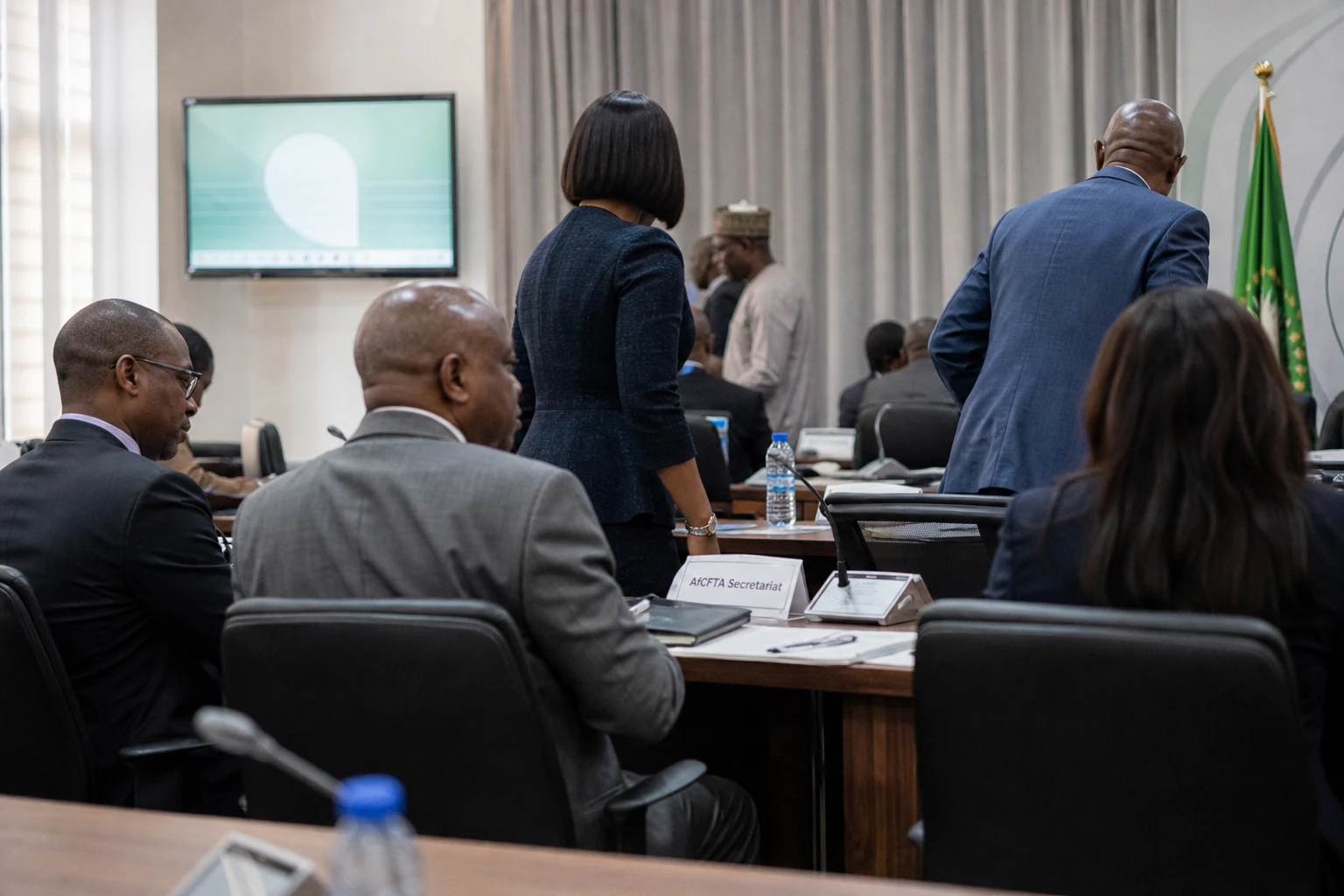
The AfCFTA Secretariat has signed a 20-year concession contract in Abuja with Nigerian company Bergmans Security Consultants and Supplies, through its subsidiary AfriTrade CMP. The announced value is $3.1 billion. The system is intended to digitise customs procedures, harmonise border formalities and enable real-time tracking of cargo across the continent. Neither the country-by-country deployment timetable nor the precise terms of the concessionaire’s remuneration have been made public in the information available.
The choice of a Nigerian company is not incidental. Bergmans describes itself as a local security and technology player, while AfCFTA authorities want to show that African expertise can drive a continental undertaking. The country in which the contract is based also matters. Nigeria is West Africa’s largest economy, and its capital, Abuja, has in recent years become an important political hub for trade and digital discussions.
The project is based on a simple argument: manual procedures encourage delays, over-invoicing, under-invoicing and revenue losses. AfCFTA has also adopted a protocol on digital trade aimed at establishing harmonised, transparent and common rules to support digital trade across the continent.
In its public communications, the AfCFTA Secretariat emphasises one point: trade integration cannot rely solely on lower customs duties. It also requires reliable data, interoperable systems and a minimum level of traceability for flows. This is precisely where customs become central. Without more transparent borders, the promise of a large African market remains theoretical.
Why customs are the real test of African integration
The figures cited in connection with the project shed light on what is at stake. Wamkele Mene, AfCFTA secretary-general, says Nigeria’s customs modernisation programme has contributed to a 90.4% rise in the country’s customs revenue. This figure is consistent with the official account of the modernisation of Nigerian customs, although it should be read as an attributed figure, not as a continental average.
For governments, the benefits are clear: better control of goods, improved cargo tracking and higher revenue collection. For businesses, especially small and medium-sized enterprises, the stakes are even more tangible: shorter delays at border posts, fewer unpredictable costs and less dependence on intermediaries. Conversely, for those who benefit from the grey areas of customs clearance, a shared platform means a loss of margin and influence.
This initiative must also be considered in the real geography of African trade. Intra-African trade is growing, but it remains hampered by transport infrastructure, non-tariff barriers and national systems that are still poorly aligned. ECOWAS, the West African regional economic community, already serves as a regional testing ground for integration, but AfCFTA wants to go further by linking the sub-regions. The challenge is therefore not only legal. It is logistical, administrative and political.
The deal also touches on trust. Digitised customs reduces human discretion in areas where opaque practices thrive. But it also requires the protection of commercial data, secure platforms and guarantees that systems will not become new points of dependence. AfCFTA’s digital trade protocol specifically emphasises common rules for a trusted, secure and predictable environment.
What to watch in the coming months
What happens next will depend on three factors. First, transparency over the deployment timetable, country by country. Second, clarity on the concessionaire’s remuneration, because a project of this scale cannot rest on contractual grey areas. Finally, the AfCFTA Secretariat’s ability to persuade states that the system will serve the collective interest, rather than just one supplier or a central administration.
The institutional timetable already points the way. In 2025, the AfCFTA Council of Ministers continued to examine the annexes to the digital trade protocol and the steps for its implementation. In other words, the technical work is progressing, but political decisions are still needed. This is where the continental significance of the contract signed in Abuja will be determined: if African customs become more efficient, AfCFTA will move from an ambitious text to a tangible tool for moving goods.
From this perspective, Nigeria occupies a strategic position. The country is not merely a large market. It could also become a demonstration base for African solutions designed in Africa and deployed across the continent. For AfCFTA, this may be the most sensitive issue: proving that integration is more than declarations, and that it can be measured in time saved at borders and revenue restored to public coffers.