
 Algeria
 Egypt
 Libya
 Morocco
 Sudan
 Tunisia
 Benin
 Burkina Faso
 Cabo Verde
 Côte d'Ivoire
 Ghana
 Guinea
 Guinea-Bissau
 Liberia
 Mali
 Mauritania
 Niger
 Senegal
 Sierra Leone
 The Gambia
 Togo
 Cameroon
 Central African Republic
 Chad
 DR Congo
 Equatorial Guinea
 Gabon
 Republic of the Congo
 São Tomé and Príncipe
 Burundi
 Comoros
 Djibouti
 Eritrea
 Ethiopia
 Kenya
 Madagascar
 Malawi
 Mauritius
 Mozambique
 Rwanda
 Seychelles
 Somalia
 South Sudan
 Tanzania
 Uganda
 Angola
 Botswana
 Eswatini
 Lesotho
 Namibia
 South Africa
 Zambia
 Zimbabwe
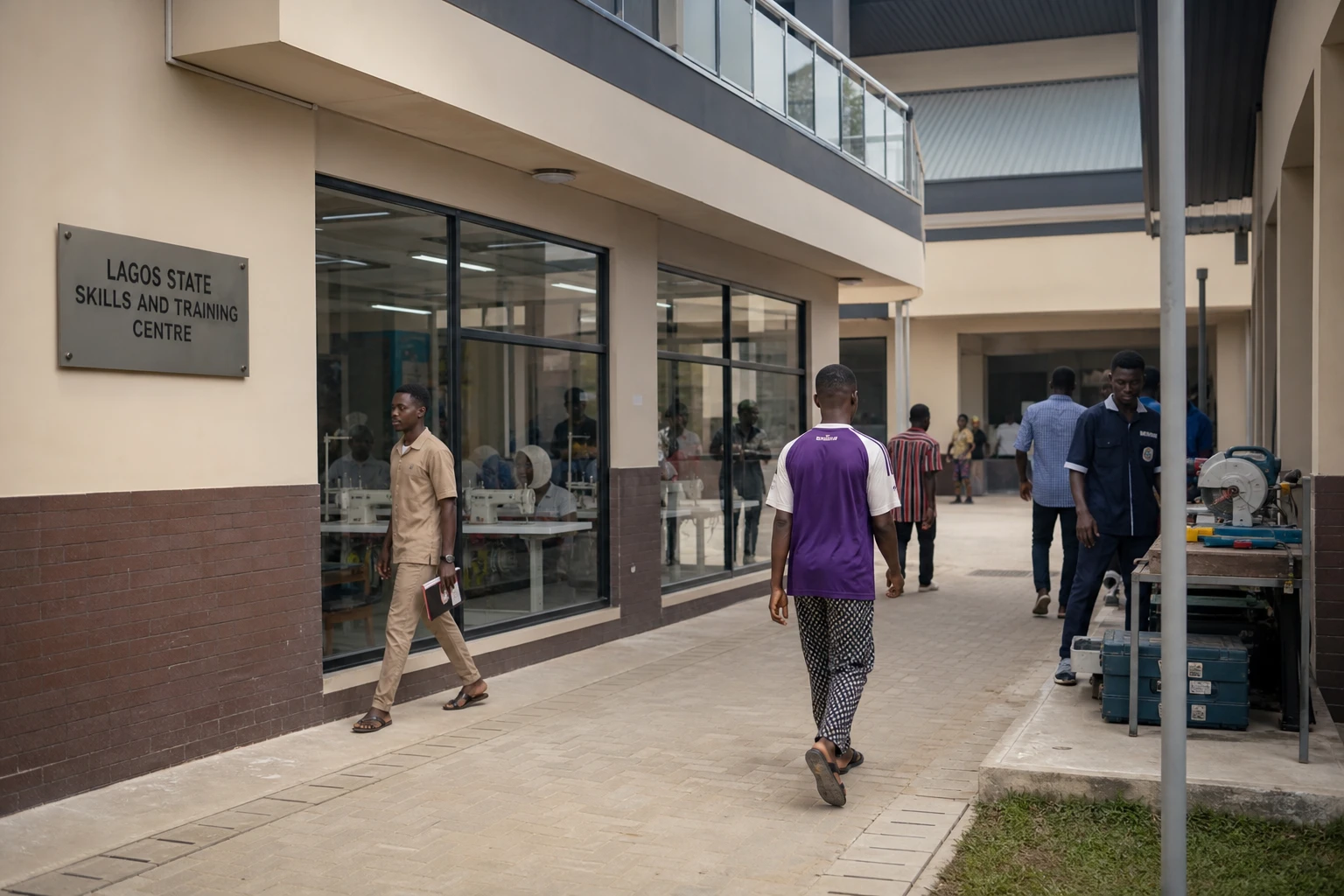
In Lagos, training offers a start, but not yet a market
In Nigeria’s largest city, employment is no longer simply a matter of finding a job. It often means surviving, selling, repairing, sewing, delivering, cooking or working for yourself. Against this backdrop, Lagos State is stepping up its support programmes for young people and women. The idea is simple: training is not enough; people also need a first tool, some start-up capital and an initial foothold in the real economy.
This strategy forms part of Governor Babajide Sanwo-Olu’s THEMES+ agenda, which puts social inclusion, young people and economic empowerment at the heart of public policy in Lagos. The state is relying on its skills centres, its Ministry of Women Affairs and Poverty Alleviation, and schemes such as the Micro Enterprise Support Initiative, or MESI, to turn free training into income-generating activity.
The figures show a real effort, but also persistent fragility
According to a review presented in early June 2026 by Commissioner Bolaji Cecilia Dada, Lagos had provided equipment to 5,339 residents and graduated 5,310 people from its free training centres over the period under review. The same source says that 19 skills centres are spread across the state, and that MESI provides start-up tools to beneficiaries. The support distributed includes sewing machines, hairdressing kits, bakery equipment and agricultural equipment.
The programme is not new. According to state communications, MESI has already benefited thousands of people since it was introduced, with successive editions mainly targeting women, young adults and other vulnerable residents. In 2025, Lagos had already announced that 1,700 beneficiaries had received start-up capital and work tools. In 2026, the government also launched a 10 billion naira fund to finance micro-enterprises through cooperative societies, signalling a gradual shift from training alone towards more structured financing.
In the latest figures reported by the local press, more than 35,000 residents are said to have received certificates since January 2026, 18,990 to have received start-up equipment and more than 1,100 to have been trained in digital skills. These figures, which point to an expansion of the programme, should be treated with caution until they have all been published in a consolidated official database. But they give an idea of the scale of Lagos’s effort, as the state seeks to respond to massive social demand through targeted interventions.
The real test comes after the tools are handed over
The problem is not just providing equipment. It is making the business last. Nigeria’s labour market remains dominated by informal work. In the National Bureau of Statistics survey, 73.1% of working people were either self-employed or engaged in agricultural activities in 2022, and 75.4% in 2023. The same report also shows that a significant share of workers are underemployed, with limited working hours and often unstable incomes.
In Lagos, this reality takes an urban form. The city is a hub for trade, transport, services, light manufacturing and street-based commerce. It also attracts young people from other states, intensifying pressure on available jobs. The result is clear: beneficiaries of public programmes often enter already crowded trades, where competition is fierce and margins are thin. A sewing machine or hairdressing kit can help someone get started, but it cannot guarantee regular customers, affordable premises, reliable power or access to credit.
This constraint is also reflected in the national picture for micro, small and medium-sized enterprises. The Nigerian Economic Summit Group has reported that about 30% of the country’s MSMEs, or 7.2 million businesses, are said to have ceased operations between 2023 and 2024 under pressure from the business climate. Other Nigerian business organisations have also raised the alarm over the closure of large numbers of small businesses. This is an important signal for Lagos: training more young people will not produce lasting results if the tax, logistics, energy and financial environment remains unfavourable to very small businesses.
What Lagos says about Nigeria, and what it means for the region
Lagos is acting as a laboratory. Nigeria’s most populous state is testing a public response to a familiar continental problem: the gap between population growth, the number of young people entering the labour market each year and the private sector’s actual capacity to absorb them. Lagos’s response combines training, equipment, support for women and the development of digital skills. It is pragmatic. It is also a way of recognising that, in many African cities, a first job often comes through micro-work, a cooperative or self-employment.
For ECOWAS, of which Nigeria is a pillar, the issue is strategic. When a major economic hub such as Lagos supports micro-enterprises, it directly affects the flow of income, goods and services across West Africa. The artisans, traders, logistics operators and small agro-processing businesses emerging from the programme do not operate in a vacuum. They feed into regional value chains, which are often informal but very real. If these chains remain fragile, social pressure quickly rises towards local authorities, then the state government and ultimately Abuja.
The next step will therefore be decisive. The issue is no longer just the number of beneficiaries, but whether businesses survive after training, whether they can access markets and the quality of support they receive during their first months. That is where the difference will be made between a useful social policy and an economic policy that genuinely transforms the lives of Lagos’s Nigerians and, more broadly, those of people in African cities facing the same challenge.



