Algeria
 Egypt
 Libya
 Morocco
 Sudan
 Tunisia
 Benin
 Burkina Faso
 Cabo Verde
 Côte d'Ivoire
 Ghana
 Guinea
 Guinea-Bissau
 Liberia
 Mali
 Mauritania
 Niger
 Senegal
 Sierra Leone
 The Gambia
 Togo
 Cameroon
 Central African Republic
 Chad
 DR Congo
 Equatorial Guinea
 Gabon
 Republic of the Congo
 São Tomé and Príncipe
 Burundi
 Comoros
 Djibouti
 Eritrea
 Ethiopia
 Kenya
 Madagascar
 Malawi
 Mauritius
 Mozambique
 Rwanda
 Seychelles
 Somalia
 South Sudan
 Tanzania
 Uganda
 Angola
 Botswana
 Eswatini
 Lesotho
 Namibia
 South Africa
 Zambia
 Zimbabwe
When the material takes over from the brush
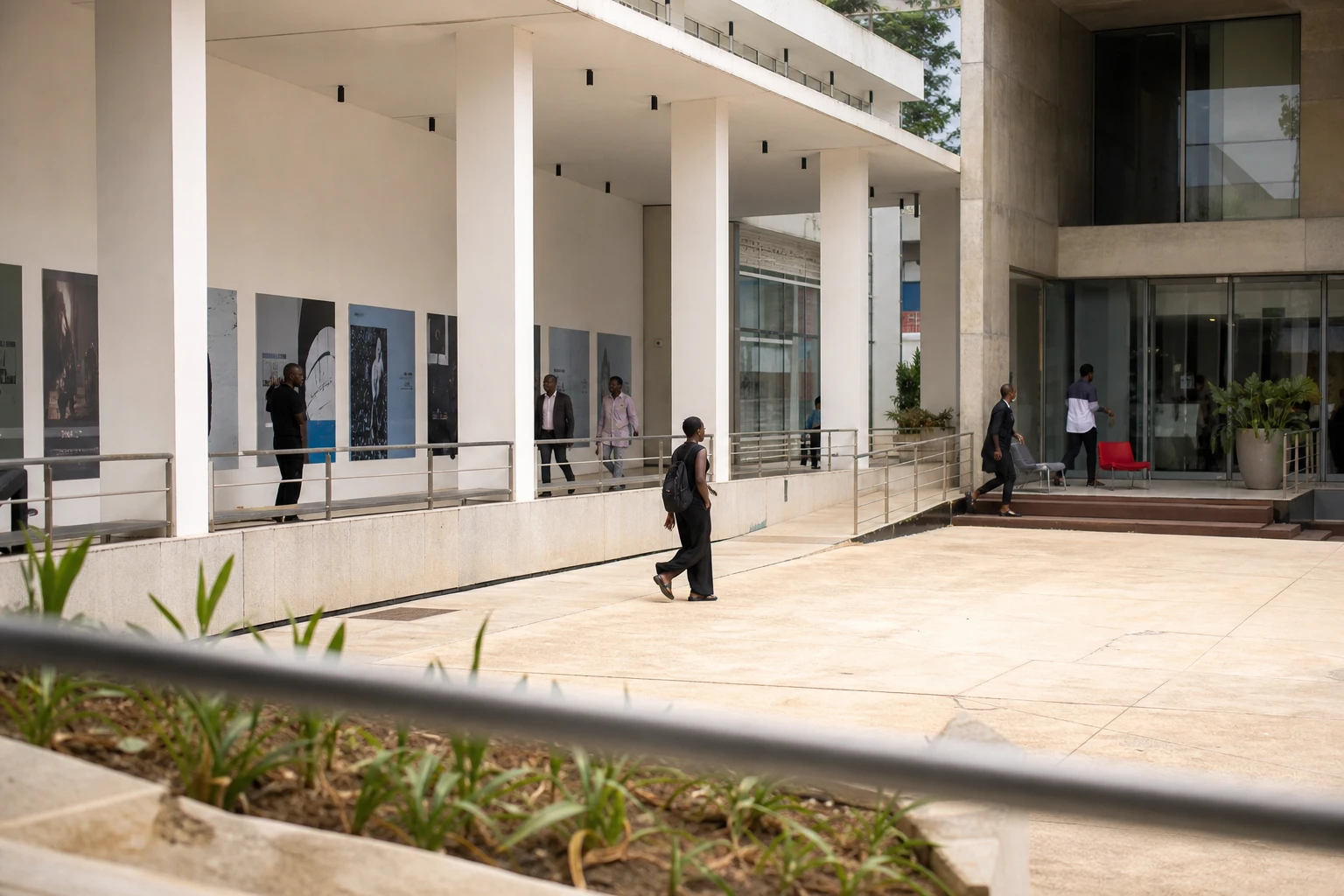
In Lagos, creativity often moves against the current. In this Nigerian megacity, artists do not simply follow the codes of the classical portrait. They also seek out materials, gestures and narratives that reflect who they are. It is in this spirit that Emmanuel Olatunde repurposes clay, not to mould a sculpture, but to use it as a living paint. This approach gives the face a rare, almost tactile texture, and places portraiture within a broader conversation about identity, memory and material.
The choice is no accident. Lagos has become one of West Africa’s main creative hubs. The Nigerian government has also made the cultural sector an explicit pillar of its policy, with a dedicated ministry since 2023 and a strategy aimed at better organising the value chain for the arts, fashion, audiovisual production and creative trades. At the same time, leading national institutions such as the National Gallery of Art and the National Theatre remind us that visual art is not mere decoration: it is part of the country’s heritage and economy.
In Lagos, an artistic practice that also tells the story of Nigeria today
Clay portraiture is part of a Nigerian art scene that is increasingly valuing experimentation. The country has a powerful visual tradition, from sculpture to ceramics, as well as a contemporary generation working with charcoal, coffee, natural pigments, textiles and hybrid media. This diversity is no passing trend. It responds to a more visible domestic market, to fairs such as ART X Lagos, and to growing recognition of the creative industries in public policy and programmes supported by UNESCO.
In this context, the use of clay has particular significance. The material evokes craft, the earth, hand-shaping and ancient skills often associated with ceramics or sculpture. By bringing it into the realm of portraiture, Emmanuel Olatunde blurs the boundaries between painting and modelling. The face is no longer read through colour alone. It is also read through thickness, relief, irregularities and the light catching the surface. It is a way of recalling that contemporary African imagery is not reduced to imitation of schools from elsewhere. It can draw on its own materials without losing its modernity. This reading is a critical interpretation of the artistic approach, based on the information provided and the context of Nigerian visual arts.
This practice also says something about Lagos itself. The city is dense and fast-moving, and marked by social contrasts, yet it remains a vast open-air workshop. Artists there often work in conditions where ingenuity makes up for a lack of infrastructure. The creative landscape is strong, but distribution channels remain uneven. Galleries, fairs and public institutions coexist with more precarious studios, where technical autonomy matters as much as visibility. In this cultural economy, the value of a work depends as much on its quality as on its ability to circulate between neighbourhoods, collectors, institutions and digital networks.
A reading that goes beyond visual impact
Emmanuel Olatunde’s work is compelling because it shifts the question of portraiture. Instead of seeking likeness alone, it explores presence. Clay gives the face an almost organic density. It evokes skin, dust and soil, but also the fragility of identities taking shape in shifting urban environments. In a young, highly urbanised country deeply connected to digital networks, this kind of work builds a bridge between old gestures and contemporary forms of dissemination. Here too, the issue goes beyond aesthetics alone: it touches on how Nigerian women and men represent themselves.
The subject also has an economic dimension. UNESCO regularly highlights the strong growth potential of Africa’s cultural industries, particularly fashion, visual arts and creative trades, if investment follows. Nigeria is often presented as a driver of this momentum, with Lagos as its showcase. The authorities want to make creativity a better-structured sector, capable of generating revenue and jobs and providing greater protection for works. In this context, a practice such as Olatunde’s is not marginal. It shows how artistic innovation can emerge from a simple material while fitting into a broader ecosystem of studios, galleries, platforms and institutions.
Finally, it says something about the circulation of African narratives. For a long time, the continent’s arts were viewed through the lens of exoticism or tradition alone. Yet the Nigerian scene shows something else: artists working with material, memory and form using highly contemporary tools. Lagos is not merely a backdrop. It is a centre of cultural production that engages with Abuja, the major West African capitals and pan-African networks of fairs, residencies and exhibitions. Emmanuel Olatunde’s work belongs in this context: in an Africa that does not ask permission to innovate, but creates its own visual languages.
What this approach heralds for the West African art scene
This kind of work deserves attention because it could inspire other artists in Nigeria and ECOWAS, the Economic Community of West African States. In a region where the circulation of works, ideas and audiences remains uneven, practices based on accessible materials often have the power to spur others on. They make it possible to produce locally, tell local stories and reach a wider audience without relying entirely on imported tools. This is an important path for an African art scene seeking to grow without losing its material and symbolic roots.
In the short term, the point to watch is how the sector is structured. If public policies, cultural institutions and local markets continue to consolidate, Lagos will be able to retain its role as a laboratory. Otherwise, many initiatives will remain dependent on individual efforts. Emmanuel Olatunde’s work therefore recalls a simple reality: in Nigerian creativity, material is never merely a support. It becomes an argument, a memory and sometimes a way of redefining Africa’s place in contemporary art.