
 Algeria
 Egypt
 Libya
 Morocco
 Sudan
 Tunisia
 Benin
 Burkina Faso
 Cabo Verde
 Côte d'Ivoire
 Ghana
 Guinea
 Guinea-Bissau
 Liberia
 Mali
 Mauritania
 Niger
 Senegal
 Sierra Leone
 The Gambia
 Togo
 Cameroon
 Central African Republic
 Chad
 DR Congo
 Equatorial Guinea
 Gabon
 Republic of the Congo
 São Tomé and Príncipe
 Burundi
 Comoros
 Djibouti
 Eritrea
 Ethiopia
 Kenya
 Madagascar
 Malawi
 Mauritius
 Mozambique
 Rwanda
 Seychelles
 Somalia
 South Sudan
 Tanzania
 Uganda
 Angola
 Botswana
 Eswatini
 Lesotho
 Namibia
 South Africa
 Zambia
 Zimbabwe
A useful partnership under pressure
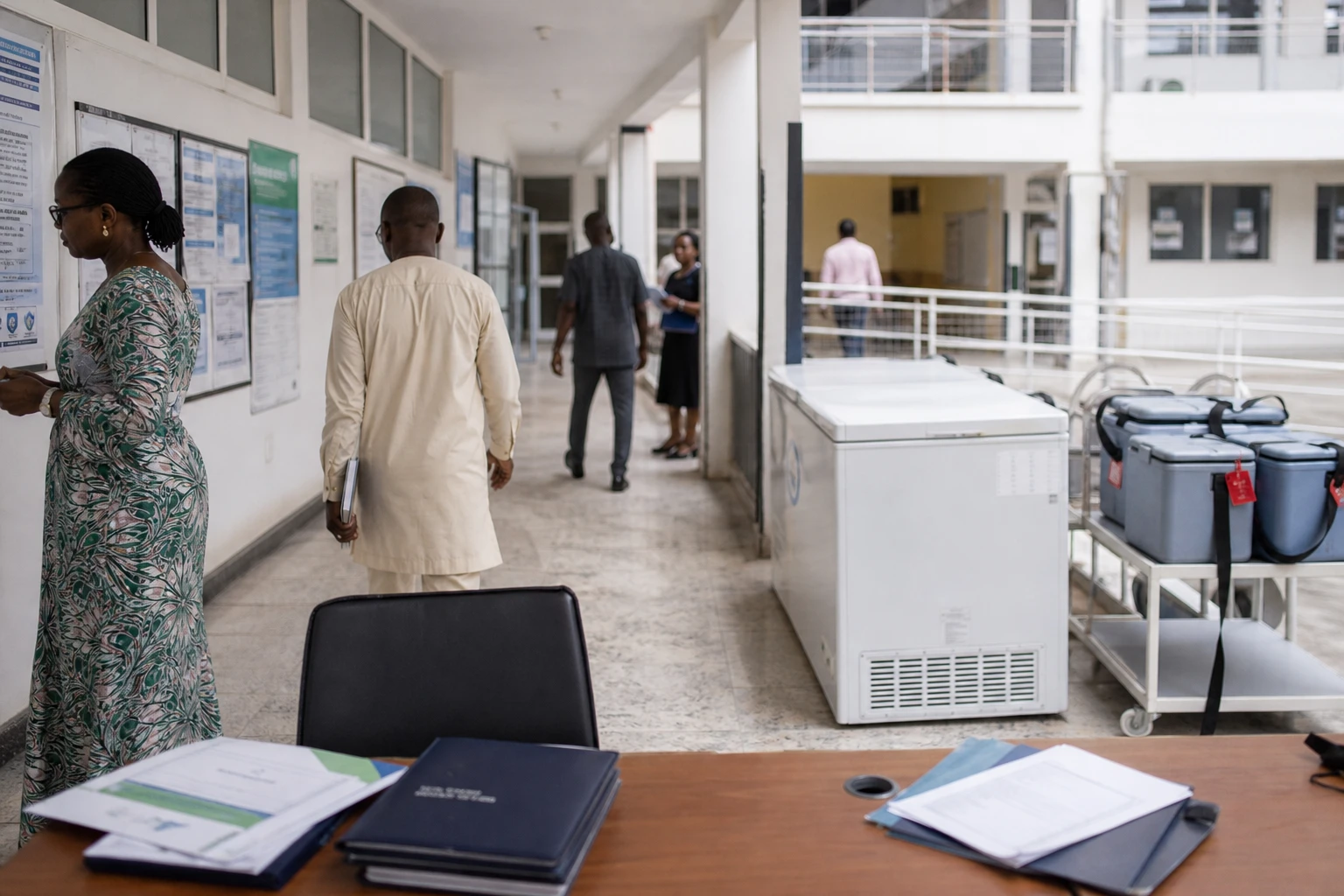
In Abuja, children’s health now hinges on two timelines. The first is immediate: vaccinate, catch up, protect. The second is more political: learn to fund independently what international aid has long supported. Gavi, the Vaccine Alliance, made its announcement in Nigeria against this backdrop.
The issue extends beyond Nigeria alone. The country has the largest population in West Africa and is a central hub for ECOWAS, the Economic Community of West African States. When vaccination coverage rises or falls in Nigeria, the effects are quickly felt across the region.
Gavi chief executive Sania Nishtar announced in Abuja a commitment of more than $500 million over five years for Nigeria’s vaccination programme. She also put forward a simple idea: aid must continue to accelerate coverage, but above all it must prepare the way for a gradual transition out of the programme.
Nigeria faces its own vaccine transition
Nigeria is no ordinary country for Gavi. According to the Alliance’s own figures, it has invested several billion dollars there since 2000. Above all, the country still has the world’s largest number of “zero-dose” children, meaning children who have received no basic vaccines. UNICEF also notes that specific obstacles persist: access, financing, the supply chain, trust and inequalities between areas.
Gavi’s model is based on co-financing. As a country’s financial capacity grows, its share increases. Nigeria is among the countries in accelerated transition, the final stage before exiting support. In effect, Abuja must gradually take on more of the costs as external support declines. Gavi says it aims to protect 500 million children between 2026 and 2030, but this ambition depends on robust resources.
This trajectory raises a very practical question: who pays, and where? The budgetary and logistical constraints in Lagos are not the same as in Sokoto, Zamfara or other northern states where vaccination delays remain more pronounced. Gavi and WHO documents stress regional disparities and the need to reach the hardest-to-access areas.
The figures shed light on the shift
The contrast is striking. In 2025 alone, Gavi provided Nigeria with $261 million, while the federal government contributed about $90 million, according to figures cited in the specialist press and cross-checked against the Alliance’s public documents on its support for the country. Over five years, the $500 million announced in Abuja therefore amounts to an average of about $100 million a year. That remains useful, but is also significantly below the level of funding seen in 2025.
This gap must be viewed in the context of the international situation. In June 2025, Gavi raised more than $9 billion for its 2026-2030 strategic period, but its stated target was $11.9 billion. The funding shortfall is partly explained by the US decision to stop contributing to the Alliance, a decision confirmed at the time by Washington and subsequently reported by several international sources. In 2026, some funds approved by the US Congress were still blocked or subject to conditions.
In other words, the announcement in Abuja is not simply a show of support for Nigeria. It comes at a time when Gavi has to do more with less. It must also persuade partner countries that a gradual shift to domestic funding remains possible without undermining vaccination momentum.
What the funding battle changes
For families, the stakes are straightforward: a vaccinated child is protected sooner, while an unvaccinated child remains exposed to preventable diseases. For state governments, the issue is whether they can actually follow through on budget promises with teams, cold-chain equipment, transport and reliable data. For Abuja, the task is to prove that “national ownership” is not just a slogan, but a workable mechanism.
The issue is not just about cash flow. It is also industrial. Sania Nishtar recalled the existence of a $1.2 billion instrument intended to support vaccine production in Africa. Nigeria sees this as a lever for health sovereignty. That is understandable. But a factory cannot replace mobile teams, catch-up campaigns or local outreach. Production and distribution address two different needs.
President Bola Tinubu praised the partnership with Gavi and highlighted Nigeria’s role in the growth of an African vaccine industry. His government has already sought to show that it can fund public health amid tight budgetary constraints. But the credibility of this path will depend above all on the regularity of payments, coordination with the states and the ability to reach children who have been left behind.
Implications beyond Abuja
Across Africa, the signal is clear. Nigeria remains a large-scale test for the AfCFTA, the African Continental Free Trade Area, and the broader idea of more widely shared health sovereignty. If a country of this size can reconcile co-financing, local manufacturing and catch-up vaccination, it could lead other capitals to follow. If it fails, the model’s fragility will be laid bare.
The next point to watch, then, is less the financial announcement itself than how it is put into practice: which states will contribute to the programme, what share the federal government will take, and how the areas with the lowest vaccination rates will be targeted. In a Nigeria where regional disparities remain stark, the answer will say far more than the amount pledged in Abuja. It will show whether the transition to health self-reliance can happen without leaving the most vulnerable children behind.



