Algeria
 Egypt
 Libya
 Morocco
 Sudan
 Tunisia
 Benin
 Burkina Faso
 Cabo Verde
 Côte d'Ivoire
 Ghana
 Guinea
 Guinea-Bissau
 Liberia
 Mali
 Mauritania
 Niger
 Nigeria
 Senegal
 Sierra Leone
 The Gambia
 Togo
 Cameroon
 Central African Republic
 Chad
 DR Congo
 Equatorial Guinea
 Gabon
 Republic of the Congo
 São Tomé and Príncipe
 Burundi
 Comoros
 Djibouti
 Eritrea
 Ethiopia
 Kenya
 Madagascar
 Malawi
 Mauritius
 Mozambique
 Seychelles
 Somalia
 South Sudan
 Tanzania
 Uganda
 Angola
 Botswana
 Eswatini
 Lesotho
 Namibia
 South Africa
 Zambia
 Zimbabwe
When household solar becomes part of the grid
In Rwanda, electricity is no longer just a question of connection. It is also about the movement, sharing and local value of power. In a country where off-grid solar already serves a significant share of households, the idea of allowing homes to feed their surplus into the national grid marks a new stage: consumers can also become producers.
This shift comes as the country has been rapidly expanding electrification for several years. At the end of July 2025, 84.6% of Rwandan households had access to electricity, including 59.6% through the national grid and 25% through off-grid systems, mainly solar. This progress is part of the Rwandan government’s strategy, which treats solar power, mini-grids and decentralised solutions as complementary tools for extending public services.
The framework is still to be written, but the direction is clear
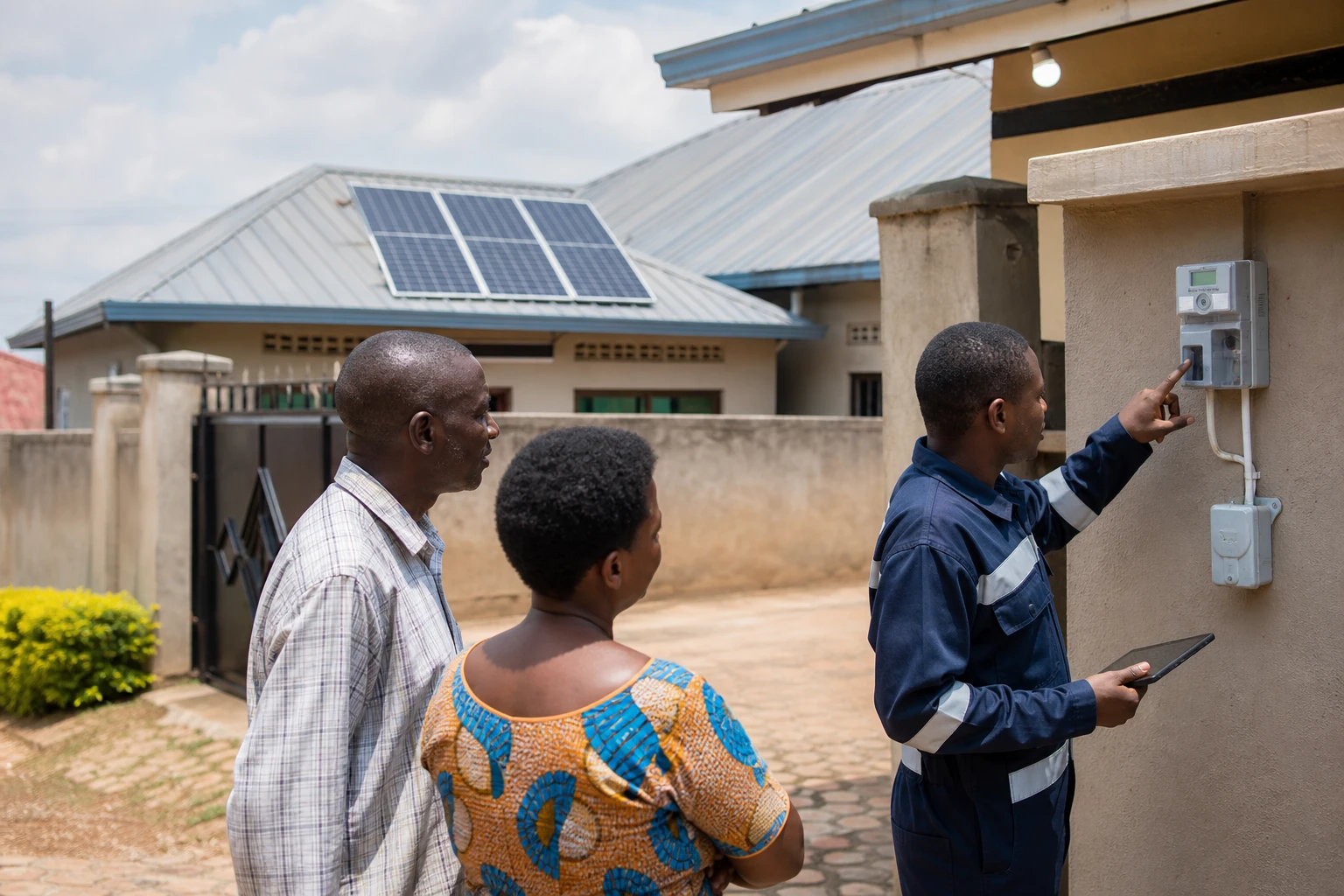
On Thursday 30 July, Prime Minister Justin Nsengiyumva told Parliament that the government was studying a mechanism allowing households, businesses and institutions equipped with solar panels to sell their surplus electricity. The idea is based on a smart meter connected to the Rwanda Energy Group grid, to measure the energy produced, consumed and fed back in. The principle is simple: first meet your own needs, then send any excess to the national grid.
In this arrangement, the regulator will have a central role. The Rwanda Utilities Regulatory Authority already oversees the electricity sector, which remains dominated by the national operator and a handful of independent producers. The current legal framework requires a licence for electricity generation, transmission, distribution and trading. In other words, Rwanda has the institutional foundations, but not yet the specific rules that would allow individuals to resell their surplus.
This regulatory caution is unsurprising. RURA has published draft rules on solar photovoltaics, a sign that the subject is already on the technical agenda. But moving to a system of positive billing, in which a household’s power exports can reduce its bill, still requires decisions on tariffs, meter quality, grid connections and liability in the event of an overload.
A response to pressure on electricity supply
The Rwandan debate over feeding solar power into the grid is no coincidence. The country is trying to keep pace with rapidly growing electricity demand, while its generation capacity still needs to diversify. The Ministry of Infrastructure says the electricity mix relies on hydropower, methane from Lake Kivu, peat, solar power and a share of fossil fuels. The same ministry also notes that the government has already promoted a policy aimed at “making productive use” of electricity on the national grid to reduce the imbalance between supply and demand.
This pressure is reflected in major projects under way. The government highlights the Nyabarongo II hydropower plant, the proposed 200 MW floating solar project and the development of Lake Kivu’s methane resources. These are joined by long-term investments intended to secure generation for an expanding Rwandan economy. In this context, household solar self-generation is no technological gimmick. It is a way of adding dispersed megawatts faster than a major project alone can.
The country already has the material foundations to do this. Rwandan regulations recognise the role of off-grid systems, and REG data show that a quarter of households are already supplied by off-grid solutions, mainly solar. This pool is significant because it includes homes that already have panels, batteries or hybrid systems. The future market for feeding power into the grid could therefore get under way with users who are already equipped, without waiting for residential solar to become universal.
For households, the stakes are economic as well as energy-related
If the scheme is introduced, its most immediate impact will be financial. A household in Kigali, a provincial business or a school with solar panels could reduce its bill, or even receive an electricity credit depending on the amount fed into the grid. This changes the logic of solar investment: a roof is no longer just a way to save on electricity bought from the grid; it also becomes a small-scale power-generation facility. This is an important shift in a country where electricity demand is growing faster than available supply.
But the issue also has a regional dimension. In urban neighbourhoods, where density makes connections more cost-effective, the system could speed up the flow of energy through an already strained grid. In rural areas, where off-grid solutions are more prevalent, it could give existing solar installations new value. That said, without clear rules on the purchase price, equipment quality and grid stability, there is a risk of making a promise that exceeds the technical capacity to deliver on it.
Rwanda is not starting from scratch. It has already demonstrated its capacity to innovate in energy, with choices such as using methane from Lake Kivu and rolling out accelerated connection programmes. The country also has a track record of using energy policy as a lever for economic transformation. Net metering therefore fits a coherent trajectory: generate more, diversify further and make better use of every kilowatt-hour already installed.
A Rwandan experiment closely watched in East Africa
At the regional level, the issue is of particular interest to the East African Community, of which Rwanda is a member. Neighbouring countries are watching closely the models that combine grid expansion, decentralised solar and reduced pressure on public budgets. If Kigali formalises the scheme, it could become a reference point for other markets where households are already installing solar but have no mechanism to derive value from their surplus.
The implications are even broader. The continent is seeking to accelerate electrification without relying solely on large power plants and fuel imports. In this equation, Rwanda is testing a simple but strategic idea: bring small-scale producers into the national electricity chain under public rules rather than informal arrangements. The real test will begin when the regulator specifies tariffs, export thresholds and access conditions. That is where the difference between a promising announcement and lasting reform will be decided.