Algeria
 Egypt
 Libya
 Morocco
 Sudan
 Tunisia
 Benin
 Burkina Faso
 Cabo Verde
 Côte d'Ivoire
 Ghana
 Guinea
 Guinea-Bissau
 Liberia
 Mali
 Mauritania
 Niger
 Nigeria
 Senegal
 Sierra Leone
 The Gambia
 Togo
 Cameroon
 Central African Republic
 Chad
 DR Congo
 Equatorial Guinea
 Gabon
 Republic of the Congo
 São Tomé and Príncipe
 Burundi
 Comoros
 Djibouti
 Eritrea
 Ethiopia
 Kenya
 Madagascar
 Malawi
 Mauritius
 Mozambique
 Rwanda
 Seychelles
 Somalia
 South Sudan
 Tanzania
 Angola
 Botswana
 Eswatini
 Lesotho
 Namibia
 South Africa
 Zambia
 Zimbabwe
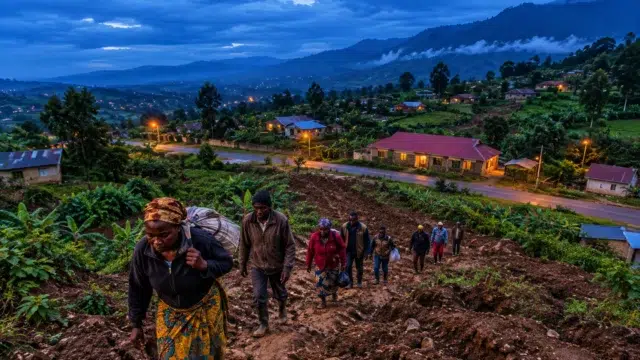
In Karamoja, hunger is not an isolated episode
In Karamoja, in north-eastern Uganda, the food crisis is not simply the result of a poor season. It reveals deeper fragility: dependence on rainfall, low rural incomes, limited access to basic services and difficulty moving food to the most remote areas. In this part of the country, every climate shock quickly becomes a social shock. The government has therefore opted for an emergency response, but the central question remains: how can aid be prevented from becoming merely a temporary stopgap?
Karamoja is not a forgotten backwater. It is a border sub-region, connected to Kenya and South Sudan, and situated in an area where trade, pastoral movements and competition over resources intersect. This is why the local situation is also of interest to the EAC, the East African Community, which relies on stability in border areas to secure trade routes and livelihoods.
A six-month plan, combining relief and stabilisation
On 29 July 2026, the Ugandan government launched a six-month response plan worth $84 million for Karamoja. Its stated aim is to meet the urgent needs of households affected by acute food insecurity and address child malnutrition. The latest data from the IPC, the Integrated Food Security Phase Classification, estimate that 473,000 people in the region are in crisis or worse between April and July 2026. The same report also projects high levels of acute malnutrition over the 2026-2027 period.
The plan is built around six pillars: coordination and early warning; food aid and cash transfers; health and nutrition; support for agriculture and livelihoods; school meals and education; and peacebuilding and the protection of communities. This structure signals an important shift. The state is no longer talking only about food distribution, but also about prevention, incomes, public health and keeping children in school. In Uganda, where the health ministry and humanitarian partners have for months called for a broader nutrition response, this approach was expected.
Funding remains incomplete, however. The authorities have already mobilised $12.16 million, but still need to raise $72.6 million to fully fund the programme. This highlights a frequent limitation of emergency responses in East Africa: the diagnosis is often clear, but funding arrives in stages, with delays that reduce the effectiveness of measures. In a context where agricultural seasons are short and local markets can quickly be disrupted, every week counts.
What aid changes, and what it does not fix
On the ground, the first priority is to limit the damage. Food aid protects households that have already exhausted their stocks. Cash transfers can support purchases in local markets while they are still functioning. School meals, meanwhile, play a quiet but crucial role: they keep some children in class as families weigh up work, temporary migration and food survival. In practice, women, children, older people and pastoral households most exposed to crop losses bear the heaviest burden.
But the emergency must not obscure the structural causes. FEWS NET and IPC analyses point to falling harvests, insufficient rainfall, heavy dependence on agricultural incomes and a health environment that worsens malnutrition. In Karamoja, the food crisis is therefore not just about production. It also affects water, health, roads, markets, schools and local security. That is why relief efforts are often complemented by resilience projects, such as water infrastructure works, community peace programmes and agricultural recovery initiatives.
The Ugandan government is also trying to link emergency relief to broader tools. The Office of the Prime Minister has begun sending food to Karamoja and announced further large-scale distributions of maize and beans. At the same time, the country has launched a national roadmap to strengthen anticipatory action in the face of disasters, shifting from a logic of response to one of warning and prevention. This is a useful change of direction, especially in a sub-region where drought returns quickly and the losses of one year spill over into the next.
A test for Kampala, and for East Africa
For Kampala, Karamoja is a political and administrative test. The central government must show that it can protect the most exposed areas without relying on high-profile announcements alone. It must also coordinate ministries, districts, humanitarian partners and the logistical capacity needed to deliver aid to hard-to-reach areas. In a country where regional disparities remain pronounced, the state’s credibility is often put to the test through these practical responses, far from the capital.
At the regional level, the stakes go beyond Uganda. Karamoja shares dynamics with other arid areas of East Africa: climate pressure, pastoral vulnerability, cross-border mobility and dependence on safety nets that remain fragile. Regional institutions, notably the EAC and IGAD, have a strong interest in following this issue, because food security is also a matter of stability. When an entire sub-region is under strain, markets, population movements and border balances all come under pressure.
What happens next will unfold over two timelines. In the short term, it will be necessary to see whether the $84 million is raised and whether food, nutrition care and transfers reach the districts concerned quickly. In the medium term, it will be necessary to determine whether the plan leads to a real reduction in hunger, or whether Karamoja remains trapped in the familiar cycle of repeated emergencies. That is where the difference between a humanitarian response and a sustainable development policy will be measured.