Algeria
 Egypt
 Libya
 Morocco
 Sudan
 Tunisia
 Benin
 Burkina Faso
 Cabo Verde
 Côte d'Ivoire
 Ghana
 Guinea
 Guinea-Bissau
 Liberia
 Mali
 Mauritania
 Niger
 Nigeria
 Senegal
 Sierra Leone
 The Gambia
 Togo
 Cameroon
 Central African Republic
 Chad
 DR Congo
 Equatorial Guinea
 Gabon
 Republic of the Congo
 São Tomé and Príncipe
 Burundi
 Djibouti
 Eritrea
 Ethiopia
 Kenya
 Madagascar
 Malawi
 Mauritius
 Mozambique
 Rwanda
 Seychelles
 Somalia
 South Sudan
 Tanzania
 Uganda
 Angola
 Botswana
 Eswatini
 Lesotho
 Namibia
 South Africa
 Zambia
 Zimbabwe
In Moroni, tap water has become an uncertain appointment
In the Comorian capital, turning on a tap no longer guarantees much. For thousands of families in Moroni, water arrives intermittently, often at night, and disappears as soon as it is needed. In a city where daily life is already shaped by the cost of food, transport and electricity, the water shortage adds a very tangible constraint.
The problem is not confined to a poorly served neighbourhood. It affects the country’s political and economic centre of gravity. Moroni is home to administrative services, commercial activity and a significant share of Comoros’ urban growth. When water runs short in the capital, households, small businesses, schools and health facilities are the first to bear the impact.
An ageing network, a growing city and limited room for manoeuvre
Authorities and sector specialists point to explanations that are now well established. First, ageing infrastructure. Then, population growth that has outpaced the assumptions behind the original installations. The World Bank says that in Greater Moroni, water is not reliable or affordable enough, nor always safe to drink, even though around 80% of households have basic access to water. The figure therefore masks a harsher reality: access may exist on paper, but not at the tap.
The same document says that nearly 35.8% of Comorians still rely on rainwater for drinking, an increasingly fragile solution as climate change takes hold. In Greater Moroni, supply is often reduced to two hours a day for most households. In this context, an outage is not an isolated accident; it becomes an ordinary feature of public service.
The country does have a dedicated public operator, SONEDE, established in 2018 to provide drinking water. But upgrading the network takes time, money and technical coordination that the capital has not always had. Ageing pumping stations, leaking pipes and power cuts further complicate the delivery of water to households.
Households forced to queue and buy water by the container
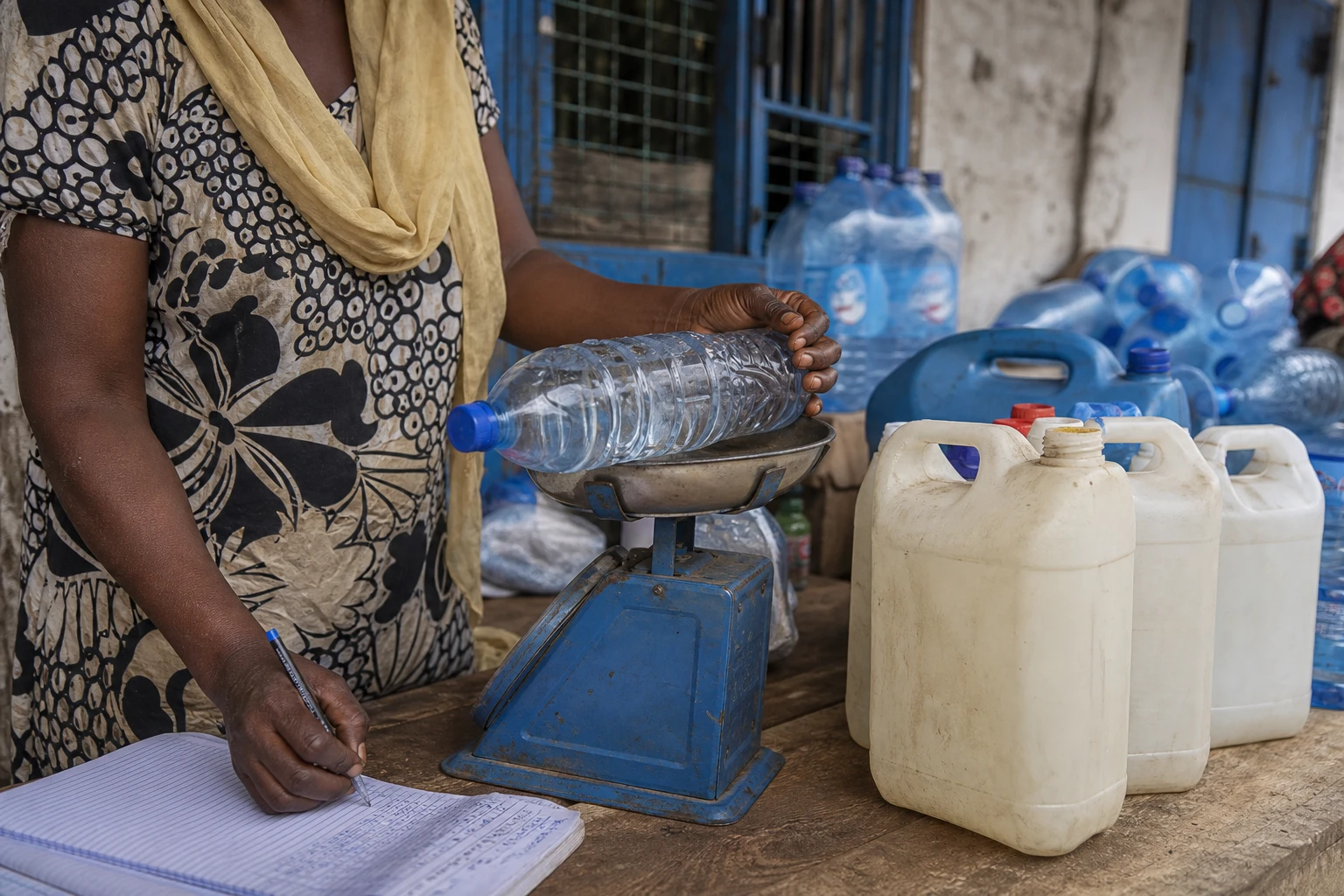
On the ground, the crisis is reflected in simple but exhausting routines. Waiting at dawn by a communal water point. Filling jerrycans. Alerting neighbours when the network finally starts flowing again. Some residents have to pay dearly for water when public taps run dry. In an urban economy already under pressure, this extra expense weighs especially heavily on large families and those with irregular incomes.
The issue goes beyond domestic comfort. Water scarcity increases health risks, undermines household hygiene and makes it harder for health centres to operate. The cholera outbreaks observed in Comoros in 2024 underscored how essential safe drinking water is to public health. UNICEF supported the emergency response in the country, including in Moroni, to limit transmission and secure water points.
The water crisis also affects social relations. When water is available only at certain hours, those who can wait have a better chance of filling their reserves. People who work far from home, live in precarious housing or lack sufficient storage are more exposed to interruptions. Inequality stems not only from the price of water, but also from the ability to be available at the right time.
A $15m project aims to bring change on a larger scale
In response, a major project has been launched: the National Water Resilience Project, funded by the World Bank to the tune of $15m. Its goal is clear: to improve access to water in Greater Moroni, strengthen service maintenance and bolster governance of the sector. The programme includes securing production, increasing storage and upgrading distribution.
The timetable remains the real question. Needs are immediate, but infrastructure work does not deliver results overnight. There may be a long wait for residents between short-term repairs, network reorganisation and the new equipment announced. The World Bank describes the project as the country’s first dedicated water financing operation, a sign that the sector has long been addressed piecemeal rather than treated as a structural priority.
In a capital where urban growth and fragile networks are advancing at the same pace, the challenge is not merely technical. It is also institutional. Investment must be sustained, responsibilities between the operator, the state and partners clarified, and emergency repairs must not take the place of fundamental reforms. Otherwise, the capital will continue to live to the rhythm of water cuts.
A Comorian issue, but also an African one
The case of Moroni resonates beyond the archipelago. More and more African capitals face the same equation: rapid urbanisation, ageing networks, a less stable climate and constrained public budgets. Water is becoming a tangible measure of a state’s ability to keep pace with the transformation of its main city. For Comoros, the issue also speaks to the place of climate resilience in national public policy and in the priorities supported by donors.
At regional level, the issue extends beyond the island. The small island economies of the Indian Ocean must contend with particular vulnerabilities: limited storage capacity, heavy reliance on central infrastructure and rapid exposure to climate shocks. Moroni is a reminder that a reliable water service is not merely an engineering matter. It is a condition for social stability, public health and institutional credibility.