Algeria
 Egypt
 Libya
 Morocco
 Sudan
 Tunisia
 Benin
 Burkina Faso
 Cabo Verde
 Côte d'Ivoire
 Ghana
 Guinea
 Guinea-Bissau
 Liberia
 Mali
 Mauritania
 Niger
 Senegal
 Sierra Leone
 The Gambia
 Togo
 Cameroon
 Central African Republic
 Chad
 DR Congo
 Equatorial Guinea
 Gabon
 Republic of the Congo
 São Tomé and Príncipe
 Burundi
 Comoros
 Djibouti
 Eritrea
 Ethiopia
 Kenya
 Madagascar
 Malawi
 Mauritius
 Mozambique
 Rwanda
 Seychelles
 Somalia
 South Sudan
 Tanzania
 Uganda
 Angola
 Botswana
 Eswatini
 Lesotho
 Namibia
 South Africa
 Zambia
 Zimbabwe
A private fortune, a public question
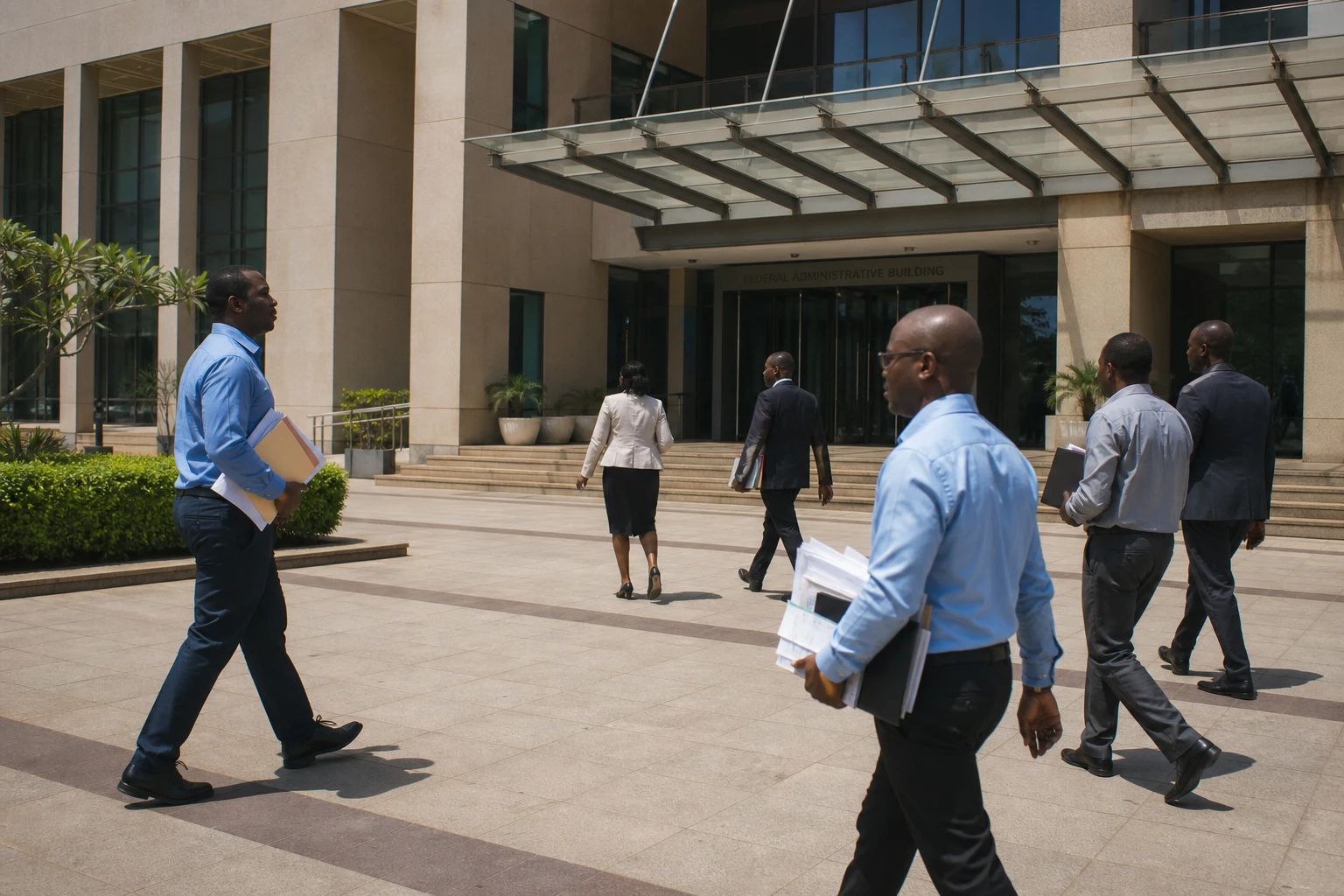
In Abuja, the discussion quickly moves beyond Aliko Dangote himself. When a fortune of this size pledges such a large share to philanthropy, the role of private enterprise in Nigeria’s essential services comes under scrutiny. In a country where the state remains under pressure over healthcare, education and social protection, the gesture matters both for what it funds and for the model it sets out.
Nigeria, West Africa’s largest economy and a pillar of ECOWAS, has for several years faced a public sector with constrained resources and a network of highly powerful private actors. It is against this backdrop that the announcement concerning the Nigerian magnate’s wealth must be understood: it touches on religion, family inheritance, the concentration of wealth and the way some of Africa’s biggest fortunes are arranging their succession.
What has been made public
The decision attributed to Aliko Dangote is to earmark 33% of his estate in his will for philanthropic causes. The information was made public by Halima Dangote, a trustee of the family foundation, who explained that the family had been informed and that she linked the provision to Muslim inheritance rules. In this context, the logic of a charitable bequest is unsurprising: under Islamic inheritance law, testamentary freedom can be exercised over a limited portion of an estate, often described as one-third, unless the heirs agree otherwise.
The potential sum is considerable. Bloomberg currently estimates Aliko Dangote’s fortune at about $35.9bn, close to the $35.1bn figure mentioned in the exchange reported around the family. At this level, a third amounts to tens of billions of dollars, far exceeding most private philanthropic budgets seen on the continent.
The announcement comes as the foundation established by the Dangote Group already has an endowment of $1.25bn, regularly described as the largest private foundation in sub-Saharan Africa. Foundation sources and institutional profiles also indicate that its work is focused mainly on Nigeria, with a broader presence elsewhere on the continent.
The weight of an established foundation
The significance of this pledge lies not only in its amount. It also lies in the framework it reinforces. The Dangote Group has already made its foundation a central instrument of its public presence, particularly in health and education. A significant share of its programmes is delivered in Nigeria, placing the federal government, state governments and private partners in a form of social co-production that has become common in the country.
The most notable precedent remains the fight against polio. The World Health Organization has noted that the African Region was certified free of wild poliovirus in 2020, after years of coordinated efforts by governments, UN agencies, foundations and community organisations. The Dangote Foundation was among the supporters of this effort, which explains why its name remains associated in Nigeria with philanthropy seen as highly tangible.
The approach is as typically Nigerian as it is African: charity does not operate only through sophisticated structures. It also flows through family, religion, community networks and long-term commitments. That is precisely why the US Giving Pledge, which invites the wealthy to give away at least half their wealth, is not enough to measure philanthropy on the continent. Sector experts point out that African giving does not always take the form of highly standardised, high-profile announcements.
An act of generosity, but also an economic signal
The timing matters. Dangote’s fortune has been boosted by the ramp-up of the Lekki refinery in Lagos, a complex announced as capable of processing 650,000 barrels a day. This infrastructure, which has become a symbol of industrial Nigeria, is one of the assets behind the recent expansion of his wealth.
In July 2026, Reuters reported that the refinery had raised $2.5bn in a private placement, ahead of a stock market listing planned for this year. Other press reports indicate that a listing on the Nigerian Exchange is being sought, with a valuation put at between $40bn and $50bn. If the deal goes ahead, the value of the share earmarked for philanthropy will rise mechanically, since the commitment is expressed as a percentage of the estate.
For Nigeria, the stakes go beyond Dangote alone. The country is still seeking ways to turn its great industrial fortunes into lasting gains for the many. The refinery reduces some of its dependence on imports of petroleum products, but it also concentrates unprecedented economic power in the hands of a single group. In Abuja and Lagos, the question is therefore not only how much will be given. It is what kind of institution will receive the money, under what rules, with what transparency and with what real impact on public services.
Continental implications and what to watch
This case resonates far beyond Nigeria. Oxfam notes that Africa accounts for a very large share of global inequality, and that the average income of the richest 1% there has grown five times faster than that of the poorest half since 2020. In this context, every great African fortune also becomes a debate about tax justice, redistribution and the social responsibility of economic elites.
Across the continent, billionaire philanthropy is increasingly being watched as a tool of influence as much as social assistance. The Dangote case illustrates this dual reality: the ability to act quickly, sometimes where the state is slow, but also the risk of leaving a private institution with functions that should remain collective. It is one of Africa’s major debates at present, from Lagos to Johannesburg and from Nairobi to Abidjan.
The next points to watch are therefore concrete: the outcome of the refinery’s stock market plans, any eventual listing, and then how the foundation announces, or does not announce, the future use of this testamentary pledge. At this stage, the essential point is already clear: Nigeria is not only watching the fortune of its most famous businessman. It is observing how that wealth will be passed on, institutionalised and, perhaps, turned into a public good.