Algeria
 Egypt
 Libya
 Morocco
 Sudan
 Tunisia
 Benin
 Burkina Faso
 Cabo Verde
 Côte d'Ivoire
 Ghana
 Guinea
 Guinea-Bissau
 Liberia
 Mali
 Mauritania
 Niger
 Nigeria
 Senegal
 Sierra Leone
 The Gambia
 Togo
 Cameroon
 Central African Republic
 Chad
 DR Congo
 Equatorial Guinea
 Republic of the Congo
 São Tomé and Príncipe
 Burundi
 Comoros
 Djibouti
 Eritrea
 Ethiopia
 Kenya
 Madagascar
 Malawi
 Mauritius
 Mozambique
 Rwanda
 Seychelles
 Somalia
 South Sudan
 Tanzania
 Uganda
 Angola
 Botswana
 Eswatini
 Lesotho
 Namibia
 South Africa
 Zambia
 Zimbabwe
An industrial gamble that goes beyond manganese
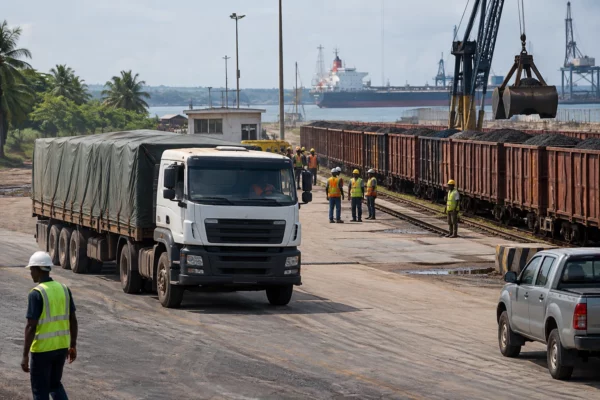
In Libreville, the real question is no longer simply how to export ore, but how to capture more value before it leaves the country. That is at the heart of the latest standoff between the Gabonese state and Eramet over manganese, a strategic resource of which Gabon is one of the world’s leading producers.
The issue forms part of a broader trend in Central Africa: states seeking to process a larger share of their raw materials locally rather than remain confined to the role of raw-material suppliers. In the CEMAC zone, this debate touches on jobs, public revenue, energy and the credibility of industrial policies.
Gabon’s context is also political. On 30 May 2025, the Council of Ministers set a ban on raw manganese exports from 1 January 2029, with a three-year transition period for investment in local processing. The policy was subsequently reaffirmed in a presidential statement.
What the protocol signed in Paris actually provides
On 20 July 2026, Eramet and the Gabonese state signed a memorandum of understanding in Paris on the manganese value chain. The agreement sets out a joint industrial roadmap and three scenarios under consideration to process up to 700,000 tonnes of manganese ore a year by the end of 2031. It also provides for a quarterly monitoring framework involving the group, Comilog and the Gabonese authorities.
But the timetable deserves close attention. The first scenario concerns a manganese oxide plant near Libreville, with an initial capacity of 10,000 tonnes a year and possible commissioning in late 2028, subject to a final investment decision. The second covers the refurbishment of the Moanda Metallurgical Complex, with a restart hoped for in late 2029 and up to 70,000 tonnes of alloys a year under consideration. The third, the most ambitious, targets 265,000 tonnes of alloys a year, but not before 2031, following a separate investment agreement and the securing of energy supplies by the Gabonese state.
In other words, the deadline before 2029 applies only to the most modest project. The decisive industrial venture, which could have a lasting impact on the value chain, remains scheduled for after the ban announced by Libreville. That is where the tension lies between the political timetable and the pace of industry.
Eramet, for its part, stresses the need for economic viability, technical studies and access to energy. The group also says it wants to develop a Gabonese biochar industry using by-products from the forestry industry and launch an industrial seed fund called “Made in Gabon”.
A key player already, but under financial strain
The French group is not entering new territory. It has been present in Gabon for more than 30 years, and Comilog remains the country’s leading manganese operator. The EITI Gabon report says Comilog accounted for more than 70% of national manganese production in 2022, confirming the sector’s central role in Gabon’s extractive economy.
This central position does not erase the current vulnerability. Eramet reported a net loss attributable to the group of €477 million for 2025. The group also approved a capital increase of up to €500 million in 2026 to strengthen its balance sheet.
In this context, Eramet’s ability to finance the new projects in Gabon quickly and on a large scale depends as much on its internal decisions as on public guarantees. The Gabonese state, which already holds 29% of Comilog according to the source material, wants to exert greater influence over local processing. This ambition is consistent with the policy set in Libreville since 2025: retain more value in the country, create industrial jobs and reduce dependence on raw exports.
The question of potential shareholders adds another layer of complexity. Discussions about Eramet’s ownership have been raised in public financial circles, but for Gabon the main issue lies elsewhere: whoever the future shareholder may be, local processing will remain a public-policy imperative if the 2029 target is maintained. This reading follows from the presidential text and the protocol signed in July 2026.
What Gabon wants to change, and what remains to be secured
Gabon’s decision says something broader about African economies rich in minerals. The country is challenging not just one way of exporting, but seeking to move up the value chain, where margins, expertise and some skilled jobs are created. On paper, the equation seems simple. In practice, it depends on electricity, infrastructure, skills and capital.
For the authorities, the issue is political and fiscal. Greater local processing could broaden the tax base, strengthen economic sovereignty and provide a visible response to calls for industrialisation. For companies, the challenge is more concrete: to build, finance, power and make heavy industrial plants profitable within deadlines compatible with Gabonese regulations. For local communities, the impact will depend on the quality of jobs created, local subcontracting and benefits for mining towns such as Moanda and for logistics corridors.
Energy remains the key issue. The protocol signed in Paris explicitly places this responsibility on the Gabonese state, which undertakes to secure supplies with support from third parties. This is crucial, because without reliable and affordable electricity, manganese processing remains an incomplete promise.
Gabon is therefore entering a delicate phase of alignment: an ambitious political timetable, a long-established industrial player and real financial constraints on the operator’s side. Success will depend on both parties moving from the protocol to firm investment, and then from financing to production. The credibility of the industrial shift announced in Libreville will be decided there, far beyond the mining sector alone.