
 Algeria
 Egypt
 Libya
 Morocco
 Sudan
 Tunisia
 Burkina Faso
 Cabo Verde
 Côte d'Ivoire
 Ghana
 Guinea
 Guinea-Bissau
 Liberia
 Mali
 Mauritania
 Niger
 Nigeria
 Senegal
 Sierra Leone
 The Gambia
 Togo
 Cameroon
 Central African Republic
 Chad
 DR Congo
 Equatorial Guinea
 Gabon
 Republic of the Congo
 São Tomé and Príncipe
 Burundi
 Comoros
 Djibouti
 Eritrea
 Ethiopia
 Kenya
 Madagascar
 Malawi
 Mauritius
 Mozambique
 Rwanda
 Seychelles
 Somalia
 South Sudan
 Tanzania
 Uganda
 Angola
 Botswana
 Eswatini
 Lesotho
 Namibia
 South Africa
 Zambia
 Zimbabwe
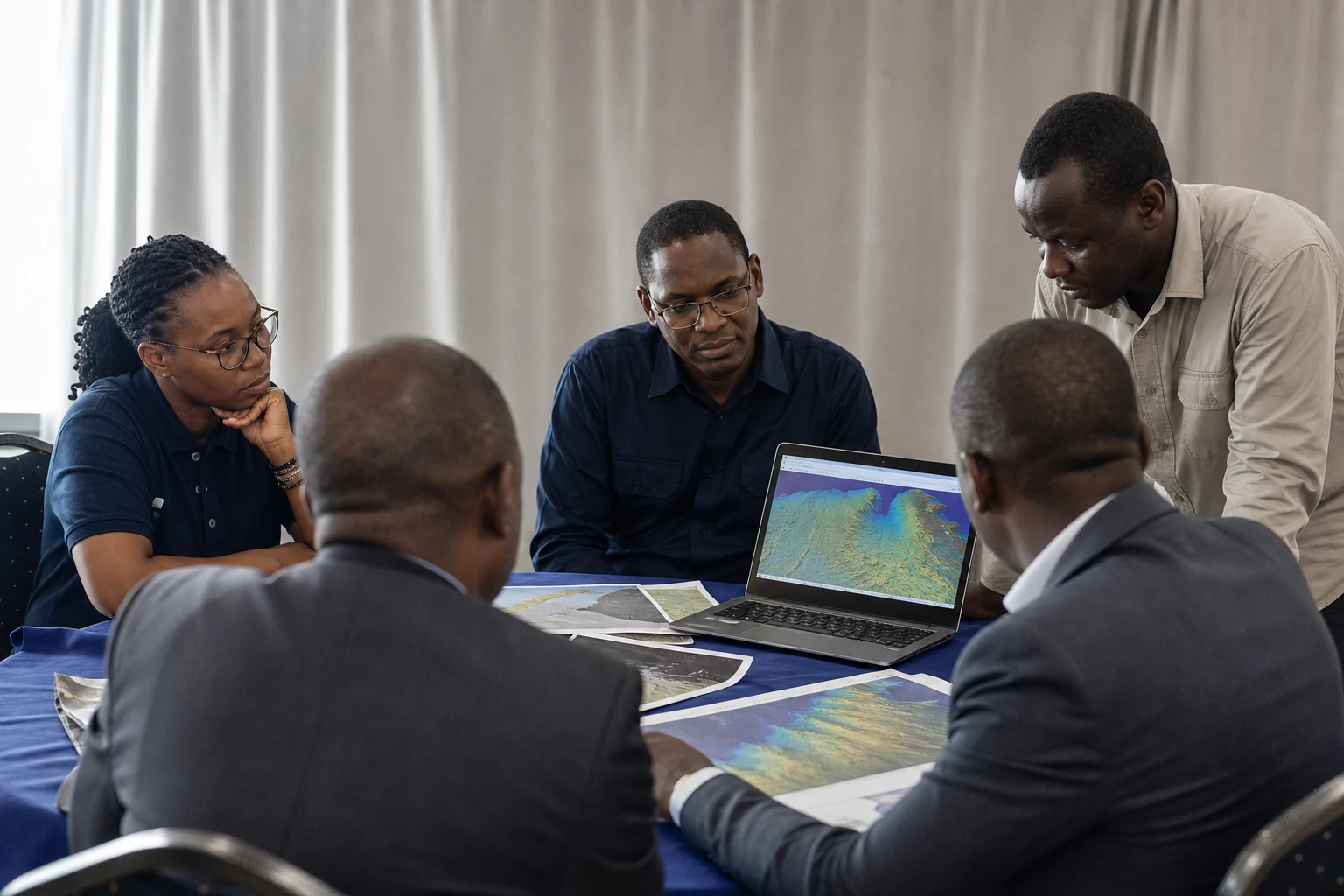
A little-known seabed off Cotonou
Off Cotonou, the Beninese seabed still holds surprises. For a long time, this area was viewed simply as a passage for fishing and shipping. It is now emerging as a place of biodiversity that needs protection, as well as a stretch of Benin’s coastline that remains poorly mapped.
Benin has about 125 kilometres of coastline on the Gulf of Guinea, in a West African region where the sea is central to fishing, transport and the blue economy — that is, all activities linked sustainably to marine resources. Within ECOWAS, coastal states are also seeking to secure their waters better and manage fish stocks more effectively, amid growing pressure on resources.
This new understanding of Benin’s coastline is also part of a broader national trajectory. The country highlights its innovation policies and environmental ambitions, but marine science remains underdeveloped there, as the researchers themselves have pointed out. For a country whose capital is Porto-Novo and whose economic life is concentrated largely in the south, the sea is not merely a tourist horizon: it is a strategic, scientific and food-producing space.
What the researchers actually observed
Between April and December 2025, a team led by Beninese researchers from the Benin Institute of Fisheries and Oceanological Research resumed work following earlier signs recorded in the 1960s. The first surveys, conducted in 1963-1964 by ORSTOM, later renamed IRD, had reported a coral barrier off Benin and Togo at depths of 52 to 56 metres. At the time, its biological condition remained uncertain.
The recent survey combined side-scan sonar with underwater video observations. The sonar helped identify hard structures along about 11.5 kilometres of transects, and then an underwater drone and a video system confirmed the presence of living coral communities at a depth of 54 metres on Benin’s continental shelf. The results showed at least six octocoral morphotypes, two black coral taxa and eight associated fish species.
The key point is scientific, but also a matter of terminology. This is not a large, continuous reef comparable to the world’s best-known coral barriers. The researchers instead describe a “mesophotic coral garden” — a living habitat in a zone where light is low, but where corals persist thanks to favourable local conditions. This distinction matters: it avoids overstating the discovery and better describes the reality of the Beninese seabed.
A discovery that matters for fishing, research and protection
The value of this area lies not only in the excitement of its rediscovery. It also lies in its ecological function. A reef or deep coral habitat can provide shelter for fish species, a breeding ground and a refuge from some fishing pressures. The researchers note that heavy fishing gear, such as trawls, would be unsuitable there and could damage the rocky structure and attached organisms.
For artisanal fishers along the coast, the stakes are twofold. On the one hand, any protected area can raise concerns if it restricts access to certain fishing grounds. On the other, better knowledge of habitats can help preserve stocks and prevent the quiet degradation of a resource on which some coastal incomes depend. The issue therefore concerns conservation as much as food security and livelihoods.
At an institutional level, the discovery also highlights the need to strengthen oceanographic research capacity in Benin. The researchers themselves said further missions would be needed to determine the ecosystem’s extent, take samples and reconstruct its history. In other words, the discovery opens up a broader programme of work rather than bringing one to a close.
A signal for the entire Gulf of Guinea
Beyond Benin, this development is of interest to the entire Gulf of Guinea. ECOWAS is already working on maritime security, illegal fishing and the blue economy in a region where states are seeking to coordinate the monitoring of maritime areas more effectively. Confirmation of a coral habitat on Benin’s continental shelf is a reminder that the West African sea remains under-documented, even in areas close to the coast and fishing routes.
It also sheds light on a point often underestimated in regional public policy: scientific knowledge comes before sustainable management. Without detailed mapping, it is difficult to define conservation areas, prevent competing uses or direct investment towards a genuinely sustainable maritime economy. This issue extends beyond Benin and concerns several West African coastal countries, from Mauritania to Nigeria, all facing the same tension between exploitation, protection and maritime sovereignty.
What happens next will depend on the ability of Beninese authorities, scientific teams and their partners to turn a one-off discovery into a monitoring programme. The question is no longer simply whether the reef exists. It is now about understanding how far it extends, which species it shelters and what role it plays in Benin’s marine ecosystem. In a region where the sea provides food, transport and connections, the answer will matter far beyond the waters off Cotonou.



