Egypt
 Libya
 Morocco
 Sudan
 Tunisia
 Benin
 Burkina Faso
 Cabo Verde
 Côte d'Ivoire
 Ghana
 Guinea
 Guinea-Bissau
 Liberia
 Mali
 Mauritania
 Niger
 Nigeria
 Senegal
 Sierra Leone
 The Gambia
 Togo
 Cameroon
 Central African Republic
 Chad
 DR Congo
 Equatorial Guinea
 Gabon
 Republic of the Congo
 São Tomé and Príncipe
 Burundi
 Comoros
 Djibouti
 Eritrea
 Ethiopia
 Kenya
 Madagascar
 Malawi
 Mauritius
 Mozambique
 Rwanda
 Seychelles
 Somalia
 South Sudan
 Tanzania
 Uganda
 Angola
 Botswana
 Eswatini
 Lesotho
 Namibia
 South Africa
 Zambia
 Zimbabwe
A week in which African capitals turned to levers of power
In several capitals across the continent, diplomacy has served not only to salute allies. It has also been used to secure very tangible ambitions: a candidacy at the UN, an Atlantic gas corridor, local mineral processing, and a firmer African voice in response to violence against the continent’s nationals in South Africa. These political gestures are best read as economic and strategic choices, not as mere protocol.
This shift says something about the present moment in Africa. States are seeking to secure alliances, add value to their raw materials at home and wield greater influence in multilateral institutions. In this context, ECOWAS (the Economic Community of West African States) remains a key forum for regional integration, while the African Union is the arena where capitals seek to turn national problems into continental issues.
The Atlantic gas pipeline, a symbol of integration moving from words to pipes
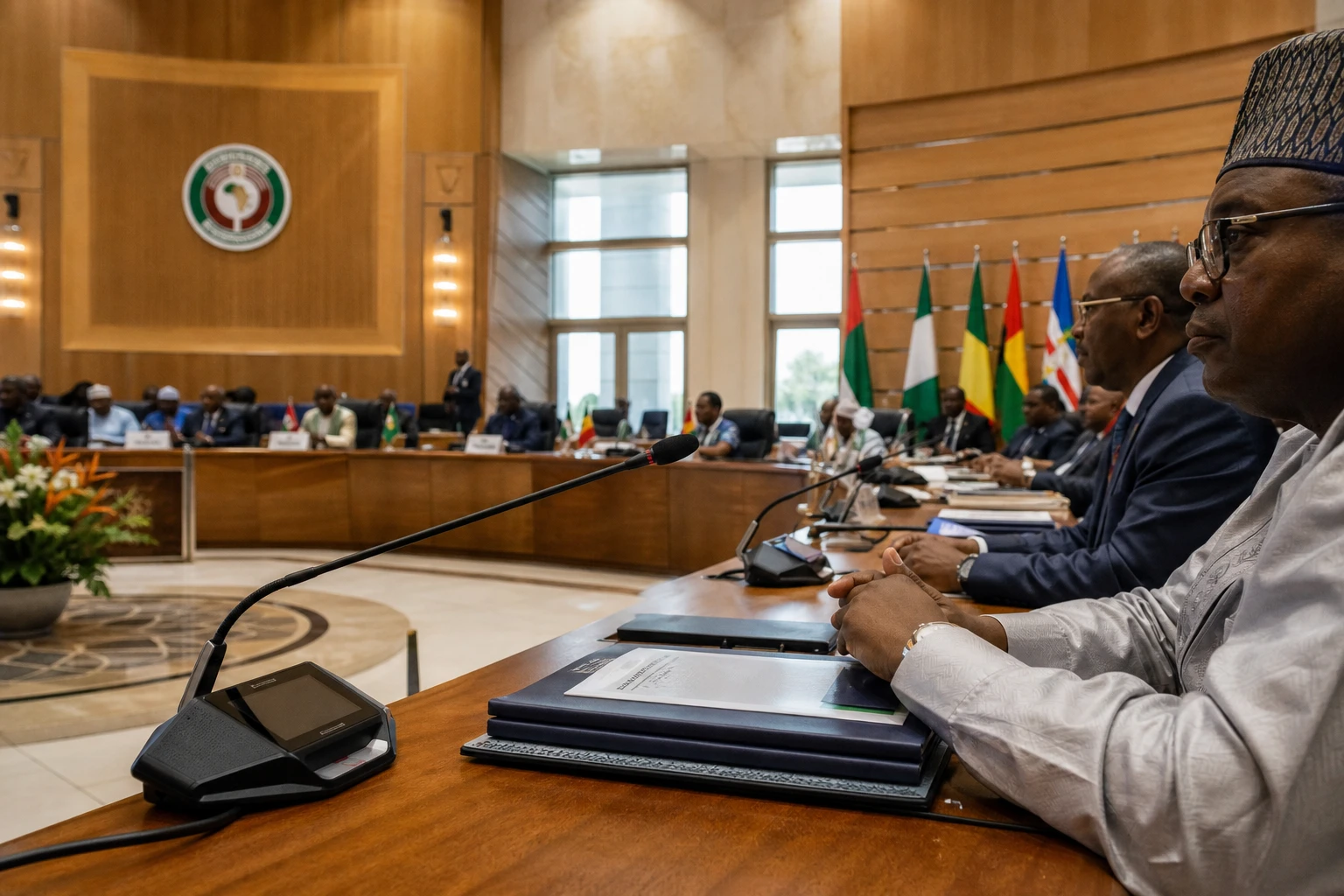
The week’s most consequential issue unfolded in Freetown, Sierra Leone. At the 69th ECOWAS summit on 19 July 2026, heads of state signed an intergovernmental agreement supporting the African Atlantic gas pipeline project, led by Nigeria and Morocco. The infrastructure is intended to link the Gulf of Guinea to the Maghreb along the Atlantic coast, over approximately 6,000 to 6,800 kilometres, depending on the source, and cross 13 African countries.
The project is not new. It was launched in 2016 and has long advanced in stages, through technical studies, financial decisions and political negotiations. The signing in Freetown gives it a different scope: it places it more clearly within a West African framework, rather than a purely bilateral one. The project company’s headquarters are to be based in Casablanca, while the pipeline’s governing authority is expected to be in Abuja, reflecting a shared leadership role for Morocco and Nigeria.
On paper, the issue is energy. The corridor is intended to carry up to 30 billion cubic metres of gas a year to regional markets and, eventually, to Europe via Morocco’s gas network. But in practice, it also says something else: the countries along the route are seeking infrastructure that can link production, transport, industrialisation and tax revenues. For countries such as Senegal, Mauritania, Côte d’Ivoire, Ghana and Benin, the interest is not simply in becoming transit countries. It is also about attracting investment, securing electricity supplies and supporting still-fragile local industries.
The project nevertheless carries high expectations. A gas pipeline of this scale requires massive financing, lasting political stability and technical coordination that few regions manage to sustain over the long term. The Freetown signing should therefore be read as a decisive political step, but not as a guarantee of rapid delivery. The history of African infrastructure shows that a regional agreement can open a window of opportunity without, by itself, dispelling risks over timing, security and profitability.
Dakar, Libreville and the choices involved in asserting sovereignty
In Senegal, Dakar’s official backing for Macky Sall’s candidacy for the post of United Nations secretary-general came as a surprise because of its symbolic weight. Bassirou Diomaye Faye endorsed the position in a ministerial statement on 20 July 2026, after receiving his predecessor at the presidential palace a few days earlier. Macky Sall said the decision “honours” him, according to words reported by his communications team.
This choice goes beyond the relationship between two men. It reflects a particular Senegalese political culture, in which the transition of power is still recent and former rivalries can be temporarily set aside in the name of diplomatic interests. It also underlines that, in Dakar, foreign policy is not separate from domestic balances. Backing a former head of state for the UN is a bid for influence, but also a signal of institutional continuity to a public attentive both to gestures of rupture and to gestures of conciliation.
In Libreville, President Brice Oligui Nguema made a state visit to France from 19 to 22 July 2026. Talks with Emmanuel Macron covered military cooperation, the future of Camp de Gaulle and the local processing of manganese, a strategic resource for Gabon. A memorandum of understanding on the manganese value chain was also signed in Paris, in the presence of Gabonese officials and representatives of Eramet, a major player in the sector.
The message is clear. Libreville wants to extract more value from its minerals before exporting them raw, while Paris is seeking to preserve its position in a country whose balance of power has changed since the August 2023 coup and the ensuing transition. The issue of Camp de Gaulle, a military base that has become the subject of political redefinition, shows that defence cooperation is no longer taken for granted. It must now be aligned with a more assertive Gabonese discourse on economic sovereignty.
A continental significance that goes beyond diplomatic events
Taken together, these events tell the story of an Africa that no longer wants to be merely the subject of external agendas. ECOWAS is seeking to project influence through infrastructure; Dakar is using diplomacy to gain weight in multilateral affairs; and Libreville is trying to turn its mineral resources into industrial power. At the same time, the continent continues to face tensions that require its institutions to respond, whether violence against migrants in South Africa or the place the African Union should give these issues at its coming summits.
The underlying theme this week is therefore less a string of separate announcements than a reshaping of the balance of power. African capitals are seeking room for manoeuvre, but they know they will then have to turn it into action: financing the gas pipeline, building up Gabon’s industry, clarifying Senegal’s UN bid, or providing practical protection for African nationals abroad. The credibility of this week’s promises will be tested there in the months ahead.