Algeria
 Egypt
 Libya
 Morocco
 Tunisia
 Benin
 Burkina Faso
 Cabo Verde
 Côte d'Ivoire
 Ghana
 Guinea
 Guinea-Bissau
 Liberia
 Mali
 Mauritania
 Niger
 Nigeria
 Senegal
 Sierra Leone
 The Gambia
 Togo
 Cameroon
 Central African Republic
 Chad
 DR Congo
 Equatorial Guinea
 Gabon
 Republic of the Congo
 São Tomé and Príncipe
 Burundi
 Comoros
 Djibouti
 Eritrea
 Ethiopia
 Kenya
 Madagascar
 Malawi
 Mauritius
 Mozambique
 Rwanda
 Seychelles
 Somalia
 South Sudan
 Tanzania
 Uganda
 Angola
 Botswana
 Eswatini
 Lesotho
 Namibia
 South Africa
 Zambia
 Zimbabwe
When a necropolis tells more than a story of ruins
North of Khartoum, in a stretch of desert crossed by the Nile, Meroë is more than an archaeological backdrop. The site also speaks to what Sudan still holds most firmly: an ancient memory, monumental craftsmanship and a central place in Nubian history. As the country endures a war that is weakening its institutions, this memory has taken on political as well as heritage value.
The site is part of a wider complex, the “Island of Meroë”, inscribed on the UNESCO World Heritage List in 2011. The complex includes the royal city of Meroë, the religious site of Naqa and the site of Musawwarat es-Sufra. UNESCO notes that this territory was the heart of the Kingdom of Kush, a major power from the 8th century BC to the 4th century AD. Sudan has three World Heritage properties, two of them cultural, placing Meroë within a rich national heritage landscape that has long been underrepresented in international narratives.
An African kingdom, ancient exchanges and a heritage under pressure
The Kingdom of Kush was no peripheral player in antiquity. It even ruled Egypt for nearly a century and maintained exchanges with the African interior, the Nile Valley and the Mediterranean. Meroë has preserved pyramids, temples, domestic buildings and water-management installations. UNESCO also notes that archaeological research carried out since the late 19th century left behind spoil heaps that disrupt the authenticity of the landscape. In other words, the site is both magnificent and vulnerable.
This vulnerability is not just the result of time. When the site was inscribed on the World Heritage List, several threats had already been identified: agricultural pressure, mining projects, road traffic, desertification, wind erosion and incomplete management. The highway linking Khartoum to Port Sudan cuts the site in two visually and acoustically, while a high-voltage power line further affects its integrity. The problem is therefore not abstract. It is concrete, visible and linked to Sudan’s development choices.
In this context, excavations and conservation work have become more difficult. UNESCO says that, since 2023, armed conflict has been among the factors affecting the property. In its 2024 report, the organisation notes that the National Corporation for Antiquities and Museums, or NCAM, has almost stopped operating. It also reports that field visits have been interrupted, neighbouring areas have been mined, and guards have reported cases of looting and armed presence near other components of the property.
What war means for monuments, residents and the local economy
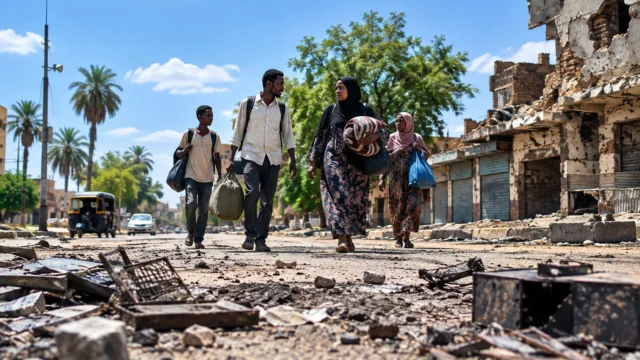
At Meroë, war is not only destroying stones. It is changing how the site is used. UNESCO reports that in 2024, mass displacement from combat zones led to uncontrolled visits, bringing risks of graffiti, falling stones and greater pressure on infrastructure. This kind of forced influx is nothing like cultural tourism. Rather, it reflects the imposed coexistence of refuge, survival and heritage.
The shock is economic too. Before the war, Meroë could support modest but real cultural tourism, providing local jobs in security, guiding, transport and informal accommodation. Today, travel within the country remains difficult, access is uneven and insecurity weighs on visitors and neighbouring communities alike. Yet the site retains rare potential: it could still support a revival of heritage tourism if roads, security and conservation measures are in place.
There are, however, responses under way. In 2025, a field report on the royal pyramids of Meroë described urgent interventions on several monuments, particularly to address sand accumulation, damp and the deterioration of sandstone. The document mentions support from Germany and the United States, as well as cooperation with NCAM. It shows that Meroë’s preservation still depends on international scientific networks, but also on Sudanese expertise that remains active despite the disruptions.
This heritage work has wider significance. In January 2026, Sudan announced the recovery of 570 artefacts looted during the conflict, following cooperation with Interpol and UNESCO. The episode is a reminder that museums, storerooms and archaeological sites form a single ecosystem of memory. When one part is looted, the whole is weakened. Meroë thus becomes a symbol: protecting a site also means defending the country’s historical narrative.
A Sudanese matter, but a continental one too
For Africa, Meroë makes a decisive point: the continent’s antiquity cannot be reduced to Egypt or to imported narratives. The site recalls that an African kingdom produced distinctive funerary architecture, a powerful political organisation and its own visual culture. This reality was long relegated to the margins of textbooks. Today, it is re-emerging as a source of knowledge, pride and cultural sovereignty.
The issue also has a regional dimension. Sudan is part of cooperation frameworks directly concerned with heritage protection, notably the African Union and IGAD, the Intergovernmental Authority on Development, which is relevant here because the Sudanese crisis is spilling over into the Horn of Africa. As front lines shift, roads close and cultural institutions weaken, historic sites immediately pay the price of regional instability. Meroë is therefore a barometer: of Sudan’s ability to preserve its heritage amid war, and of the place Africa intends to give its own civilisations in its shared narrative.