Algeria
 Egypt
 Libya
 Morocco
 Sudan
 Tunisia
 Benin
 Burkina Faso
 Cabo Verde
 Côte d'Ivoire
 Ghana
 Guinea
 Guinea-Bissau
 Liberia
 Mali
 Mauritania
 Niger
 Nigeria
 Senegal
 Sierra Leone
 The Gambia
 Togo
 Cameroon
 Central African Republic
 Chad
 DR Congo
 Equatorial Guinea
 Gabon
 Republic of the Congo
 São Tomé and Príncipe
 Burundi
 Comoros
 Djibouti
 Eritrea
 Ethiopia
 Kenya
 Madagascar
 Mauritius
 Mozambique
 Rwanda
 Seychelles
 Somalia
 South Sudan
 Tanzania
 Uganda
 Angola
 Botswana
 Eswatini
 Lesotho
 Namibia
 South Africa
 Zambia
 Zimbabwe
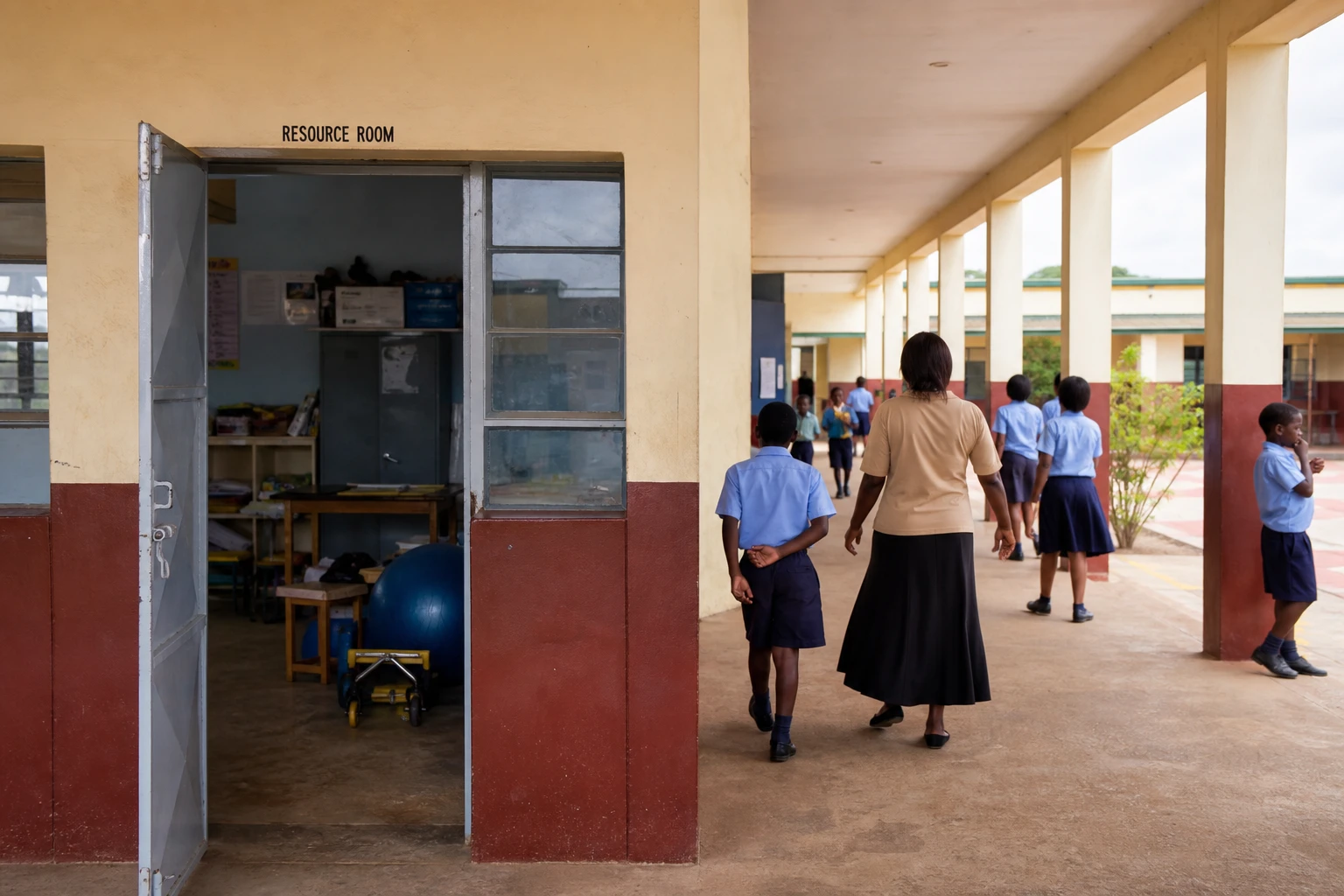
In Lilongwe, inclusive education moves from promises into the classroom
In Malawi, the question is no longer just how to open the doors of schools. It is also how to ensure that Malawian children living with disabilities can stay, learn and make progress in appropriate conditions. In Lilongwe, this effort is now centred on a practical tool: a resource room at Chamwasongwe Primary School, designed to support pupils with special educational needs.
The issue, however, extends beyond a single school. Malawi is a member state of SADC, the Southern African Development Community, which brings together 16 countries in the region and also focuses on social cohesion, public services and inclusive education. In this context, schools are a measure of public capacity: they show what the state can guarantee, as well as what it still needs to build with its partners.
Public-NGO partnership addresses practical gaps
On 20 July 2026, Malawi’s Ministry of Education presented the initiative as support for the inclusion of children living with disabilities. It is part of the RISE project, or Realising Inclusive and Safe Education, implemented with Link Community Development Malawi and led by Link Education International. The programme is funded by the Scottish Government.
The figures indicate the scale of the project. According to programme presentation documents, RISE mobilises £7.5 million, or just over $10 million, across several countries, including Malawi. In the country, the stated goal is to reach 108 schools, train nearly 2,000 teachers and school leaders, and benefit 134,119 learners, including 4,527 children living with disabilities.
Malawi’s ministry said the project had already enabled the installation of resource rooms and the distribution of assistive equipment. The official statement refers to 20 equipped rooms, as well as devices to facilitate learning for the pupils concerned. This approach responds to a legal and social reality already recognised in the country: Malawian law defines inclusive education as a process aimed at reducing exclusion in education and responding to the diversity of learners’ needs.
Real progress, but a system that remains too limited
Progress is being made, but it remains fragile. The ministry said the primary school enrolment rate for children with disabilities had risen from 4 to 6 per cent. This is progress, but from a very low base. At the same time, only 4 per cent of primary schools, or about 209 schools, have specialist teachers. In other words, access is expanding faster than the human resources available to support these pupils over the long term.
Field data confirm this gap. A Link publication on RISE in Malawi reports that 2,443 teachers have been trained in inclusive education and Universal Design for Learning, an approach designed to make teaching accessible to pupils with a range of learning profiles. The project also mentions assistive devices, referrals to specialist services and early identification activities. This shows that inclusion depends not only on words, but on a combination of technical measures, training and health and social support.
The challenge is even more pronounced in rural areas. In less well-resourced schools, a lack of adapted materials, appropriate furniture or trained professionals can turn school enrolment into a purely administrative presence. By contrast, in urban centres such as Lilongwe, targeted partnerships can accelerate results. This divide between the capital and outlying areas weighs heavily in a country where public resources remain constrained and needs are dispersed.
A valuable signal for southern Africa as aid tightens
The funding aspect also gives this initiative broader significance. The OECD forecasts a fall in official development assistance to sub-Saharan Africa in 2025 and 2026, with education under particular pressure. It also anticipates a marked decline in aid for education, including primary schooling. In this context, programmes such as RISE become strategic because they support sectors in which the Malawian state still needs to strengthen its own capacity.
Malawi is therefore making progress in small steps, but in a clear direction: making inclusion public policy rather than a one-off initiative. The signal for southern Africa is important. It is a reminder that an accessible school is more than an open building. It requires prepared teachers, adapted tools, identification services and lasting coordination between government, local authorities, NGOs and donors. That is where the promise of education for all is realised in practice.