Algeria
 Egypt
 Libya
 Morocco
 Sudan
 Tunisia
 Benin
 Burkina Faso
 Cabo Verde
 Ghana
 Guinea
 Guinea-Bissau
 Liberia
 Mali
 Mauritania
 Niger
 Nigeria
 Senegal
 Sierra Leone
 The Gambia
 Togo
 Cameroon
 Central African Republic
 Chad
 DR Congo
 Equatorial Guinea
 Gabon
 Republic of the Congo
 São Tomé and Príncipe
 Burundi
 Comoros
 Djibouti
 Eritrea
 Ethiopia
 Kenya
 Madagascar
 Malawi
 Mauritius
 Mozambique
 Rwanda
 Seychelles
 Somalia
 South Sudan
 Tanzania
 Uganda
 Angola
 Botswana
 Eswatini
 Lesotho
 Namibia
 South Africa
 Zambia
 Zimbabwe
When Africa seeks capital, the question is no longer just about resources, but about the rules
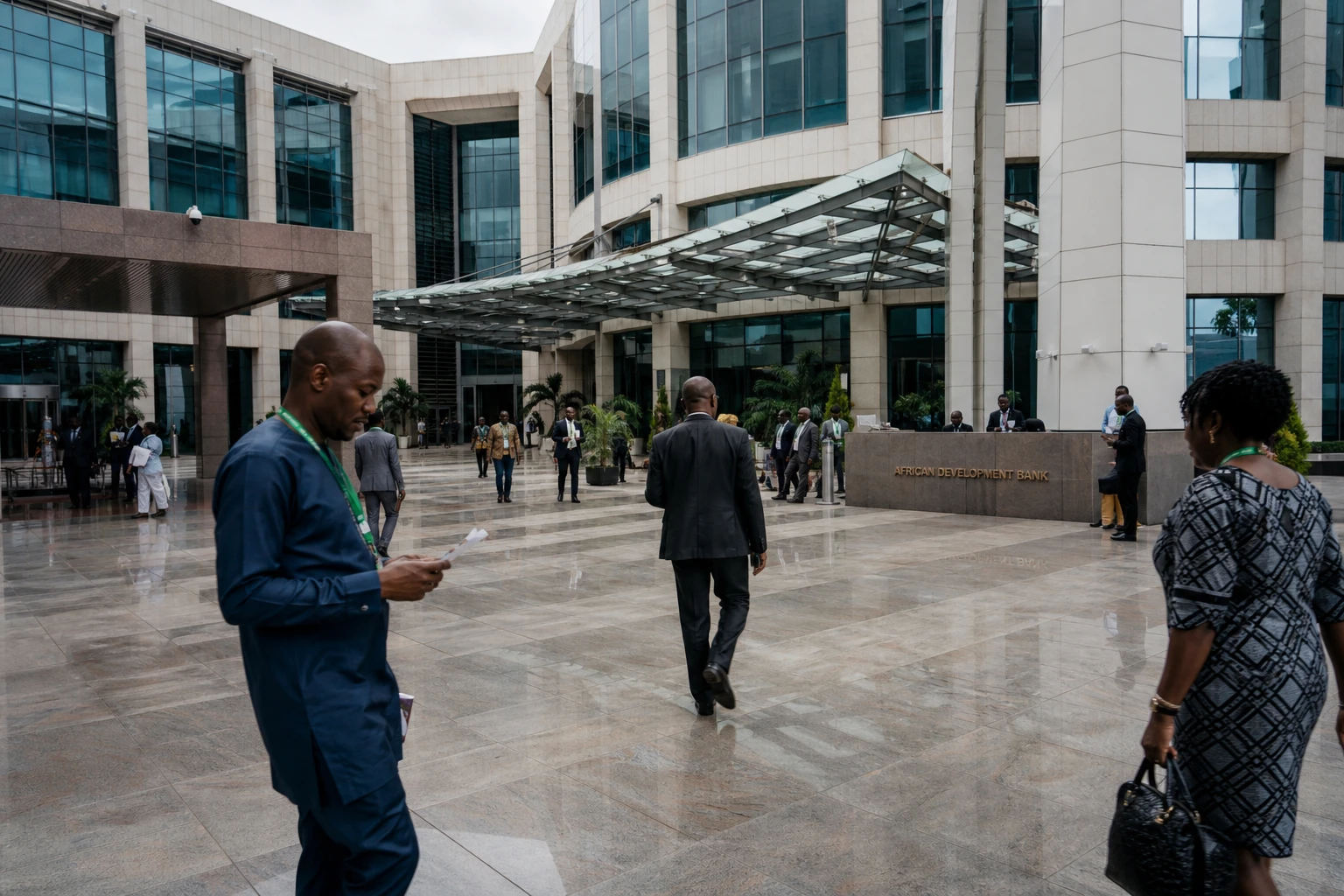
In Abidjan, the discussion moved beyond simply acknowledging the lack of financing. It focused on a tougher question: how can an African economy finance its businesses, protect its nascent sectors and retain control over its growth when global trade is fragmenting and major powers are multiplying subsidies, barriers and reshoring efforts? The African Economic Conference 2026, held from 10 to 12 July at the headquarters of the African Development Bank, placed this debate at the centre of the continental agenda.
For Côte d’Ivoire, the choice of Abidjan is no coincidence. The country’s economic capital has become a focal point for debates on African finance, while the country remains one of West Africa’s economic powerhouses. The African Development Bank estimates that Côte d’Ivoire’s economy grew by 6.5% in 2025, after 6.0% in 2024, amid reforms and sustained public investment. This trajectory lends weight to the message being delivered in the city: regional integration and industrial upgrading are no longer theoretical options, but conditions for economic stability.
A new African financial architecture moves from concept to mechanics
At the heart of the debate is the New African Financial Architecture for Development, or NAFAD. The AfDB has made it a flagship initiative to better mobilise domestic savings, strengthen African financial markets, improve risk-sharing and attract more capital. At a consultative dialogue held in Abidjan in April, the Bank secured agreement on an 11-point consensus, with a clear promise: to reduce an annual development financing gap that the institution puts at $400bn. In May, the Bank’s governors also called for the reform of the continent’s financial architecture to be accelerated.
The economic message is simple. If national banks, regional development banks, sovereign wealth funds, pension funds and commercial banks each work in their own lane, Africa remains fragmented. The AfDB is therefore pushing four levers at once: subsidiarity, complementarity, cooperation and the intelligent transformation of risk. The idea is to finance the right project at the right level, then de-risk it sufficiently to lower the risk premium that makes credit more expensive across the continent. This is no technical detail. It is the difference between projects that remain on paper and factories, roads, power plants or logistics platforms that get built.
Subsidise, protect, invest: the dilemma is global, but Africa has fewer tools at its disposal
The most political aspect of the debate concerns international competition. The AfDB argues that trade openness only makes sense if the rules are comparable for everyone. Otherwise, African SMEs face competitors already backed by public subsidies, subsidised loans or assertive industrial policies. The argument is a concrete one: an “open” market can in reality remain closed to local producers if their financing, energy or transport costs are still too high. In that case, openness mainly benefits imports.
The figures lend weight to this warning. The United Nations Economic Commission for Africa notes that intra-African trade remains low, at around 17% to 18% depending on the year and calculation method, far below the continent’s potential. The same institution also points out that Africa’s share of global trade remains below 3%, confirming the continent’s limited weight in global value chains. In other words, Africa still exports too many raw materials and imports too many processed products. Until this structure changes, growth will create few sustainable industrial jobs for young people and women.
This is where the African Continental Free Trade Area, or AfCFTA, comes into its own. It was not designed to produce fine speeches, but to expand the market for African producers. The AfDB and the ECA agree on one point: without a stronger expansion of intra-African trade, effective rules of origin and regional logistics, the industrial promise will remain incomplete. The continent often talks about integration. The real question now is implementation.
What this means for Côte d’Ivoire and West Africa
For Ivorians, the stakes are twofold. On the one hand, Côte d’Ivoire wants to consolidate its position as the WAEMU’s logistics, financial and industrial hub. On the other, it must turn growth into more jobs that are more evenly distributed, particularly beyond Abidjan. A regional policy that better protects nascent industries could stimulate local processing of cocoa, agricultural products, construction materials and textiles. Conversely, poorly calibrated openness would leave local SMEs on the front line against cheaper imports.
The debate is also institutional. ECOWAS has been seeking for years to ease trade, but progress remains constrained by infrastructure, customs procedures and differences in industrial policy among member states. In this context, the call for “smart” trade agreements reflects a broader African reality: economic sovereignty does not mean isolation, but the ability to negotiate without sacrificing productive sectors. The AfDB takes the same view at continental level. It wants to anchor development financing in African instruments, rather than in permanent dependence on external capital.
The continental signal is clear: Africa wants to have a say, but it must first coordinate better
The political context reinforces this view. Since the African Union’s admission as a permanent member of the G20, confirmed by the AU after the 2023 New Delhi summit, the continent has had a new platform from which to defend its interests in global economic governance. But a seat at the G20 is not enough. A clear mandate, common positions and credible financial instruments are needed. This is precisely what the AfDB is seeking to build through NAFAD and networks of African financing institutions.
The continental significance lies here: Africa lacks neither markets, nor resources, nor young people. It still lacks alignment among its banks, states, RECs, trade policies and industrial priorities. In the short term, attention will focus on the practical application of NAFAD, the implementation of the AfCFTA and the ability of states to support their SMEs without creating rent-seeking opportunities. In the medium term, the real measure of success will be visible in factories, jobs and processed exports, not declarations of principle.