Algeria
 Egypt
 Libya
 Morocco
 Sudan
 Tunisia
 Benin
 Burkina Faso
 Cabo Verde
 Côte d'Ivoire
 Ghana
 Guinea
 Guinea-Bissau
 Liberia
 Mali
 Mauritania
 Niger
 Nigeria
 Senegal
 Sierra Leone
 The Gambia
 Togo
 Cameroon
 Central African Republic
 Chad
 DR Congo
 Equatorial Guinea
 Gabon
 Republic of the Congo
 São Tomé and Príncipe
 Burundi
 Comoros
 Djibouti
 Eritrea
 Ethiopia
 Madagascar
 Malawi
 Mauritius
 Mozambique
 Rwanda
 Seychelles
 Somalia
 South Sudan
 Tanzania
 Uganda
 Angola
 Botswana
 Eswatini
 Lesotho
 Namibia
 South Africa
 Zambia
 Zimbabwe

When a fibre becomes a survival strategy
In south-eastern Kenya, drought is no longer an isolated episode. It weighs on harvests, incomes and farming choices. In this context, sisal is attracting attention because it grows where maize and some legumes struggle, with less water and fewer inputs.
But it is not a simple bet. Sisal requires time, capital and market access. Yet in arid and semi-arid areas such as Taita-Taveta, the crop offers a practical option for farms seeking to secure an income without relying entirely on rainfall.
Taita-Taveta, a region shaped by cash crops and climate
Taita-Taveta, in Kenya’s coastal region, remains one of the country’s main sisal-growing areas. Kenya classifies the fibre as an export crop, grown mainly in eleven arid and semi-arid counties. The public body responsible for fibres also says that nearly 95% of the sisal produced in Kenya is exported.
The issue goes beyond agriculture alone. In Nairobi, authorities responsible for arid and semi-arid areas have made climate resilience a pillar of public policy, while the National Drought Management Authority closely monitors exposed counties. Taita-Taveta regularly features in these monitoring systems, even when conditions there are classified as normal.
Smallholders join a sector dominated by large estates
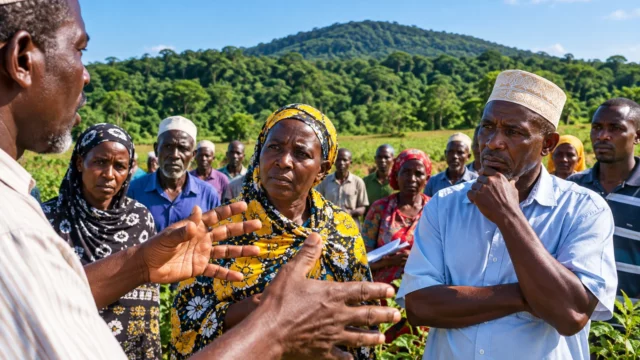
On the ground, the sector remains largely structured around large plantations. But smallholders are beginning to enter it. The idea is simple: turn a hardy plant into a steady source of income, provided they accept a slow start. Small-scale farmers then sell their harvest to larger estates, joining an established supply chain.
A producer in Taita-Taveta says she planted her first sisal plants several years ago and harvests twice a year. Her experience illustrates one of sisal’s main attractions: the plant withstands prolonged periods of drought without intensive irrigation, reducing production costs in areas where water is scarce. This resilience makes it a diversification crop, not a miracle solution.
A promising sector, but slow to finance
The main obstacle is not agronomic. It is financial. Sisal first requires a nursery period of about two years, followed by several more years before the first commercial harvests. In practice, it often takes nearly five years before it generates a genuinely useful income. For low-income rural households, that delay remains a major barrier.
There is also the cost of decortication equipment, which is essential for extracting fibre from the leaves. Without this equipment, producers are confined to selling raw material and capture little added value. The potential is there, however: global demand exceeds supply, according to the sector’s technical services, and Kenya is seeking to better organise this value chain.
What the crop means for the local economy
For rural families, sisal serves several purposes at once. It provides supplementary income, protects soils from erosion and can be used to make baskets locally, drawing on a craft tradition found in the region. This dual agricultural and artisanal role is important: it reduces dependence on a single source of income and creates opportunities for women and small entrepreneurs.
For large farms, by contrast, the stakes are different. They remain the main producers, control volumes and organise exports. Smallholders still depend on them for access to markets, processing and sometimes transport. This is where the real battle lies: not simply in growing more, but in distributing the value created more fairly.
A lesson for East Africa
Kenya’s experience resonates beyond Taita-Taveta. In the Horn of Africa and across East Africa, more frequent droughts are prompting governments to seek crops suited to dry areas. Sisal is not a universal answer, but it shows how an export sector can also serve as a tool for climate adaptation.
For Kenya, the question to watch is local industrialisation. As long as almost all the fibre is exported raw, the country captures only a limited share of the wealth. If processing expands, the sector could support more jobs, co-operatives and artisanal activity in arid counties, at the intersection of agriculture, climate and regional trade.