Algeria
 Egypt
 Libya
 Morocco
 Sudan
 Tunisia
 Benin
 Burkina Faso
 Cabo Verde
 Côte d'Ivoire
 Ghana
 Guinea
 Guinea-Bissau
 Liberia
 Mali
 Niger
 Nigeria
 Senegal
 Sierra Leone
 The Gambia
 Togo
 Cameroon
 Central African Republic
 Chad
 DR Congo
 Equatorial Guinea
 Gabon
 Republic of the Congo
 São Tomé and Príncipe
 Burundi
 Comoros
 Djibouti
 Eritrea
 Ethiopia
 Kenya
 Madagascar
 Malawi
 Mauritius
 Mozambique
 Rwanda
 Seychelles
 Somalia
 South Sudan
 Tanzania
 Uganda
 Angola
 Botswana
 Eswatini
 Lesotho
 Namibia
 South Africa
 Zambia
 Zimbabwe
The sea, ever farther from departure than from destination
Along Mauritania’s Atlantic coast, the crossing to the Canary Islands is measured not only in nautical miles. It is measured in families left without news, exhausted survivors and bodies the ocean does not always give back. This week, a new tragedy was a reminder that the Atlantic route remains one of the deadliest between West Africa and Europe.
Mauritania, and Nouadhibou in particular, once again finds itself at the intersection of several dynamics: departures from the sub-region, rescue operations at sea, the reception of survivors, and constant pressure on local authorities and humanitarian actors. In a West African region beset by economic crises, the effects of climate change and insecurity in the Sahel, the sea has become, for many, an option perceived as more accessible than waiting at home.
What happened between 14 and 18 July
Between 14 and 18 July, three rescue and disembarkation operations brought 387 people ashore in Nouadhibou, in north-western Mauritania, according to the United Nations High Commissioner for Refugees. At the same time, the UN agency reported that 144 people had died or were missing off the country’s coast during the week of 13 to 19 July.
The most dramatic case involved a boat that departed from Bufalo, in Gambia, bound for Spain. It is believed to have been at sea for nearly 25 days before being rescued on 18 July. Of its passengers, 38 survived, while 143 others died or remain missing, according to information provided by UNHCR. One other death was also reported among the passengers on a boat that disembarked on 14 July. The total toll reported by the agency therefore includes confirmed deaths and presumed missing persons, making caution necessary over the final status of each passenger.
Since the beginning of 2026, UNHCR has recorded 17 disembarkation operations in Nouadhibou and Nouakchott, involving 2,147 people rescued. This succession of interventions confirms that Mauritania is not merely a transit country. It is also increasingly a point where sea rescues conclude, before any potential humanitarian or administrative support.
An Atlantic route once again at the centre
The phenomenon is part of a migration geography well documented by international organisations. The International Organization for Migration describes the western Atlantic route as a corridor for irregular departures that have increased since 2020, with departure points along the coasts of Mauritania, Senegal, Gambia and Morocco. In 2025, the organisation estimated that 17,788 migrants had arrived irregularly by boat in the Canary Islands from the coasts of West and North Africa, a 62% decrease compared with 2024, but one that did not eliminate the risk to human life.IOM warning on the Atlantic route
UNHCR, for its part, stresses that the route remains one of the world’s most dangerous mixed migration corridors. The reasons are well known: long distances, difficult navigation, overcrowded boats, a lack of rapid rescue capabilities and unpredictable weather. The Atlantic is unforgiving of unseaworthy vessels, especially when they are launched more than 2,000 kilometres from their final destination.
Spanish figures also confirm that migration pressure has not disappeared, even when it eases in the short term. Arrivals in the Canary Islands fell in 2026 compared with 2025, but the route remains active. Spain’s Interior Ministry closely monitors these flows, a sign that the archipelago remains a sensitive entry point for the European Union. In this equation, departures from Mauritania weigh heavily, not only on smuggling networks but also on surveillance and rescue systems.
Nouadhibou, a rescue hub and a point of tension
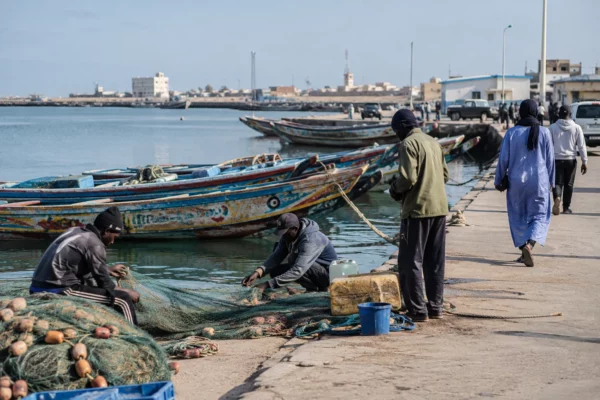
For Mauritania, the issue goes beyond the latest maritime events. Nouadhibou already concentrates port, fisheries and logistics functions that are essential to the national economy. The influx of survivors, the management of disembarkations and coordination with international partners add further pressure to a city that is already strategically important to the country. In Nouakchott, the capital, the authorities must contend with a recurring reality: controlling departures, rescuing shipwreck survivors and preserving limited reception capacity.
The contrast between the macroeconomic figures on migration flows and the reality at the disembarkation quay is stark. For the authorities, the aim is to prevent the Mauritanian coast from becoming an established departure platform. For families, the matter is more immediate: finding the missing, identifying survivors and understanding what drove so many young people to embark. For coastal municipalities, the questions are also practical: emergency accommodation, medical care, registration, and cooperation with security services and humanitarian actors.
Mauritania is thus at the centre of a familiar regional dilemma. On the one hand, it is expected to control departures, amid enhanced cooperation with Europe. On the other, it performs a first-responder role rooted primarily in maritime law and humanitarian emergencies. This dual role highlights a point that is often overlooked: on the route to the Canary Islands, West African coastal countries are not merely places of passage. They bear a significant share of the human and institutional cost of this migration.
What this episode reveals about West Africa
This latest episode says a great deal about the regional situation. When departures continue despite the danger, it is because the drivers of migration remain powerful: unemployment, insecure incomes, family mobility, the effects of climate change on livelihoods, and the perception that Europe remains reachable by sea. Unless these drivers recede, a temporary fall in arrivals will not be enough to close the route.
It is also a reminder that the response cannot be solely security-focused. Surveillance and deterrence operations may curb some departures, but they do not eliminate either the desire to leave or the market for smugglers. At the continental level, this case feeds into African debates on migrant protection, coastal cooperation and shared responsibility between countries of origin, transit and destination.
Finally, this series of shipwrecks puts Mauritania at the heart of an issue that the African Union and regional organisations cannot treat as a mere imported European crisis. The Atlantic route is African in its origins, its management and its tragedies. What unfolded in the waters near Nouadhibou between 13 and 19 July was not an isolated accident. It is another warning about migration that has become longer, riskier and harder to contain.