Algeria
 Libya
 Morocco
 Sudan
 Tunisia
 Benin
 Burkina Faso
 Cabo Verde
 Côte d'Ivoire
 Ghana
 Guinea
 Guinea-Bissau
 Liberia
 Mali
 Mauritania
 Niger
 Nigeria
 Senegal
 Sierra Leone
 The Gambia
 Togo
 Cameroon
 Central African Republic
 Chad
 DR Congo
 Equatorial Guinea
 Gabon
 Republic of the Congo
 São Tomé and Príncipe
 Burundi
 Comoros
 Djibouti
 Eritrea
 Ethiopia
 Kenya
 Madagascar
 Malawi
 Mauritius
 Mozambique
 Rwanda
 Seychelles
 Somalia
 South Sudan
 Tanzania
 Uganda
 Angola
 Botswana
 Eswatini
 Lesotho
 Namibia
 South Africa
 Zambia
 Zimbabwe
A stronger grid for a transition on a new scale
In Egypt, the question is no longer simply how to produce more green electricity. Above all, it must be carried to where it is consumed. This is where the success of the energy transition is decided in practical terms: without transmission lines able to absorb new wind and solar farms, megawatts remain far from cities, factories and homes.
The country is making progress on this front. On 15 June 2026, the European Union and Egypt announced a financing package of up to €690 million to modernise and expand the national electricity grid, with a clear objective: to integrate 22 gigawatts of renewable capacity by 2030. The strategy is part of broader cooperation between Cairo, Brussels and the European Investment Bank, focused on the public grid operated by the Egyptian Electricity Transmission Company, or EETC, the operator responsible for high-voltage electricity transmission.
A 500 kV line between the Gulf of Suez and the centre of the country
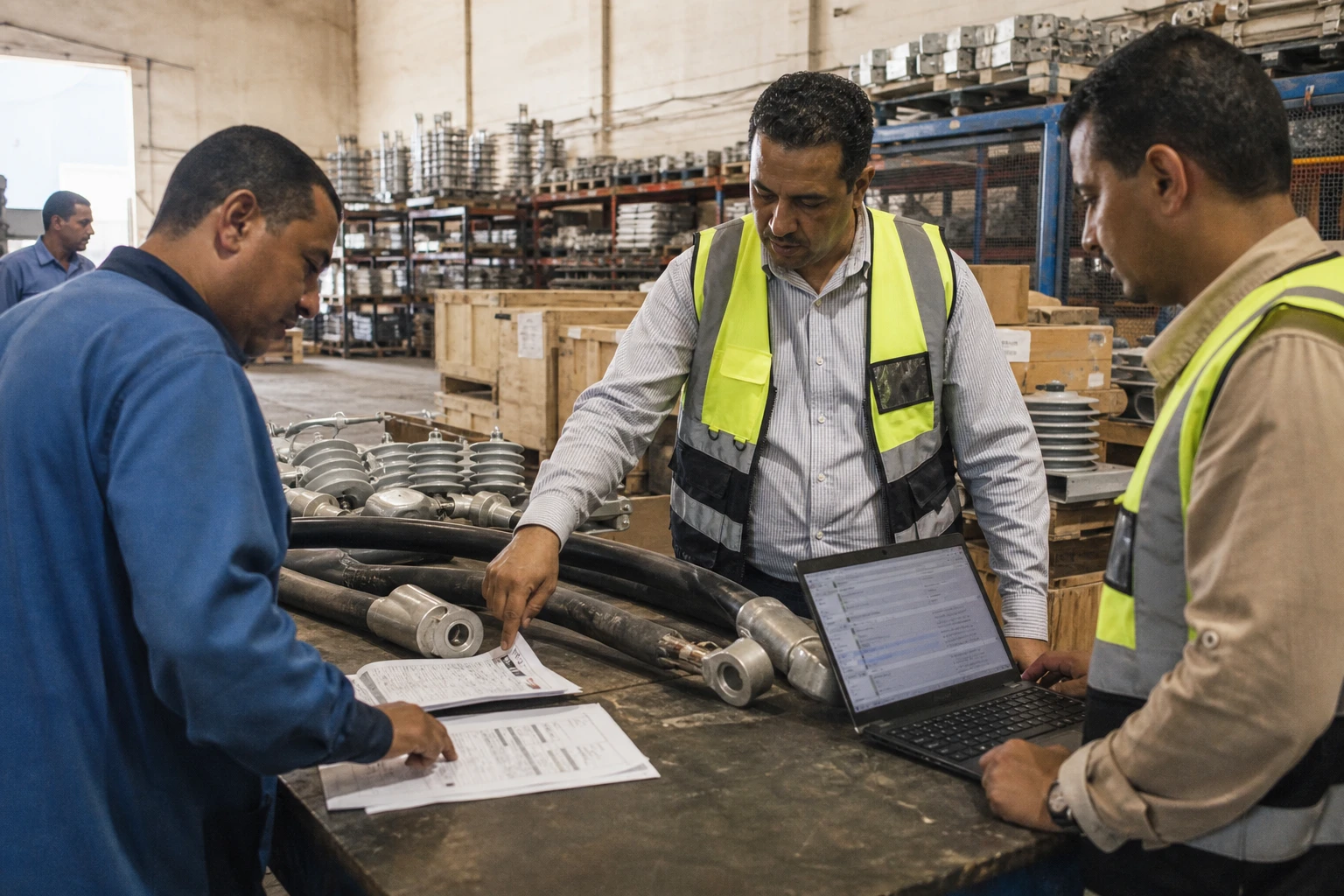
Against this backdrop, the EETC awarded Intelligent Globe Construction, or IGC, lot 2 of a 500-kilovolt overhead line. The section in question is about 61.6 kilometres long and links the Orascom and El Hawamdeya substations, south of Cairo. The project covers engineering, equipment supply, installation, testing and commissioning. According to specialist Egyptian media, the line is intended to carry electricity generated by wind projects in the Gulf of Suez to the national grid.
The choice of this area is no coincidence. The Gulf of Suez is one of the country’s main wind corridors. For several years, the Egyptian state has concentrated large-scale projects there, precisely because the wind is more regular and more exploitable than elsewhere. But this wealth of generation is valuable only if the infrastructure keeps pace. A 500 kV line, with four conductors per phase, can carry large volumes of electricity over long distances, with fewer losses than an undersized grid. It is a technical link, but also a political choice: to make renewable electricity useful nationwide, and not just locally.
The real issue: moving from installed capacity to delivered electricity
This project says a great deal about the stage Egypt is entering. The country has already built a substantial industrial and energy base, with rising renewable capacity and a public strategy that aims for renewables to account for 42% of the electricity mix by 2035, according to the Ministry of Electricity and Renewable Energy. At the same time, the authorities are seeking to avoid the classic pitfall of rapid transitions: building power plants faster than the lines needed to connect them.
On the ground, the challenge is twofold. For the state, it is a matter of securing supply, easing pressure on thermal power plants and maintaining control over an increasingly complex electricity system. For industrial companies, project developers and investors, grid quality is becoming a decisive factor. A wind farm that is profitable on paper can lose value if it has to wait months, or even years, before it is fully connected. The transmission grid has therefore become a strategic asset, on a par with the generation sites themselves.
The social implications are just as clear. In the capital, where electricity demand is high and constant, grid stability underpins economic activity, public services and daily life. In producing regions such as the Red Sea and the Gulf of Suez, the challenge is different: natural resources must be turned into lasting value without allowing infrastructure to fall behind projects. This link between the energy-producing coast and the centre of consumption is becoming one of the mainstays of Egyptian energy policy.
Part of a broader movement around the Mediterranean
The issue extends beyond Egypt’s borders. In June 2026, the EU-Egypt package was also presented as a lever for regional stability, with the idea of making the country an energy hub for the eastern Mediterranean and north-east Africa. For Europe, the interest is clear: an Egypt able to absorb its own renewable energy also becomes a more credible partner for future interconnectors, industrial supply chains and energy exchanges. For North Africa, the signal is just as important: grids, long relegated behind generation projects, are back at the centre of the picture.
This development also resonates across the continent. Many African countries have substantial solar, wind or hydropower resources, but face the same obstacle: transmission, grid stability and the ability to integrate growing volumes of intermittent electricity. Egypt’s experience shows that a credible transition is not simply about inaugurating power plants. It requires lines, substations, transformers, well-managed connection timelines and public operators able to plan ahead. This is often less visible than a solar farm, but far more decisive.
The coming months will show whether this new section delivers on its promise. The execution of lot 2, progress on the other sections of the grid and the delivery of the modernisation programme financed by Europe will be the clearest indicators. In Egypt, the energy transition is now playing out as much in transmission corridors as in the wind farms of the Gulf of Suez. And it is often there, in the invisible infrastructure, that the success of public policy is decided.