Algeria
 Egypt
 Libya
 Morocco
 Sudan
 Tunisia
 Benin
 Burkina Faso
 Cabo Verde
 Côte d'Ivoire
 Ghana
 Guinea
 Guinea-Bissau
 Liberia
 Mali
 Mauritania
 Niger
 Nigeria
 Senegal
 Sierra Leone
 The Gambia
 Togo
 Cameroon
 Central African Republic
 Chad
 DR Congo
 Equatorial Guinea
 Republic of the Congo
 São Tomé and Príncipe
 Burundi
 Comoros
 Djibouti
 Eritrea
 Ethiopia
 Kenya
 Madagascar
 Malawi
 Mauritius
 Mozambique
 Rwanda
 Seychelles
 Somalia
 South Sudan
 Tanzania
 Uganda
 Angola
 Botswana
 Eswatini
 Lesotho
 Namibia
 South Africa
 Zambia
 Zimbabwe

At Méyang, the poultry sector is still seeking its balance
In Gabon, producing eggs is no longer simply a matter of agriculture. It has become a test of economic sovereignty, disease control and price stability for households in Libreville and towns inland. In this context, every expansion of poultry capacity carries significance far beyond the farm itself.
The country is now moving forward within a more assertive policy framework. The Gabonese authorities have set 1 January 2027 as the date for ending imports of broiler chicken and, since 2025, have launched an initiative to structure the poultry sector. The Ministry of Agriculture says it is mobilising more than 775 billion CFA francs to accelerate domestic production. In addition, health regulations governing poultry farms have already been established by decree.
Capacity growth that signals more than a simple delivery
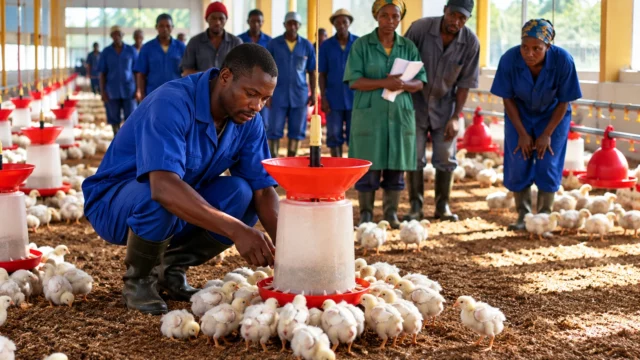
Against this backdrop, the arrival of more than 55,000 day-old chicks intended for egg production at the Société gabonaise de développement agricole marks a new stage for the private complex in Méyang, in Komo-Mondah, around 50 kilometres from Libreville. The company was founded in 2013 by Gabonese businessman Hervé Patrick Opiangah, and local media describe it as a 162-hectare agro-industrial site already involved in poultry farming, pig farming and processing.
The figure of 55,000 chicks represents an investment in scaling up, not merely a supply operation. The aim is to boost egg production in a country where the authorities have said they want to reduce dependence on imports and make food supplies more secure. Official documents say Gabon wants to turn its logistical and commercial constraints into opportunities for local production.
This momentum is not isolated. In August 2025, the ministry brought together stakeholders in the poultry sector to prepare for the entry into force of the ban on broiler chicken imports. More industrialised breeding centres, animal-feed plants and integrated farms are now being presented as the pillars of the new model.
Biosecurity, jobs and the true cost of local production
On the ground, the question is not simply how to produce more. Production must be maintained without disease outbreaks, with inputs available and at an affordable cost. Specialist reports on SOGADA describe a shift from artisanal poultry sheds to enclosed buildings, with stricter biosecurity protocols. This approach is consistent with Gabon’s 2022 decree on the establishment of poultry farms, health inspections and the marketing of poultry products.
The main obstacle, however, remains economic. Local producers are still exposed to the cost of feed, transport and imports of certain raw materials. Information published on SOGADA indicates that feed can account for an overwhelming share of production costs. This is crucial, because food sovereignty is not achieved on the farm alone, but across the entire chain: maize, soya, logistics, storage, veterinary checks and commercial outlets.
The social dimension also matters. Local sources already cite around 150 direct jobs at the site, with plans to expand capacity. In a country where youth unemployment and limited local processing remain persistent concerns, every integrated agricultural facility can become a small hub of economic activity, provided it buys and trains locally and makes use of local subcontractors.
What this signal says about Gabon — and beyond
The arrival of the chicks comes as Gabon redefines its approach to food security. The government wants to move from an import-based economy to one based on production, in a country that is a member of CEMAC, the economic organisation of Central Africa. This regional framework matters because managing health controls at borders, inputs and marketing standards goes beyond national decisions alone.
Across the continent, the signal is clear. Gabon is joining a broader trend in Central and West Africa: reviving agro-industry, reducing exposure to supply shocks and making local production a driver of competitiveness. Recent developments show that Libreville is no longer relying on words alone. Government decisions, technical forums and private projects are now moving in the same direction, towards a concrete deadline: January 2027, when Gabon’s poultry sector will have to operate without broiler chicken imports.
In this context, SOGADA illustrates a question that goes beyond its own development. Gabon wants to know whether its domestic operators can become industrial leaders without being held back by production costs, access to land, the availability of inputs and the coherence of public policy. If the answer is yes, poultry farming could become one of the few sectors where food sovereignty quickly translates into jobs, added value and a more stable supply for consumers in Libreville and the provinces.