Algeria
 Egypt
 Libya
 Morocco
 Sudan
 Tunisia
 Benin
 Burkina Faso
 Cabo Verde
 Côte d'Ivoire
 Ghana
 Guinea
 Guinea-Bissau
 Liberia
 Mali
 Mauritania
 Niger
 Nigeria
 Sierra Leone
 The Gambia
 Togo
 Cameroon
 Central African Republic
 Chad
 DR Congo
 Equatorial Guinea
 Gabon
 Republic of the Congo
 São Tomé and Príncipe
 Burundi
 Comoros
 Djibouti
 Eritrea
 Ethiopia
 Kenya
 Madagascar
 Malawi
 Mauritius
 Mozambique
 Rwanda
 Seychelles
 Somalia
 South Sudan
 Tanzania
 Uganda
 Angola
 Botswana
 Eswatini
 Lesotho
 Namibia
 South Africa
 Zambia
 Zimbabwe
A presidency at a time of difficult choices
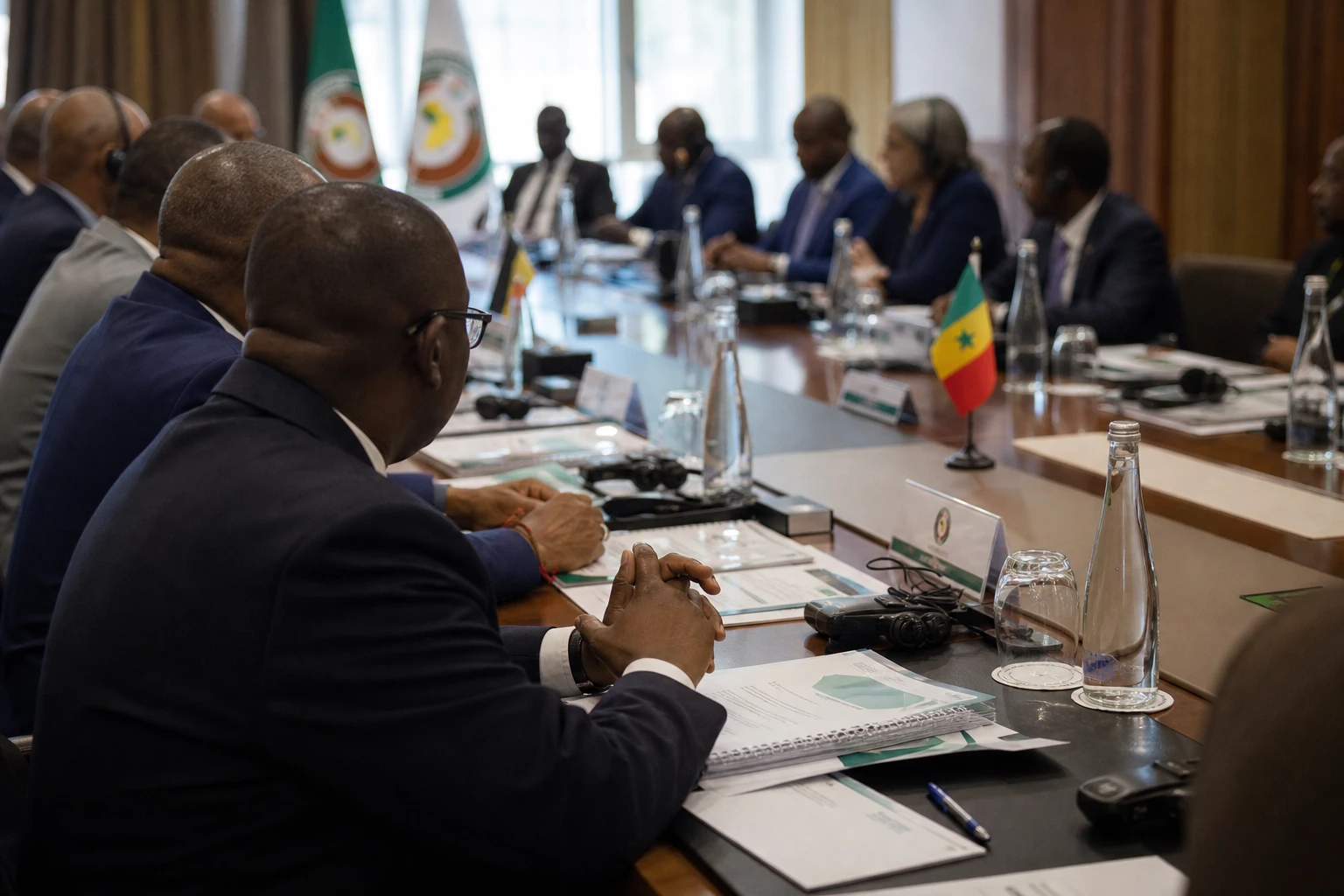
In West Africa, the rotating presidency of ECOWAS is never merely a ceremonial title. It sets the political pace in a region where borders remain porous to trafficking, armed violence and economic shocks. This time, the baton passes to Senegal as the organisation seeks to hold together security, institutional credibility and economic integration.
On 19 July 2026, in Freetown, West African heads of state and government entrusted the ECOWAS chairmanship to Bassirou Diomaye Faye for a one-year term. He succeeds Sierra Leone’s president, Julius Maada Bio, who was himself elected to the post in June 2025. The timetable is in keeping with the Community’s rules, which provide for an annual rotation at the head of the Authority of Heads of State and Government.
The symbolism matters, but the timing matters more. Since 29 January 2025, Burkina Faso, Mali and Niger have officially left ECOWAS, following the expiry of the one-year withdrawal period announced earlier. The organisation has maintained certain technical safeguards, particularly on the movement of people and goods, but the rupture has weakened the integration project inherited from the 1975 Treaty of Lagos.
Security, institutions, the economy: Senegal’s roadmap
Against this backdrop, Dakar arrives with a clear agenda. Senegal’s presidency says Bassirou Diomaye Faye first wants to speed up the operationalisation of the regional counter-terrorism force and strengthen the pooling of military resources among member states. The word matters: pooling here means sharing intelligence, logistics, air assets and border coordination, rather than allowing each army to act alone.
The Senegalese president also intends to press for internal reforms. ECOWAS is expected to demonstrate that it can fund its missions more robustly, simplify its procedures and ensure its decisions are better implemented. This is no minor issue. Without genuine financial autonomy, a regional organisation is too dependent on irregular contributions and external partnerships, slowing its response to crises. The Freetown ministerial session had specifically put the Community’s financial situation, governance and regional political priorities on the agenda.
On the ground, the effects look different to different groups. For governments, Senegal’s presidency offers a diplomatic opening to revive dialogue with the Sahel states that have left the bloc. For the population, the stakes are more tangible: smoother movement, cheaper cross-border trade, better protection for road corridors and a faster response to attacks in exposed areas. In a West African economy that remains largely informal, every border bottleneck quickly affects markets, transporters and small traders.
One confusion that has appeared in several quick takes on the summit also needs correcting: ECOWAS has not placed its Commission under Senegalese leadership. The Commission remains headed by Gambian Omar Alieu Touray, based in Abuja, where the institution’s new headquarters was officially inaugurated in early July 2026 by Julius Maada Bio. The chairmanship of the Authority and the leadership of the Commission are two distinct roles.
How much influence can Dakar wield in a changing ECOWAS?
The real test of Senegal’s term will be political. At the July 2024 summit, Bassirou Diomaye Faye had already been appointed as ECOWAS facilitator in its dealings with the Alliance of Sahel States, alongside Togo’s president, Faure Gnassingbé. That experience matters, as it puts Dakar in the role of intermediary rather than lecturer. In a fractured region, diplomatic tact is often as valuable as leverage.
The continental significance is clear. West Africa remains one of the continent’s most important regions for free movement, partial monetary integration, port trade and security diplomacy. When ECOWAS falters, other African regional frameworks also take note of its weaknesses: its ability to impose sanctions, negotiate, and balance democracy with stability. Discussions in Freetown on security, community financing and the future of integration show that ECOWAS is not just looking for a new face. It is seeking a way to survive as an institution.
The next meeting will therefore matter more than the ceremony on 19 July. It will be necessary to assess Senegal’s ability to advance concrete issues: dialogue with the AES countries, the response to terrorism, funding for the Community, and the credibility of an organisation seeking to remain useful to its 300 million inhabitants. For ECOWAS, the question is no longer simply who chairs it. It is whether it can still arbitrate, protect and integrate.