Algeria
 Egypt
 Libya
 Morocco
 Sudan
 Tunisia
 Benin
 Burkina Faso
 Cabo Verde
 Côte d'Ivoire
 Ghana
 Guinea
 Guinea-Bissau
 Liberia
 Mali
 Mauritania
 Niger
 Nigeria
 Senegal
 Sierra Leone
 The Gambia
 Togo
 Cameroon
 Central African Republic
 Chad
 DR Congo
 Equatorial Guinea
 Gabon
 Republic of the Congo
 São Tomé and Príncipe
 Burundi
 Comoros
 Djibouti
 Eritrea
 Ethiopia
 Madagascar
 Malawi
 Mauritius
 Mozambique
 Rwanda
 Seychelles
 Somalia
 South Sudan
 Tanzania
 Uganda
 Angola
 Botswana
 Eswatini
 Lesotho
 Namibia
 South Africa
 Zambia
 Zimbabwe
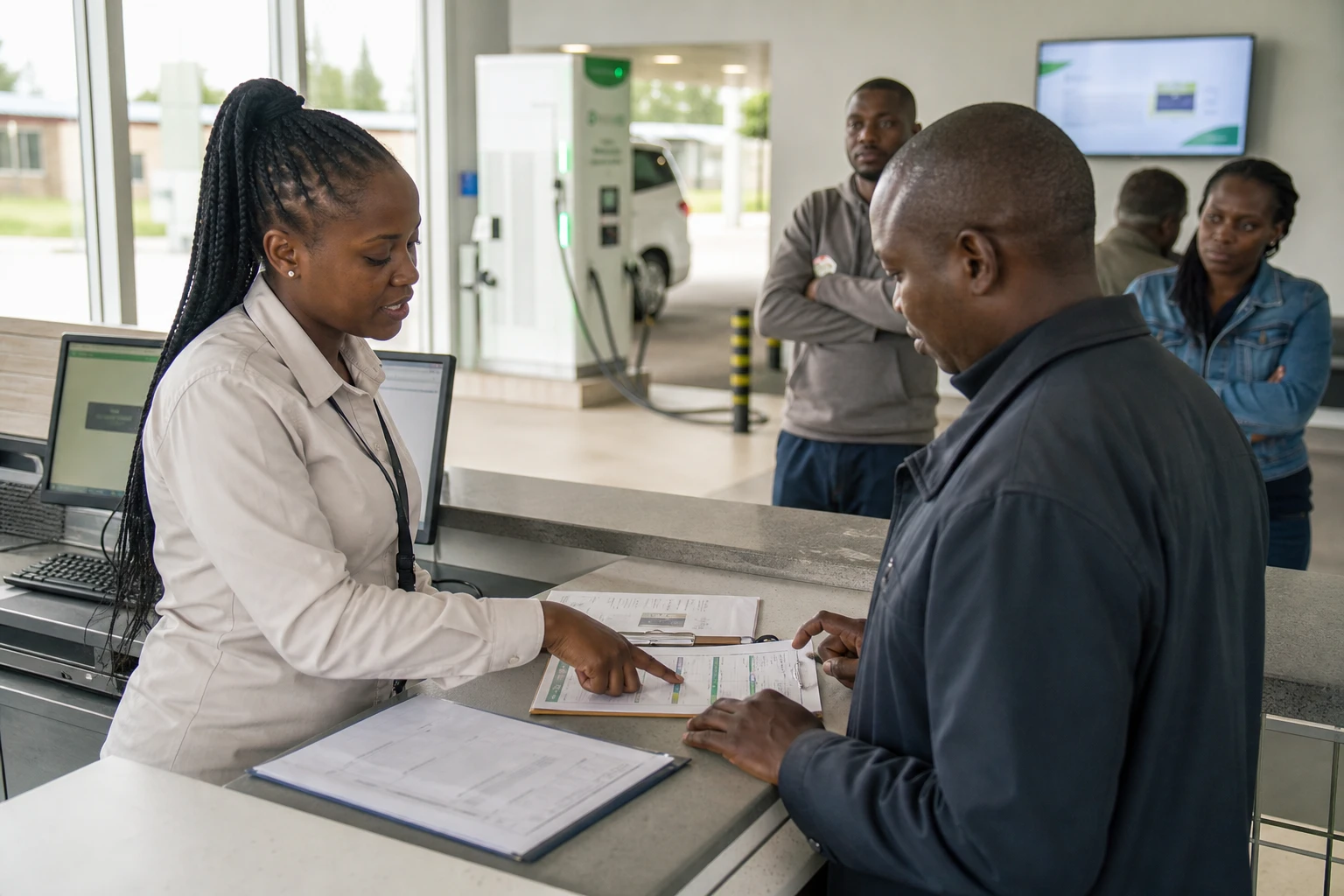
As charging moves beyond Nairobi, electric transport scales up
In Kenya, the question is no longer just about electric buses. It is about the country as a whole. As long as charging remains concentrated around Nairobi, electric mobility will advance mainly in the city. Once it spreads along intercity routes, it can reach long-distance operators, passengers and small transport businesses. In practice, this is where the credibility of a still-young market is at stake.
This shift comes as the Kenyan government pursues a national electric mobility policy, aiming to modernise transport, cut emissions and attract more private investment in charging infrastructure. The Ministry of Roads and Transport has also acknowledged that these facilities remain concentrated mainly in Nairobi and need to be extended to other cities across the country. In an economy where the capital often gets new services first, that matters.
A partnership designed for corridors, not just the capital
BasiGo and Rubis Energy Kenya announced an agreement on 20 July 2026 to install fast-charging stations at several service stations across the country. A first site is already operating in Sabaki, near Athi River. Three more are due to open in Meru, Nanyuki and Nyeri by the end of July 2026. The idea is simple: create charging points on routes linking Nairobi with the country’s central and northern regions.
The Sabaki site is equipped with 100 kW fast chargers compatible with the CCS2 standard, used mainly by European manufacturers, and GB/T, more common on several Chinese models. The announced price is 48 Kenyan shillings per kilowatt-hour, or about $0.37. The facilities will not be reserved for BasiGo buses. They will also be available to compatible minibuses, light trucks, commercial vehicles and electric cars.
The commercial strategy is clear. BasiGo wants to take electric vehicles beyond the urban sphere. Rubis, for its part, is looking to adapt its distribution network to a wider range of mobility needs. Its regional managing director describes a gradual shift from fuel distributor to energy partner. This is significant in Kenya, where service stations often serve as key logistics hubs, far beyond fuel sales.
What the deal reveals about the Kenyan market
Rubis has more than 300 service stations in Kenya, according to BasiGo. This network gives the partnership a decisive advantage: charging can follow existing traffic flows rather than requiring an entirely new network to be built. In a country where electric vehicle adoption is growing rapidly but remains unevenly distributed, the location of charging stations is becoming almost as strategic as the technology itself.
This is not BasiGo’s first step. In November 2025, the company opened three charging depots in Komarock, Taj Mall and Riruta, in the Nairobi region. Earlier, it had launched trials of intercity electric minibuses on routes including Nairobi to Thika, Nyeri, Nakuru and Nyahururu. The new agreement therefore expands an infrastructure already under development rather than starting from scratch.
The regulatory context is also working in the sector’s favour. In 2026, Kenya launched a national electric mobility policy and introduced tax incentives to accelerate the adoption of electric vehicles and charging stations. The government aims to decarbonise transport, strengthen energy security and create new jobs in assembly, services and maintenance. The authorities acknowledge, however, that demand still exceeds supply and that infrastructure needs to be more evenly distributed outside the capital.
The issues differ from one stakeholder to another. For transport operators, the concerns remain charging time, reliability and total operating costs. For passengers, the expected benefit is uninterrupted journeys without range-related stops. For the government, the challenge is industrial: to prevent electric mobility from remaining a niche market confined to affluent neighbourhoods and demonstration shuttles.
The shift is also affecting the wider economy. Electric buses, minibuses and taxis require flexible financing arrangements, since Kenyan transport operators often work on tight margins and have limited access to credit. Leasing, pay-per-use and deposit-based models have already been tested in the country, showing that the transition depends as much on finance as on technology.
A Kenyan trend reaching beyond East Africa
Kenya is becoming one of Africa’s most closely watched electric mobility test beds. Data published in 2026 show a rapid rise in electric vehicle registrations, from 796 in 2022 to 24,754 in 2025. This pace has not yet transformed the entire vehicle fleet, but it confirms the emergence of a real market, driven by two-wheelers, buses and corporate fleets.
Within the East African Community, this trajectory is of particular interest to neighbouring countries facing similar constraints: dependence on energy imports, pressure on public finances, the need for industrial jobs and the rapid growth of informal public transport. Kenya’s experience shows that a charging network can be built around road corridors and private partners, provided it is backed by clear rules and a territorial vision.
It is also a signal for the continent. In Africa, the shift to electric vehicles is still concentrated on buses, minibuses and motorbikes, because these are the vehicles that shape urban life and daily incomes. Kenya, with Nairobi as a starting point and corridors extending towards Meru, Nanyuki and Nyeri, is testing the next phase: taking electric mobility beyond the big cities and making it credible on the road. The next stage of a transition is often decided there.